
Church of Saint James
(Please allow a few seconds for the video to load)
Welcome to
“The Church of Saint James” digital experience where history and technology intertwine to bring you something that is immersive and entertaining.
Explore the Church
Below, you will find a ‘Paywall’ feature, requesting you to make a donation to be able to enter the page.
Once you are in, you will find
Support a Mission, Explore a Treasure
Your entry helps Missio Malta continue their vital work in missionary lands overseas. By donating, you directly support communities in need while gaining 24-hour full access to this chapel's 3D experience and history.
Learn more about Missio's workAccess is valid for 1 Chapel for 24 hours from the time of donation
OR
360° Panorama
Zoom to full screen to view
Church of St. James
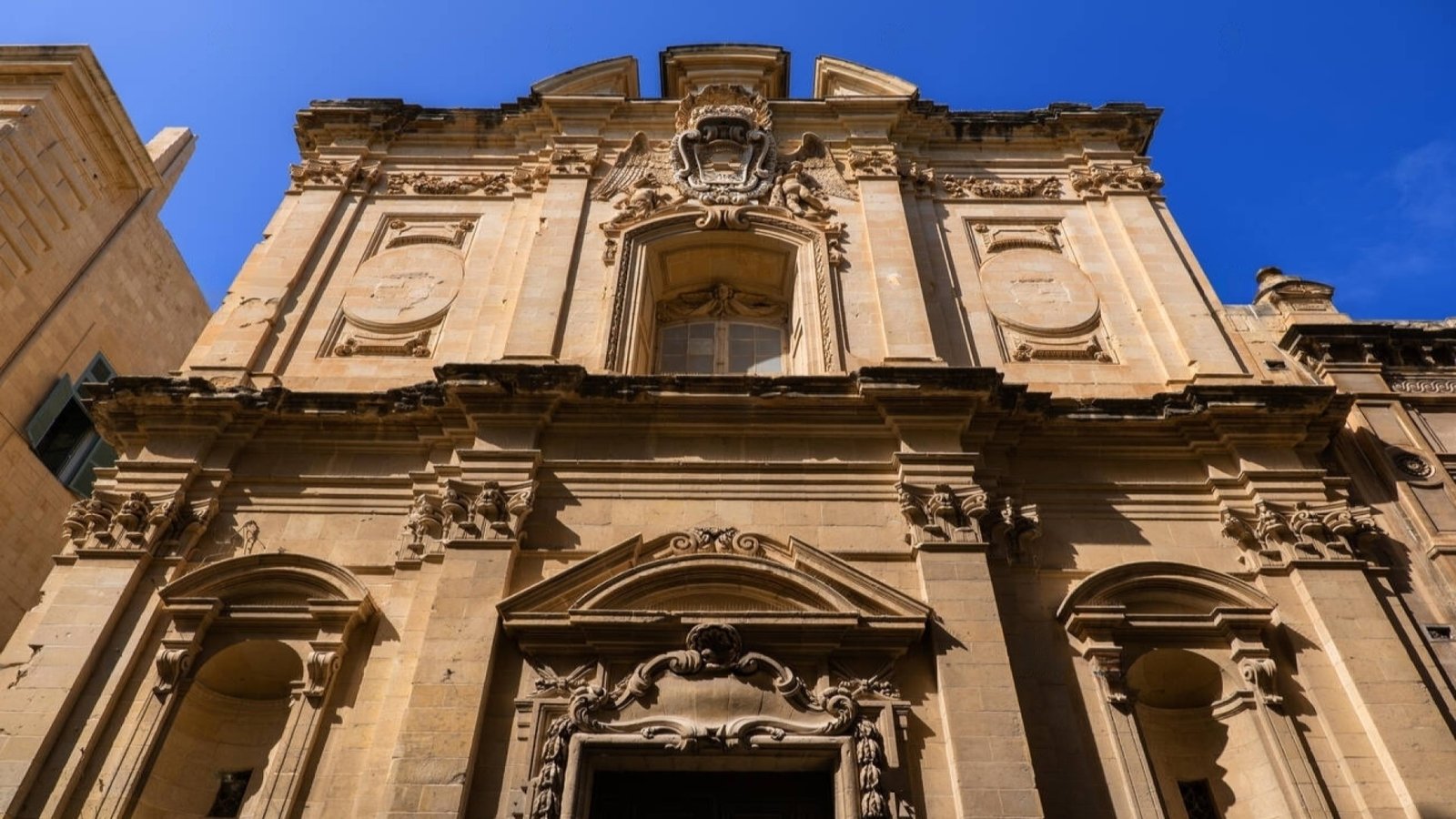
The Church of St. James the Apostle in Valletta’s Merchants Street served as the conventual Church of Portugal, Castile, and Leon. The first church dedicated to St. James was a much smaller edifice established in the city’s early days. One hundred years later, in 1710, the Church of St. James was restored in the most recent Baroque style, the first in Malta to be inspired by Bernini’s work in Rome. Romano Carapecchia, who had joined the Order as an architect and water engineer, designed St James, his first project. The Priory of Castile, Cardinal d’Arias, and other great benefactors covered the building’s costs.
The facade has two storeys, and the stone, while finely carved, adheres to the restraint of the Roman example rather than the inflated style found in Spain and Sicily. The doors, windows, and niches create a striking chiaroscuro effect in the brilliant Mediterranean sun. A superb cartouche above the centre window surrounds a coat of arms. The Church is topped with a unique elliptical cupola. Inside, the altar is renowned for its dramatic width and height, with a picture of St. James by Filippo Paladino (1544-1614) as the highlight. A niche beneath the picture has a’miraculous’ depiction of the Madonna of Soledad brought to Malta by a Spanish member of the Order.
When it was finished, the Prior of the Conventual Church of St. John’s assigned St. James to the care of a secular priest from the Maltese Diocese who served as Sacristan, and he was given adjoining housing. Another priest, a Conventual Chaplain, was chosen as the Church’s Beneficiary.
Langue of Portugal, Castile, and Leon’s celebration of their patron’s Feast Day began on the eve of the feast, with prayers offered in St. John’s. The Grand Master, along with the Knight’s Grand Cross and other Palace authorities, proceeded to St. James. A service was held there, aided by two Conventual Chaplains of the Langue, and the assembly was known to flow out onto Merchants Street.
On the morning of the Feast Day, July 25th, at approximately 8 a.m., the Grand Master, accompanied by his retinue of Grand Crosses and the Palace entourage, proceeded to St. James with all of the usual pomp and grandeur. The Beneficiary and Conventual Chaplains of the Langue celebrated a solemn Choral High Mass on the eve. At the end of the High Mass, a procession headed by the Vice-Prior of the Conventual Church left St. John’s bearing the Ostensory and the Relic of Saint James. A motet was sung in honour of the saint before the procession returned through the streets to St. John’s with the Relic, led by the Grand Master and other dignitaries.
At St. John’s, the Prior of the Church entered wearing the pontifical robes, accompanied by his aides, and the Antiphon of the Feast was chanted. The relic was then censed, and the Prior intoned the Saint’s ritual prayer before placing it on the high altar. The pontifical ceremony for the Feast then began in the presence of the Grand Master and the assembled Knights.
The Knights Hospitallers
 The Knights of St. John of Jerusalem, also known as the Hospitallers, established themselves in Malta in 1530 after being expelled from Rhodes by the Ottoman Turks. During their over 260-year rule of Malta, the Knights constructed numerous churches, chapels, and other religious buildings across the island. The exact number of chapels built by the Knights is difficult to determine due to the passage of time and the destruction caused by wars and natural disasters. However, based on historical records and existing structures, it is estimated that the Knights commissioned the construction of over 60 chapels in Malta.
Many of these chapels were dedicated to specific Saints or religious orders, while others served as private oratories for individual knights. Some notable examples include:
* Saint John’s Co-Cathedral: The main cathedral of the Knights, located in Valletta, features nine chapels dedicated to the patron saints of each of the Order’s langues (divisions).
* Chapel of Our Lady of Philermos: This chapel, situated within Saint John’s Co-Cathedral, houses the revered icon of Our Lady of Philermos, a precious relic brought to Malta by the Knights from Rhodes.
* Chapel of the Langue of England: Located in Valletta, this chapel served as the spiritual center for English knights within the Order.
* Chapel of the Langue of Provence: Situated in Birgu, this chapel was the spiritual hub for Provençal knights.
* Chapel of Saint George: Found in the Grand Masters’ Palace in Valletta, this chapel was used for private devotions by the Grand Masters of the Order.
In addition to these prominent chapels, the Knights also commissioned many smaller chapels in various locations across Malta, including rural villages, fortifications, and hospitals. These smaller chapels served as places of worship for the local population and for knights stationed in different parts of the island.
The construction of these chapels played a significant role in shaping the religious and cultural landscape of Malta. They provided spaces for spiritual reflection, devotion, and community gatherings, fostering religious identity and strengthening the ties between the Knights and the Maltese people.
