
Chapel of St. Lucy
(Please allow a few seconds for the video to load)
Welcome to
“The Chapel of St. Lucy” digital experience where history and technology intertwine to bring you an immersive experience.
Explore the Chapel
Below, you will find a ‘Paywall’ feature, requesting you to make a donation to be able to enter the page.
Once you are in, you will find
Support a Mission, Explore a Treasure
Your entry helps Missio Malta continue their vital work in missionary lands overseas. By donating, you directly support communities in need while gaining 24-hour full access to this chapel's 3D experience and history.
Learn more about Missio's workAccess is valid for 1 Chapel for 24 hours from the time of donation
OR
360° Panorama
Zoom to full screen to view
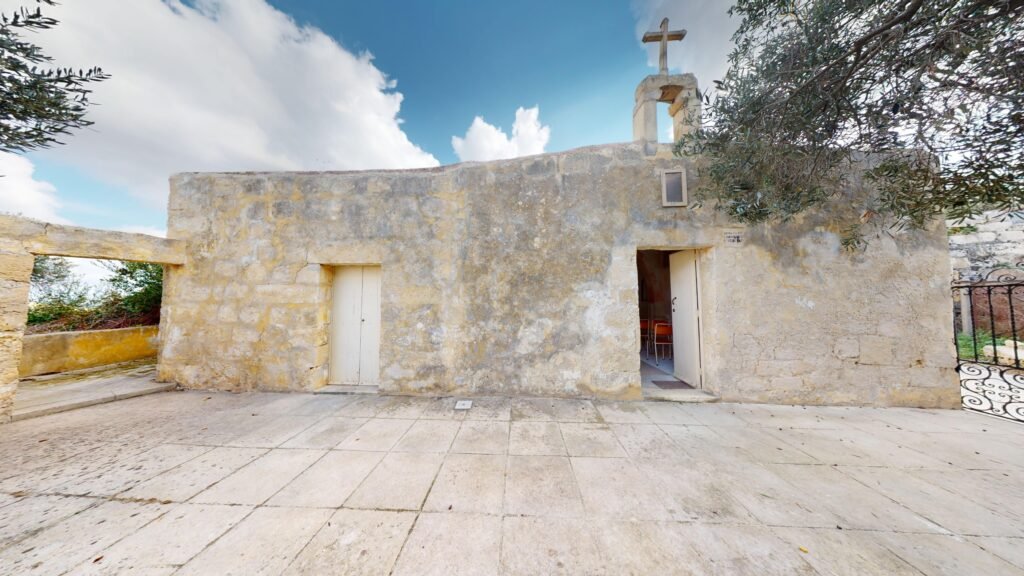
The Darmanin family of Birgu built the chapel in 1500. Monsignor de Siena paid it a visit in 1575. It overlooks Wied Qlejgħa, one of Malta’s most beautiful valleys, and the view from the Chapel is breath-taking.
Its rector, Dun Mikiel Saliba, enlarged it a few years ago by opening up the sacristy to create an extra wing. To make way for the new sacristy, an old staircase was demolished. During the excavation, an old semi-circular crypt was discovered. It had been destroyed when stone was extracted from it to be used in the construction of the chapel. Fr. Saliba discovered sacks of mouldering ex-votos below stairs, the majority of which were quite decayed. On some of them , the years 1911 and 1917 were easily discernible.
During the 1914 and 1918 wars, when the Mtarfa military hospital was the main one on the island, many of the war wounded suffered from poison gas damage to their eyes. They presumably offered the ex-votos to St. Lucy, who is traditionally regarded as the protector of those suffering from eye disease.
The St. Lucy painting is quite old. During a solemn ceremony, Monsignor DePiro, who later founded the Missionary Society of St. Paul, crowned it.
Mass was said on Sundays under Fr. Saliba’s rectorship, and children from the neighbourhood were taught the Catechism at St Lucy’s. Every day in October, Mass was said and the rosary was recited.
Saint Lucy
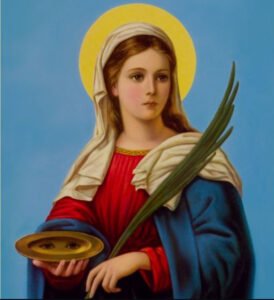 Saint Lucy’s noble family was from Syracuse, Sicily’s biggest city. Her mother, Eutychia, educated her well in our holy faith after her father died in infancy. Our saint’s mother considered marrying her when she was old enough, but Lucy, who had pledged her virginity to Jesus Christ, waited for a good chance to tell her.
Opportunity arose soon. Eutychia has blood flow for years without a cure. Thus, Saint Lucy convinced her to visit the tomb of Saint Agatha, martyred fifty years earlier in Catania, where the Lord performed numerous miracles, to pray for her healing. In Catania, they prostrated themselves in prayer before Saint Agatha’s tomb, where Lucy, possibly exhausted from the trek, fell asleep.
The blessed martyr appeared to her and said, “Lucy!” (Roman Breviary) Why do you demand through my intercession what you can get for your mother by faith?
She then told Lucy that God would cure her and reward her in Syracuse with the same glory she had received in Catania for keeping her virginity.
This vision strengthened Saint Lucy’s resolve to remain committed to Jesus Christ, and she begged her mother to stop talking about marriage and give her riches to the poor. Saint Lucy replied that gratitude for her miraculous cure should induce her to willingly deprive herself during life of that which she must leave behind at death. Eutychia replied that she would bequeath all to her and that she could do with it as she pleased.
The mother agreed, and when they returned to Syracuse, they sold their land and gave the earnings to the poor. Saint Lucy’s suitor discovering this, complained to Eutychia; but he saw that his protestations were entirely fruitless, and, in his fury, charged her before the governor, Paschasius, as being a Christian, contrary to the edicts of Diocletian and Maximian.
The saint was arrested and brought before the governor, who tried to get her to sacrifice to the idols, but Saint Lucy said that the most pleasing sacrifice to God was the relief of the poor, which she was doing and would sacrifice her life for.
Paschasius, more puzzled and furious than ever, authorised a huge fire to burn the saint.
Saint Lucy assured the dictator, “I will pray to the Lord Jesus Christ that the fire may not injure me, in order that the faithful may witness the divine power, and that the infidels may be confused.”
Paschasius’ companions persuaded him to have her beheaded to avoid additional miracles, but after much torture, her throat was pierced with a sword.
She knelt, offered her death to God, and died in 303 or 304, having promised that peace would soon return to the Church. Her name appears in the Mass Canon.
