
Chapel of The Immaculate Conception
(Please allow a few seconds for the video to load)
Welcome to
“The Chapel of The Immaculate Conception” digital experience where history and technology intertwine to bring you an immersive experience.
Explore the Chapel
Below, you will find a ‘Paywall’ feature, requesting you to make a donation to be able to enter the page.
Once you are in, you will find
Support a Mission, Explore a Treasure
Your entry helps Missio Malta continue their vital work in missionary lands overseas. By donating, you directly support communities in need while gaining 24-hour full access to this chapel's 3D experience and history.
Learn more about Missio's workAccess is valid for 1 Chapel for 24 hours from the time of donation
OR
360° Panorama
Zoom to full screen to view
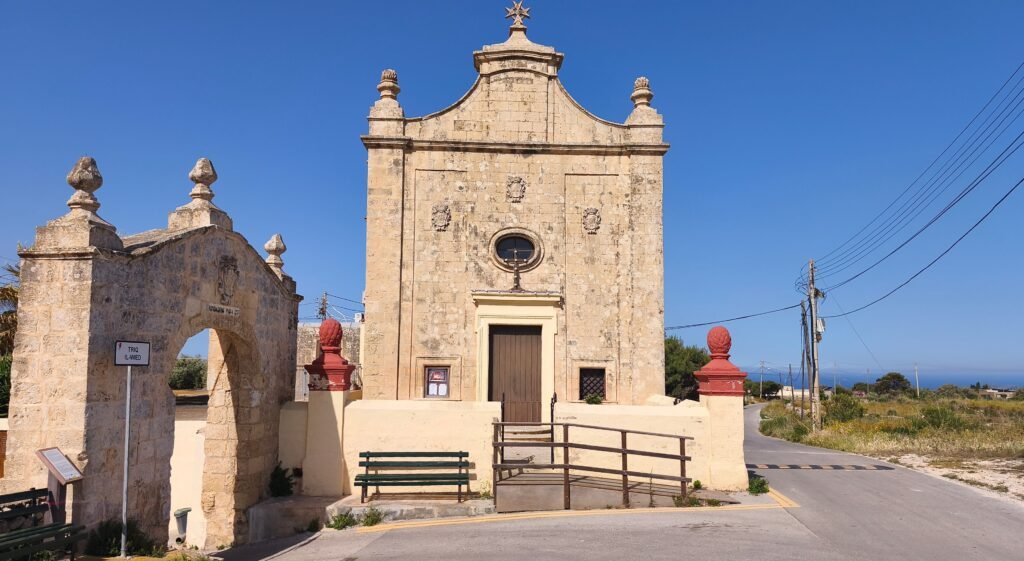
Chapel of the Immaculate Conception at Kunċizzjoni, Baħrija
Historical Background
At the entrance to Wied Gerżuma, near Baħrija within Rabat’s limits, the Chapel of the Immaculate Conception is a notable rural wayside church. Grand Master António Manoel de Vilhena built it in 1736 on land belonging to the Fondazione Paola, established by Grand Master Antoine de Paule. Income from the foundation’s estates helped finance the Order of St John’s ships and buildings.
An adjoining arch bears de Paule’s arms and the inscription “Fondazione Paola 1731”. Fra Giuseppe Ruggier blessed the chapel on behalf of the Grand Prior of St John’s Conventual Church. After the Order left Malta in 1798, ownership passed to the civil authorities. It remains state property.
Construction and Architecture
Built from Maltese limestone in restrained rural Baroque style, the chapel has a rectangular nave, barrel-vaulted roof, transverse arches and one altar. Tuscan pilasters frame the façade, which is crowned by a curved pediment, stone finials and an eight-pointed Maltese cross. An oval window lights the interior. Two low side windows allowed prayer when the doors were closed, while a square rear belfry holds two bells.
No reliable published record identifies the architect, builders, cost or major construction difficulties.
Art and Devotion
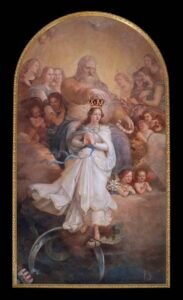
The titular painting by Ġannikol Buhagiar depicts the Immaculate Conception with St John the Baptist, St Paul, St Joseph and St Anthony of Padua. Paintings of St Anne and St Joachim flank the altar. Sculpted foliage, angels, gilding and the inscription “Pura Pudica Pia Miseris Miserere Maria” enrich the sanctuary.
The processional statue, made by Girolamo Dingli in 1952, was restored and regilded in 2007 by Arthur Vassallo, with its face repainted by Joseph Sultana.
Tradition and Present Use
A priest responsible for Masses, maintenance and the annual feast received a viġenda, initially 40 and later 60 scudi annually. The feast is celebrated on the first Sunday after 8 December with Mass and a procession, once attended by the Grand Master and knights.
Ship graffiti on the façade is traditionally interpreted as ex-voto imagery left by rescued mariners. Listed on Malta’s National Inventory as property 2323, the chapel remains active, well maintained and served through Rabat parish, preserving the identity of the small Kunċizzjoni community.
The Immaculate Conception in Malta: Knights, Maritime Faith and the Hidden Chapel of Kunċizzjoni
 Hidden among the fields and valleys beyond Baħrija stands one of Malta’s most evocative rural churches. The Chapel of the Immaculate Conception at Kunċizzjoni is small, but its story reaches far beyond Wied Gerżuma. It connects an ancient Marian devotion with the Order of St John, Malta’s naval history, the financing of the Knights’ fleet and the religious life of a remote farming community.
What the Immaculate Conception Means
The Immaculate Conception is often confused with the Virgin Birth of Jesus. They are two separate beliefs.
The Virgin Birth concerns the conception of Christ in Mary’s womb through the Holy Spirit. The Immaculate Conception concerns Mary herself. Catholic teaching holds that, from the first instant of her conception in the womb of her mother, traditionally identified as St Anne, Mary was preserved from original sin through the saving merits of Jesus Christ.
The feast is celebrated on 8 December, exactly nine months before the Nativity of Mary on 8 September.
This teaching does not suggest that Mary did not need redemption. Catholic theology presents her as the first and most completely redeemed person, saved by Christ in advance and prepared for her unique role as the Mother of God.
Mary’s Life and Place in Christian Tradition
The canonical Gospels provide relatively few details about Mary’s early life. The names of her parents, Joachim and Anne, come from early Christian tradition rather than the New Testament.
Mary enters the Gospel narrative at the Annunciation, when the Archangel Gabriel announces that she will become the mother of Jesus. She visits her relative Elizabeth, gives birth to Christ in Bethlehem, presents him in the Temple and later appears at important moments in his ministry.
At the wedding feast at Cana, Mary draws Jesus’s attention to the shortage of wine. She remains near the Cross during the Crucifixion and is later found with the apostles as the early Church gathers in prayer.
These episodes helped shape the Christian image of Mary as a woman of faith, obedience, courage and maternal concern. Her Immaculate Conception was understood as the beginning of a life entirely directed towards God.
From Early Devotion to Catholic Dogma
Devotion to Mary’s holiness developed during the first centuries of Christianity. A feast celebrating her conception appeared in the Christian East before spreading through Western Europe.
The belief was debated by medieval theologians. The difficulty concerned how Mary could be free from original sin while still being redeemed by Christ. The Franciscan theologian John Duns Scotus offered the explanation that became decisive. Mary was not outside Christ’s redemption. She received its benefits in the most complete possible way by being preserved from sin before it touched her.
The devotion became particularly strong among the Franciscans and throughout the Catholic regions of the Mediterranean.
On 8 December 1854, Pope Pius IX formally defined the Immaculate Conception as a dogma of the Catholic Church through the apostolic constitution Ineffabilis Deus.
Four years later, the reported apparitions at Lourdes gave the devotion further popular importance. Bernadette Soubirous stated that the lady who appeared to her identified herself as the Immaculate Conception.
The Symbols of the Immaculate Conception
Images of the Immaculate Conception normally show Mary as a young woman dressed in white and blue. White represents purity, while blue traditionally signifies heaven, fidelity and divine favour.
She may stand upon a crescent moon, sometimes with the serpent or dragon beneath her feet. These images draw upon the woman clothed with the sun in the Book of Revelation and the promise in Genesis that the serpent would be defeated.
A crown or circle of twelve stars frequently surrounds her head. Clouds, angels and rays of light emphasise her place within the heavenly order. The downward-facing crescent and crushed serpent signify the triumph of grace over sin and evil.
These symbols appear repeatedly in Maltese paintings, processional statues, church façades, silverwork and feast decorations.
