
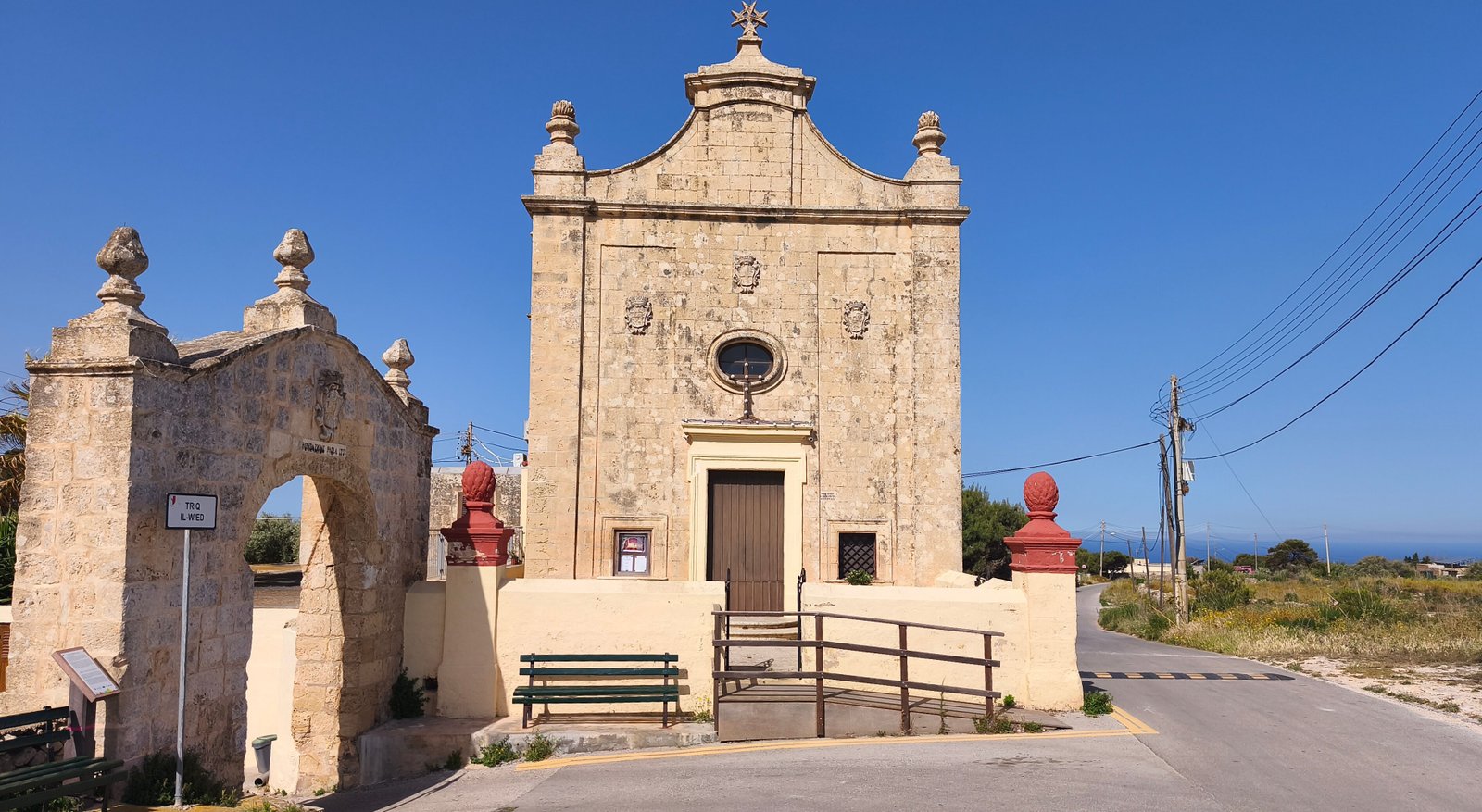
Chapel of The Immaculate Conception
The Immaculate Conception in Malta: Knights, Maritime Faith and the Hidden Chapel of Kunċizzjoni
Hidden among the fields and valleys beyond Baħrija stands one of Malta’s most evocative rural churches. The Chapel of the Immaculate Conception at Kunċizzjoni is small, but its story reaches far beyond Wied Gerżuma. It connects an ancient Marian devotion with the Order of St John, Malta’s naval history, the financing of the Knights’ fleet and the religious life of a remote farming community.
What the Immaculate Conception Means
The Immaculate Conception is often confused with the Virgin Birth of Jesus. They are two separate beliefs.
The Virgin Birth concerns the conception of Christ in Mary’s womb through the Holy Spirit. The Immaculate Conception concerns Mary herself. Catholic teaching holds that, from the first instant of her conception in the womb of her mother, traditionally identified as St Anne, Mary was preserved from original sin through the saving merits of Jesus Christ.
The feast is celebrated on 8 December, exactly nine months before the Nativity of Mary on 8 September.
This teaching does not suggest that Mary did not need redemption. Catholic theology presents her as the first and most completely redeemed person, saved by Christ in advance and prepared for her unique role as the Mother of God.
Mary’s Life and Place in Christian Tradition
The canonical Gospels provide relatively few details about Mary’s early life. The names of her parents, Joachim and Anne, come from early Christian tradition rather than the New Testament.
Mary enters the Gospel narrative at the Annunciation, when the Archangel Gabriel announces that she will become the mother of Jesus. She visits her relative Elizabeth, gives birth to Christ in Bethlehem, presents him in the Temple and later appears at important moments in his ministry.
At the wedding feast at Cana, Mary draws Jesus’s attention to the shortage of wine. She remains near the Cross during the Crucifixion and is later found with the apostles as the early Church gathers in prayer.
These episodes helped shape the Christian image of Mary as a woman of faith, obedience, courage and maternal concern. Her Immaculate Conception was understood as the beginning of a life entirely directed towards God.
From Early Devotion to Catholic Dogma
Devotion to Mary’s holiness developed during the first centuries of Christianity. A feast celebrating her conception appeared in the Christian East before spreading through Western Europe.
The belief was debated by medieval theologians. The difficulty concerned how Mary could be free from original sin while still being redeemed by Christ. The Franciscan theologian John Duns Scotus offered the explanation that became decisive. Mary was not outside Christ’s redemption. She received its benefits in the most complete possible way by being preserved from sin before it touched her.
The devotion became particularly strong among the Franciscans and throughout the Catholic regions of the Mediterranean.
On 8 December 1854, Pope Pius IX formally defined the Immaculate Conception as a dogma of the Catholic Church through the apostolic constitution Ineffabilis Deus.
Four years later, the reported apparitions at Lourdes gave the devotion further popular importance. Bernadette Soubirous stated that the lady who appeared to her identified herself as the Immaculate Conception.
The Symbols of the Immaculate Conception
Images of the Immaculate Conception normally show Mary as a young woman dressed in white and blue. White represents purity, while blue traditionally signifies heaven, fidelity and divine favour.
She may stand upon a crescent moon, sometimes with the serpent or dragon beneath her feet. These images draw upon the woman clothed with the sun in the Book of Revelation and the promise in Genesis that the serpent would be defeated.
A crown or circle of twelve stars frequently surrounds her head. Clouds, angels and rays of light emphasise her place within the heavenly order. The downward-facing crescent and crushed serpent signify the triumph of grace over sin and evil.
These symbols appear repeatedly in Maltese paintings, processional statues, church façades, silverwork and feast decorations.
The Immaculate Conception and the Knights of St John
The Order of St John brought to Malta a strong culture of Marian devotion. As a religious and military order, the Knights looked to the Virgin Mary as a protector during warfare, disease and dangerous voyages.
Research into the Order’s naval standards shows that the image of the Immaculate Conception was carried on important battle ensigns. Admirals and commanders chose her as a protector of the galley squadron, whose crews faced storms, combat, captivity and disease.
The connection between the Immaculate Conception and the fleet is particularly relevant to Kunċizzjoni. The chapel stood on land belonging to the Fondazione Paola, an estate foundation whose income helped finance the construction and operation of the Order’s ships.
The chapel was therefore not merely built on land owned by the Knights. It stood within an economic system that connected Maltese agriculture directly to the Order’s maritime power.
Sarria Church and the Plague of 1676
One of the strongest Maltese links between the Knights and the Immaculate Conception is found at Sarria Church in Floriana.
During the plague of 1675 and 1676, the Order sought the intercession of the Immaculate Conception and saints traditionally invoked during epidemics. Grand Master Nicolás Cotoner funded a new church, designed and decorated by Mattia Preti.
Its foundation stone was laid on 8 December 1676, the feast of the Immaculate Conception. Preti’s great titular painting presents Mary above a plague-stricken world, with evil defeated beneath her.
The church became a public thanksgiving for deliverance from the epidemic. A solemn procession from St John’s Conventual Church to Sarria was established and continued for centuries.
This helps explain why an Order-owned rural chapel built sixty years later could naturally receive the same dedication.
The Fondazione Paola and the Birth of Kunċizzjoni
The Fondazione Paola was established by Grand Master Antoine de Paule, who governed the Order between 1621 and 1636. It administered estates acquired by the Order in Malta and Gozo.
The rents collected from tenants were used to support the building and maintenance of the Knights’ vessels. Agricultural land, farmhouses and rural settlements therefore formed part of the financial foundation of the Order’s naval activities.
Near the chapel is a monumental limestone arch bearing de Paule’s coat of arms and the inscription “Fondazione Paola 1731”. The arch marks the area’s direct association with the foundation.
The surviving chapel was built in 1736 by Grand Master António Manoel de Vilhena, during the final year of his magistracy. Vilhena was responsible for major military, civic and architectural works throughout Malta, including Fort Manoel, the Manoel Theatre and extensive improvements around Mdina and Floriana.
At Kunċizzjoni, however, his intervention was modest and practical. The chapel provided a place of worship for tenants, farmers, labourers and families living far from the larger churches of Rabat and neighbouring villages.
The locality eventually took its name from the chapel. Kunċizzjoni simply means Conception, referring to its dedication to the Immaculate Conception.
The Blessing and Religious Foundation
The new church was blessed by Fra Giuseppe Ruggier, a Chaplain of Obedience of the Order, acting on behalf of the Grand Prior of St John’s Conventual Church in Valletta.
Provision was made for a priest to celebrate Sunday Mass, care for the chapel and organise the annual feast. The priest received a viġenda, an annual stipend attached to the religious duties of the church.
This arrangement reveals the chapel’s original purpose. It was not constructed only as a private memorial or decorative estate church. It was intended to provide regular religious service to an isolated population.
During the period of the Knights, the Grand Master and members of the Order are recorded as attending the annual celebration.
Architecture of the Kunċizzjoni Chapel
The chapel is built from local limestone and follows the restrained Baroque style commonly found in Maltese rural churches.
Its façade is framed by Tuscan pilasters rising towards a curved pediment. Above the entrance is an oval window that lights the interior. Three heraldic emblems appear higher on the façade: the arms of Vilhena, a central cross and the arms of de Paule.
A stone eight-pointed cross crowns the building. Decorative stone vessels with carved flames stand at the outer edges, introducing a ceremonial Baroque element to an otherwise simple elevation.
The rectangular entrance is surrounded by a plain stone moulding. Low windows beside the doorway allowed passers-by to look inside or pray before the altar when the chapel was closed.
The small parvis is enclosed by a low wall and an iron gate. The bell structure is positioned towards the rear rather than dominating the front elevation.
An unusual surviving feature is the original style of door, which turns on upper and lower pivots rather than depending entirely upon conventional side hinges.
Interior and Titular Painting
The interior consists of a rectangular nave covered by a traditional stone barrel vault supported by transverse arches. A single principal altar is recessed beneath an arch at the far end.
The titular painting is attributed to the Maltese artist Gian Nikola, or Ġannikol, Buhagiar. It shows the Immaculate Conception accompanied by St John the Baptist, St Paul, St Joseph and St Anthony of Padua.
The choice of saints gives the painting a distinctly Maltese and Hospitaller character. St John the Baptist was the patron of the Order of St John, while St Paul represents Malta’s ancient Christian identity. St Joseph and St Anthony were among the most widely loved saints in Maltese popular devotion.
The painting is held within a sculpted reredos. Two angels above it support a crown, presenting Mary as a heavenly queen. Small oval paintings of St Anne and St Joachim flank the altar, connecting the sanctuary directly with the story of Mary’s conception and family.
The Processional Statue
The chapel possesses a life-sized papier-mâché statue of the Immaculate Conception made by Girolamo Dingli in 1952.
By 2007 the statue required extensive attention. Gilder and restorer Arthur Vassallo repaired and redecorated it, renewing the gilding and creating a delicate sky-blue colour using traditional egg tempera. The face was entrusted to the Rabat artist Joseph Sultana.
The restored statue was returned to the hamlet for the feast, renewing a tradition that had remained important to Kunċizzjoni’s residents despite the community’s small size.
The Mysterious Ship Graffiti
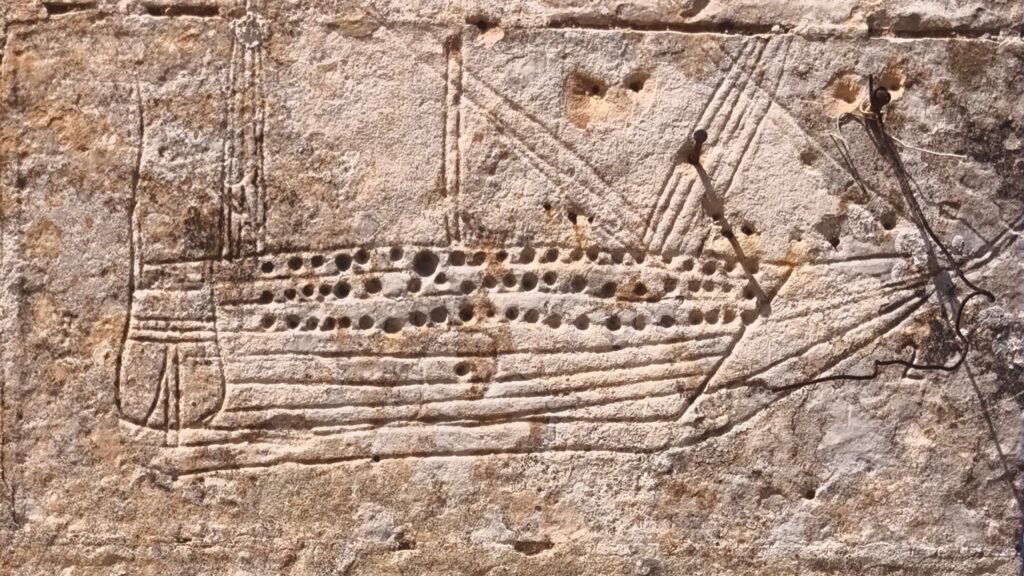
Among the chapel’s most intriguing details are scratched images of galleys and sailing vessels on its exterior stonework.
Such graffiti are found at several Maltese rural chapels, especially those connected with Marian devotion. They are often interpreted as informal ex-votos made by sailors, travellers or their relatives in thanksgiving for survival at sea.
There is no surviving inscription that proves who carved the Kunċizzjoni vessels or why. They may represent prayers for protection, thanks for a safe return or simply the work of people familiar with the ships of the Order.
Their location is nevertheless striking. They appear on a chapel built on an estate whose rents supported the Knights’ fleet and dedicated to a Marian title carried on the Order’s naval standards.
From the Knights to the Maltese State
When Napoleon expelled the Order of St John from Malta in 1798, properties belonging to the Order passed into the hands of the succeeding authorities. The Kunċizzjoni chapel consequently became government property and remains associated with the state rather than private ownership.
A pastoral visit by Bishop Pietro Pace in 1889 found the chapel generally in good order under the care of Dun Andrea Mifsud, although some minor repairs were required.
Records concerning the chapel’s viġendarji, the priests appointed to fulfil its religious obligations, survive for the period from 1801 to 1962. They demonstrate that worship continued long after the departure of the Knights.
The Feast and the Chapel Today
The traditional celebration takes place on the first Sunday following 8 December. Mass and a procession with the statue preserve the religious identity of the small settlement.
A local heritage account published in 2023 described the chapel as being in very good condition and recorded that Mass was celebrated on Saturday evenings.
Its remote setting remains essential to its character. The chapel is surrounded by agricultural land, rubble walls and the valleys of western Malta. Nearby routes lead towards Baħrija, Binġemma, Fomm ir-Riħ and the western approaches of the Victoria Lines.
It continues to serve as a place of worship, a landmark for walkers and a rare surviving reminder of Malta’s estate communities under the Knights.
Malta’s Wider Devotion to the Immaculate Conception
The dedication remains deeply rooted in Maltese religious life. The most prominent national celebration takes place in Cospicua, or Bormla, where the collegiate church is dedicated to the Immaculate Conception.
Its celebrated titular painting was produced by Pietro Paolo Caruana in 1828. The image was solemnly crowned in 1905 with papal approval. During the Second World War, the painting and processional statue were moved to Birkirkara for protection from aerial bombardment.
Their return to Cospicua on 19 November 1944 became a national pilgrimage and an expression of thanksgiving after years of war.
Churches and communities dedicated to the Immaculate Conception are also found in Ħamrun, Tal-Ibraġ, Mqabba, Qala and several other Maltese and Gozitan localities.
The importance of the devotion is reflected in the Maltese calendar. The feast of the Immaculate Conception on 8 December is a public holiday.
A Small Chapel with a Remarkable Story
The Chapel of the Immaculate Conception at Kunċizzjoni appears, at first, to be an isolated country church. Its story reveals something much larger.
It links the farming estates of western Malta with the Order’s warships, the Marian faith of the Knights with the prayers of rural families, and an eighteenth-century Grand Master with a devotion that remains alive today.
Its heraldic shields, ship graffiti, paintings and annual procession preserve the memory of a landscape where agriculture, naval power and religion once formed part of the same world.