
Chapel of Our Lady of Bir Miftuħ
(Please allow a few seconds for the video to load)
Welcome to
“The Chapel of Our Lady of Bir Miftuħ” digital experience where history and technology intertwine to bring you something that is immersive and entertaining.
Explore the Chapel
Below, you will find a ‘Paywall’ feature, requesting you to make a donation to be able to enter the page.
Once you are in, you will find
Support a Mission, Explore a Treasure
Your entry helps Missio Malta continue their vital work in missionary lands overseas. By donating, you directly support communities in need while gaining 24-hour full access to this chapel's 3D experience and history.
Learn more about Missio's workAccess is valid for 1 Chapel for 24 hours from the time of donation
OR
360° Panorama
Zoom to full screen to view
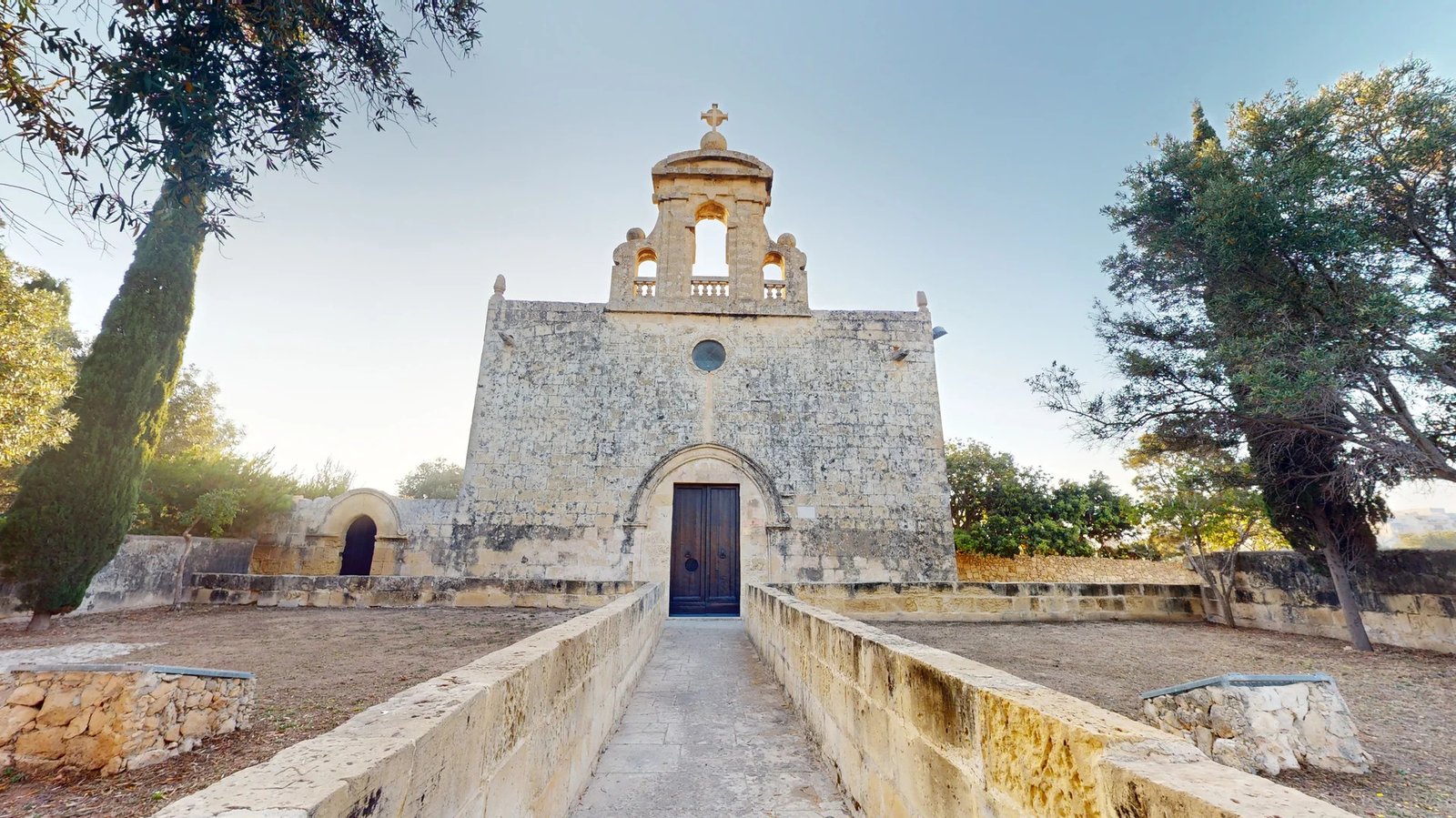
This chapel, built around 1430, is one of Malta’s best preserved examples of a fifteenth-century parish church.
Bishop Senatore de Mello declared it a parish in 1436, and it remained so until 1676, when the Parish Church of Gudja was built. It was never in the village centre, but rather a parish church that served several villages. Between 1978 and 1980, the remains of a fresco covering the inside western wall were discovered after being covered by multiple layers of lime.
The Last Judgement is depicted in three tiers of figures in the fresco. A painting of a woman in costume holding a lily in one hand and pointing to the main painting hangs on the north wall.
The clothes she is wearing were fashionable at the start of the sixteenth century. The portrait most likely depicts a benefactress of the Bonici family, whose emblem is a lily. The altar painting, which depicts God surrounded by angels in the top of the panel, is most likely from the second half of the same century. A hilly landscape surrounds the Virgin and Child, who are flanked by St Peter and St Paul.
The Chapel was damaged during WWII and was repaired and a new floor was laid by Father Rapa, the parish priest of Gudja.
George Farrugia, Diplomato Istituto del Restauro, Roma, and Associate of the International Institute for Conservation, restored the frescoes. The floor laid in 1942 was replaced with globigerina limestone flagstones, and the outside areas adjacent to the walls were paved. The frescoes are subjected to regular inspections by restoration experts. The restoration of the churchyard behind the chapel was completed in 2004.
Bir Miftuħ
Bir Miftuh is a locality in the southern part of Malta, known for its historical significance and its agricultural roots. It’s a small village located close to the larger town of Żejtun. The name “Bir Miftuh” translates to “an open well” in Maltese, hinting at its history linked to water sources.
Throughout history, Malta has been shaped by various civilizations, and Bir Miftuh is no exception. The area bears traces of ancient settlements and agricultural activity dating back centuries. The village, like many other parts of Malta, experienced the rule of the Phoenicians, Romans, Arabs, Normans, Knights of St. John, and the British Empire.
The village was primarily rural, with agriculture playing a significant role in its economy. Olive and citrus groves, vineyards, and fields of crops were common sights in the region. Over time, with modernization and urbanization, Bir Miftuh evolved, incorporating contemporary infrastructure and developments while retaining elements of its traditional heritage.
One notable landmark in the area is the Church of the Annunciation, a historic church that stands as a testament to the village’s religious and cultural heritage. Churches often serve as focal points in Maltese villages, reflecting the strong influence of Catholicism on the island’s history and culture.
Like many places in Malta, Bir Miftuh is likely to have its own unique stories, folklore, and local traditions passed down through generations. While small in size, its historical significance contributes to the rich tapestry of Malta’s past and present.
