
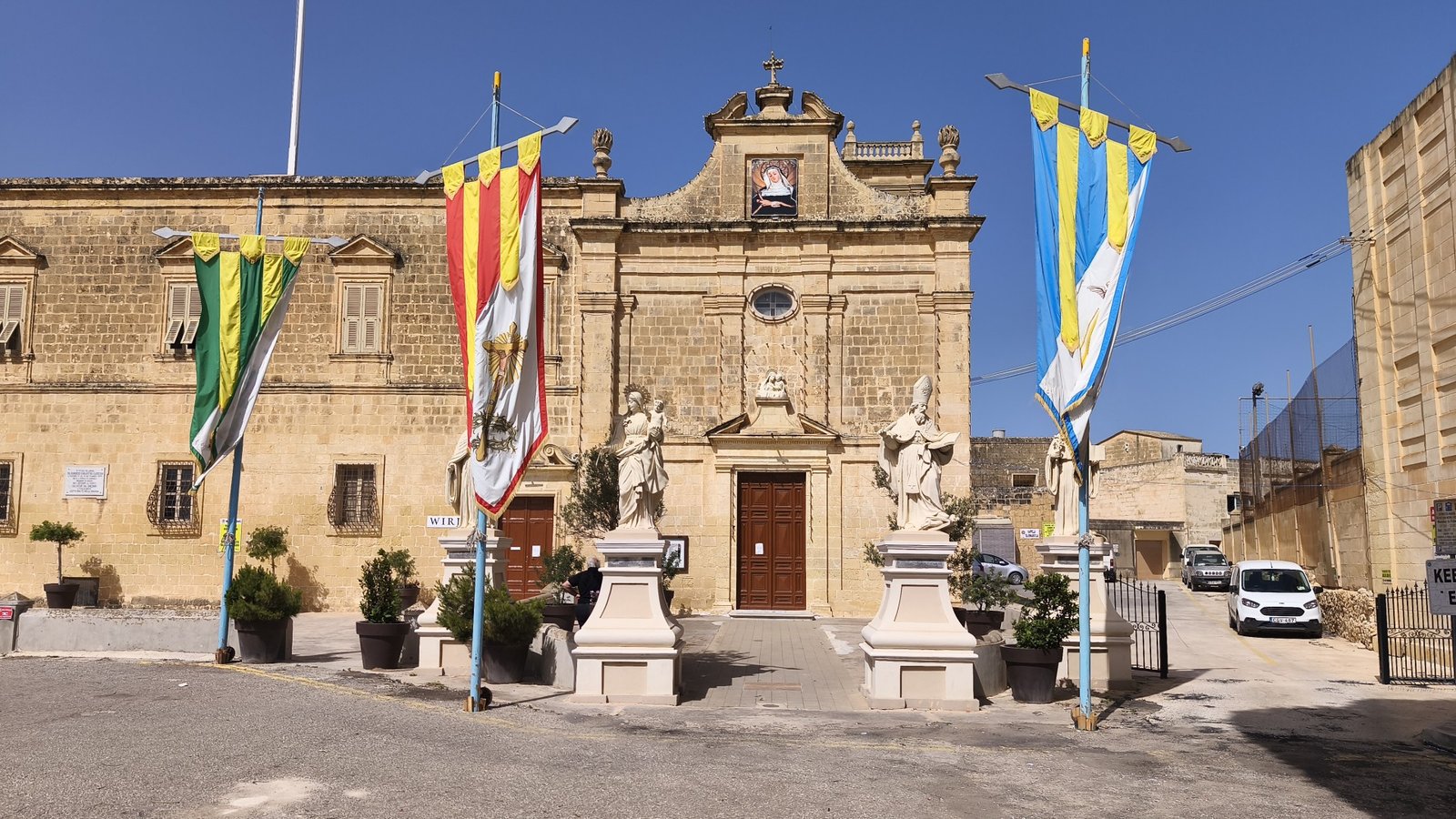
The Church of St Augustine in Victoria, Gozo – A Journey Through History, Faith and Art
Nestled in the heart of Victoria (Rabat) on the island of Gozo, the Church of St. Augustine (Knisja ta’ Santu Wistin) stands as a testament to centuries of faith, art, and community. This Augustinian friary church, with its humble limestone façade and rich interior, has quietly witnessed the ebb and flow of Gozo’s history since the 15th century. From its medieval origins and Baroque reconstruction to its role in local spirituality and culture, the story of St. Augustine’s church is an engaging narrative of resilience, devotion, and artistic heritage.
Historical Background: Medieval Roots and Augustinian Origins
The Augustinian presence in Gozo is the oldest of any religious order on the island According to historical records, the friars had settled in Gozo by the mid-15th century – and possibly even earlier. In fact, the church of St. Augustine in Gozo was listed among those granted special indulgences during the Holy Year of 1450, indicating its active use by that date. An Augustinian priory in Gozo is documented as early as 1435, and some researchers even suggest the community may have existed around 1260. While that early date remains more legend than fact, it’s clear that by the 1400s the Augustinian friars were established on Gozo, enriching the spiritual life of this small “Island of the Three Hills”.
Origins in Xagħra: Local lore holds that the Augustinians first lived as hermit-monks on a cliff overlooking Ramla Bay in Xagħra. There they cared for a tiny chapel dedicated to Santa Marija tas-Seba’ Ferħat – Our Lady of the Seven Joys. A painting of St. Augustine venerating the Seven Joys of Mary, believed to have come from this Xagħra chapel, survives today in the Victoria monastery. By 1453, the order had shifted to the town of Rabat (today’s Victoria), which was the administrative center of Gozo. The small monastery in Victoria is mentioned in Augustinian registries of that year, suggesting the friars established a permanent base in the shadow of the medieval Citadel.
Patrons and Early Development: The early Augustinian community enjoyed the support of local notables. In 1465, a Gozitan nobleman, Antonio de Naso, financed the casting of a new bell for St. Augustine’s church. A few years later, in 1470, official records referred to the cemetery adjacent to the church and convent as the “Cimiterio di Sant’Agostino,” showing that the site was already well known by that name. By 1492, the Augustinian provincial Jacob de Leo formally founded the conventual community in Gozo, solidifying its status. The priory’s original purpose was to provide a base for the friars’ pastoral work on Gozo – offering sacraments, preaching, and education – at a time when this rural island was often overlooked in wider Maltese affairs.
The church and convent saw steady growth through the 16th century. In 1533 the complex was enlarged and the church was renovated to better serve the faithful. However, Gozo’s tranquility was not to last. The mid-1500s brought turbulent times that tested the resilience of both the islanders and the Augustinians.
Surviving Ottoman Siege and Suppression: One pivotal event in Gozo’s history was the Ottoman attack of July 1551 – often called the Great Siege of Gozo. The island fell to Ottoman marauders who enslaved most of its inhabitants. Amid this tragedy, an Augustinian friar named Fra Bartolomeo Bonavia played a remarkable role. He acted as an intermediary between the Knights of St. John (who governed Malta and Gozo) and the Ottoman commander, negotiating in an attempt to spare lives. Despite his efforts, the island was devastated, but the presence of Augustinian friars in historical accounts of the siege underlines their integration into the community’s life and trials.
Later in the 17th century, the Augustinian friary faced another challenge – this time from church reforms. In 1652, Pope Innocent X, aiming to enforce stricter discipline, decreed that religious houses with too few members should be closed. Gozo’s tiny Augustinian convent, home to only a small number of monks, was caught in this net. On 15 October 1652 the friars in Victoria were ordered to leave. The prior at the time, Fr. John Augustine Sapiano, surrendered the keys of St. Augustine’s church and monastery to the ecclesiastical authorities on the last day of October 1653. The convent’s possessions were even distributed to other religious institutions. But the closure was mercifully short-lived – just four months – thanks to a powerful ally. Grand Master Giovanni Paolo Lascaris of the Knights of St. John, a friend of the Augustinians, petitioned for the Gozo convent to be reinstated. By early 1654, the friars were back, continuing their ministry as an integral part of Gozitan life.
Construction and Architectural Details: Rebuilding in Baroque Style
The reinstated friars set about renewing their aged church. By the 1660s, the medieval chapel in Victoria was showing serious structural problems – it was old and in danger of collapse. Thus in 1662 the decision was made to rebuild a brand-new church on the site, likely incorporating some of the old stone but following the contemporary Baroque architectural style. The project moved swiftly: the new church of St. Augustine was completed by 1666. This timing places it in the high Baroque period of the Maltese Islands, when many churches were being rebuilt with grander designs.
Despite the new construction, one curious detail stands out – the church was only solemnly consecrated in 1782, over a century later. Bishop Vincenzo Labini of Malta performed the consecration rites on 12 May 1782. The delay might be explained by the fact that consecration (the formal dedication of the altar and building for sacred use) often happened only after a church was entirely debt-free and fully embellished. It is possible that St. Augustine’s took decades to decorate and equip, and the ceremony was deferred until all works were complete in the late 18th century.
Architecturally, the Church of St. Augustine is a modest example of local Baroque. Its limestone façade is plain yet elegant, characterized by a simple rectilinear layout and a curving Baroque frontispiece. The main door is topped by a broken pediment and an oculus (circular window), above which the façade rises to a curved gable flanked by scroll buttresses. A small belfry crowns the top, where a single bell calls the faithful to prayer. Not long after the church’s completion, a new freestanding bell tower was also planned. In 1679 the friars decided to build a sturdier belfry, presumably to replace or augment the original small bellcot. This shows their commitment to equipping the church with practical features for daily monastic life.
Adjoining the church to its left is the Augustinian monastery (priory), which underwent significant enlargement in the late 17th and early 18th centuries. Starting in 1690, work began to expand and reconstruct the convent buildings, but fate hastened the plans. In January 1693 a powerful earthquake struck the Maltese islands, causing damage even on Gozo. The quake made the new construction even more urgent, and the friars engaged architect Ferdinando Valletta to design a larger, more resilient monastery. The rebuilt convent was completed by 1717. It was laid out in traditional monastic style, with the friars’ living quarters arranged around a central cloister (an open-air courtyard). Originally the cloister was open to the elements, but Gozo’s climate proved inhospitable for a life of contemplation – winter winds and summer heat plagued the courtyard. By 1724 the Augustinians installed glazed windows around the cloister walkways to enclose it, creating a sheltered interior space for prayer and study.
The resulting complex – church and monastery – presents a subdued yet harmonious architectural profile in St. Augustine’s Square. Built of honey-coloured Maltese limestone, the structures reflect the Baroque ethos without excessive ornamentation, in keeping with Gozo’s simpler, rustic style. Thick walls, semi-circular arched openings, and a few stone pilasters give the church an air of solid dignity. The attached priory features a plain two-storey façade with modest fenestration, matching the church in material and style. Though not as lavish as some grand churches on mainland Malta, St. Augustine’s exudes a humble charm that has aged gracefully over centuries.
Challenges and Renovations: Over time, the church required upkeep and tweaks. A notable 20th-century intervention occurred in 1929–1931. In anticipation of the 15th centenary of St. Augustine’s death (which occurred in AD 430), the Gozo friars undertook renovations to refresh the church. The bell tower was rebuilt in December 1929, likely to stabilize it and perhaps to alter its style slightly. Inside, the choir loft balconies – which had once housed an organ – were removed in 1931 to open up the interior space. In place of those side lofts, large canvases were installed (more on those artworks later). These changes necessitated enlarging the main altar to maintain visual balance in the sanctuary. The friars also expanded their living quarters upward: in 1932 a new floor was added to the monastery to serve as a novitiate (training space for new monks). Through all these changes, the integrity of the original 17th-century structure was respected, and the church retained its historic character.
Cultural and Religious Significance in Gozo’s Life
For over five centuries, the Augustinian friars and their church have played a quiet but influential role in Gozo’s spiritual and cultural life. As the first Catholic religious order to establish a base on Gozo, the Augustinians significantly enriched the island’s Christian heritage. In an era when Gozo often felt like a backwater – isolated by distance (“double insularity” as historians call it) – the presence of a monastic community in Victoria was a source of pride and learning for Gozitans.
Pastoral Service and Education: The friars historically served the local populace in various ways. They provided pastoral care, preaching at services and hearing confessions, thus bolstering the religious life of Gozo’s inhabitants. Being learned men, the Augustinians also likely ran a small school or offered instruction, as was common for mendicant orders, though specifics are scarce (some records were lost in a 1583 pirate raid that plundered books and documents). What is known is that the community maintained continuous service despite hardships – whether the depredations of corsairs or the reforms of distant popes – underscoring their importance to the faithful of Gozo.
The church itself, while technically not a parish church (Victoria’s main parishes are the Cathedral and St. George’s Basilica), has long been a place of devotion open to all. Locals would attend Mass there on ordinary weekdays or seek the friars for spiritual counsel. Over the years, various confraternities and devotional societies met at St. Augustine’s. For example, the Augustinians fostered special devotion to the Blessed Virgin Mary, a hallmark of their order. The old Xagħra chapel’s dedication to Our Lady of Seven Joys continued in spirit at Victoria, and Marian feasts were celebrated with particular fervor. In 1765, the friars brought from Rome a revered image of Our Lady of Good Counsel, installing it on their main altar. This reinforced Marian devotion in the church – Our Lady of Good Counsel (Madonna tal-Parir it-Tajjeb) became a patroness of the community, and her feast is observed every April 26th.
Notable Celebrations: Among the annual highlights is the feast of St. Nicholas of Tolentino (a 13th-century Augustinian saint). The friars in Gozo celebrate St. Nicholas’ feast each September with distinctive traditions. A solemn Mass is held, during which they bless and distribute the traditional “St. Nicholas bread” to the faithful – a custom recalling the saint’s legendary charity in feeding the poor. This ritual bread-blessing, accompanied by prayers for healing and comfort, draws locals to the church and keeps alive an old Augustinian practice. In earlier times, the feast was also marked by a procession: a statue of St. Nicholas would be carried by the friars and devotees through the square. (The original 1734 wooden statue was so heavy that a lighter papier-mâché version was later commissioned for processional use – more on that later.)
The church’s patronal feast of St. Augustine of Hippo (celebrated on August 28th) is another occasion for festivity. Although it might not rival the scale of larger Gozitan parish feasts, the Augustinian community honours their namesake with devout liturgies and reflections on his teachings. In 1930, on the 1500th anniversary of St. Augustine’s death, the friars held centenary celebrations which, as noted, spurred renovations of the church. Such events highlight the cultural continuity – linking the island’s present to its past through ritual and remembrance.
Beyond religious rites, St. Augustine’s has been a community hub in subtler ways. Generations of Gozitans have grown up seeing the four statues on its front porch, hearing its bell toll, and perhaps stopping by for a moment of prayer in its cool, quiet interior. The friary’s library (to the extent it was rebuilt after losses like the 1583 raid) and the learned friars contributed to local scholarship. In the 18th century, for instance, the Gozitan historian Francesco Agius de Soldanis consulted the Augustinians’ records for his writings. And in modern times, Augustinian friars such as Fr. Peter Paul Cachia have become key figures in preserving Gozo’s history and heritage – Fr. Cachia’s extensive research on the order’s traditions in Gozo is a prime example.
Present-Day Context: Restoration, Retreats and Community Relevance
Today, the Church of St. Augustine and its adjoining monastery remain an active yet tranquil corner of Victoria. While the number of friars has dwindled (only a handful of Augustinian monks reside there now, reflecting the general decline in vocations), the site is well cared for and continues to fulfil a dual role: a place of worship and a beacon of cultural heritage.
Current Role: St. Augustine’s is no longer a parish church, but it is very much alive. Daily Mass and devotions are held according to a regular schedule, and locals often drop in for private prayer. The church’s atmosphere – peaceful and steeped in history – also attracts visitors. Those exploring Victoria’s streets find their way to St. Augustine’s Square to admire this historic gem, frequently noting the serene, prayerful ambience inside. In addition, the Augustinian monastery has reinvented part of its space as a retreat house. The friars host groups and individuals seeking days of quiet reflection, offering simple accommodations within the monastic quarters. This initiative has opened the door for people from Malta and beyond to experience a live-in spiritual retreat on Gozo, thereby continuing the Augustinians’ centuries-old mission of providing spiritual nourishment.
Maintenance and Restoration: Recognising its historical and artistic value, local and national authorities have invested in preserving St. Augustine’s church. In recent years a comprehensive restoration project was undertaken to address wear and tear. Portions of the timber ceiling and the old organ gallery were repaired, and nearly the entire interior received fresh conservation treatment and repainting. Workers also restored stone niches and upgraded the lighting at the main door, and even the wooden furniture received careful maintenance. The Augustinian prior in Gozo, Fr. Adeodato Schembri, noted that the costs incurred were significant, involving skilled labour and heavy machinery to reach high vaults. The community rallied to support the project, and fundraising efforts are ongoing to fully cover the expenses. By 2021, the restoration was completed, breathing new life into the centuries-old structure and ensuring its longevity for future generations.
The artworks and statuary at St. Augustine’s have also seen recent care. In 2023, the Victoria local council launched a project to restore the five statues that adorn the church’s front parvis. These statues – representing St. Augustine, Our Lady of the Belt, St. Nicholas of Tolentino, St. Thomas of Villanova, and Our Mother of Good Counsel – had suffered the effects of weather and needed cleaning and structural repair. A professional restorer, under the supervision of heritage authorities, began treating the stone figures to return them to their former glory. The restoration of these statues is funded by Gozo’s Ministry for Culture as part of an initiative (EcoGozo) to preserve local landmarks. Community members take pride in seeing their beloved statues gleaming white once again, each one a familiar “face” in the square.
Beyond physical restorations, the Augustinian convent has even served the community in practical ways. During recent renovations of government offices in Victoria, a portion of the monastery was leased to temporarily host a public department. Thus, the ancient cloisters once more sheltered busy daily life – albeit secular office work – demonstrating the adaptive reuse of historic spaces in modern Gozo.
In short, St. Augustine’s today stands as a bridge between past and present. It is managed by the Augustinian Order in tandem with the Diocese of Gozo, and it enjoys protection as a Grade 1 scheduled property (a registered cultural monument). Visitors are welcome to explore (respectfully, as it is a working church), and many are enchanted by its blend of simplicity and historical richness. The continuing presence of the Augustinian friars – however few – means that this is not just a museum piece, but a living church that still resonates with prayer, community, and the echoes of history.
Unique Stories and Legends of St. Augustine’s
A site as old as the Church of St. Augustine inevitably collects its share of legends and anecdotes. We’ve already touched on a few – the hermits of Xagħra, the friar in the Ottoman siege, the papal suppression and Lascaris’ intervention – but there are other colourful tales woven into the fabric of this place.
The Lost Records and Pirate Raid: One historical incident veiled in legend is the loss of the monastery’s earliest records. Gozitan historian Soldanis recounts that on 9 October 1583, Barbary pirates from Bizerta raided Gozo. Among the treasures they looted were books and documents from the Augustinian convent’s library. This theft, he lamented, “deprived the monks of all documentary records” of their foundation. As a result, the exact date of the friary’s establishment was shrouded in mystery – fuelling later speculation that it might date back to 1260. While we may never know if the Augustinians truly arrived that early, the pirate story underscores how vulnerable Gozo was in the age of corsairs, and how lucky it is that the community rebounded despite such setbacks.
The Legend of the Turk and the Hidden Spring: Local folklore also links the Augustinians to a popular tale of a miraculous rescue. According to a legend still whispered in Victoria, during one of the periodic corsair raids a Turkish marauder came upon a local woman kneading dough in her home near St. Augustine’s. He ordered her to follow him, presumably to abduct her. The clever woman asked to wash off her floured hands first, and the Turk allowed it. As the story goes, she led him to a spot behind the Augustinian church where she knew a secret spring emerged. When she dug at the ground, water gushed forth. Distracted and curious about this sudden spring, the Turk bent down – and the woman seized the moment to flee and hide safely, her life saved by wit and perhaps a bit of divine providence. Some say a niche in the area marks the spot of this legend, symbolizing deliverance. While details vary in retellings, the story echoes a common theme in Maltese lore: faith and cunning triumphing over danger.
The Seven Joys and Ta’ Gajdoru Chapel: Another cherished tale is tied to the aforementioned chapel of Our Lady of the Seven Joys in Xagħra. The site, known as Ta’ Gajdoru, is today an archaeological area, but tradition holds that Augustinian friars tended the chapel there in Gozo’s early Christian years. One legend asserts that an old painting of the Virgin Mary with seven angels (representing her seven joys) was brought from that chapel to the Victoria church for safekeeping. Miraculously, despite the tumult of history, this painting survived and is still displayed in the friary – a tangible link to the very beginnings of the Augustinian story on Gozo. Whether by miracle or good fortune, the preservation of this artwork is seen by some as a sign that the Virgin’s joy and protection have always rested on this community.
Relic of St. Dionisia: In more factual lore, the church also became the resting place of a sacred relic with its own small legend. In 1836 the friars acquired the remains of St. Dionisia, a catacomb saint from Rome, and interred them beneath a side altar. In the 19th century it was fashionable for churches to house relics of ancient martyrs, believed to bless the congregation and inspire devotion. St. Dionisia’s relic was venerated at St. Augustine’s, and stories likely spread of favours received through her intercession. Though her name is not widely known today, the fact that her bones lie in this quiet Gozitan church adds a layer of mystique – connecting the island to the early Christian era.
These and other anecdotes – the kind that do not always make it into official histories – contribute to the aura of St. Augustine’s. Ask an elderly local, and they might recall how “il-knisja ta’ Santu Wistin” (the Church of St. Augustine) was where their grandparents sought refuge in times of trouble, or how a particular prayer said there was answered in unexpected ways. Such is the living tapestry of legend and memory that surrounds this venerable place.
Visual and Artistic Features: A Treasure Trove of Baroque Art
While externally unassuming, the Church of St. Augustine in Victoria is home to several artistic treasures that delight historians and art lovers. Its artwork reflects the deep faith of its patrons and the connections of Gozo’s small community to the broader currents of Baroque art in Malta and Italy.
References
- Augustinian Archives Malta and Gozo
• Diocese of Gozo Historical Records
• EcoGozo Cultural Heritage Reports
• Malta and Gozo Tourism Authority
• Research papers by Fr Peter Paul Cachia
• The Wirt Għawdex Historical Society