
Church of St. Augustine
(Please allow a few seconds for the video to load)
Welcome to
“The Church of St. Augustine” digital experience where history and technology intertwine to bring you an immersive experience.
Explore the Chapel
Below, you will find a ‘Paywall’ feature, requesting you to make a donation to be able to enter the page.
Once you are in, you will find
Support a Mission, Explore a Treasure
Your entry helps Missio Malta continue their vital work in missionary lands overseas. By donating, you directly support communities in need while gaining 24-hour full access to this chapel's 3D experience and history.
Learn more about Missio's workAccess is valid for 1 Chapel for 24 hours from the time of donation
OR
360° Panorama
Zoom to full screen to view
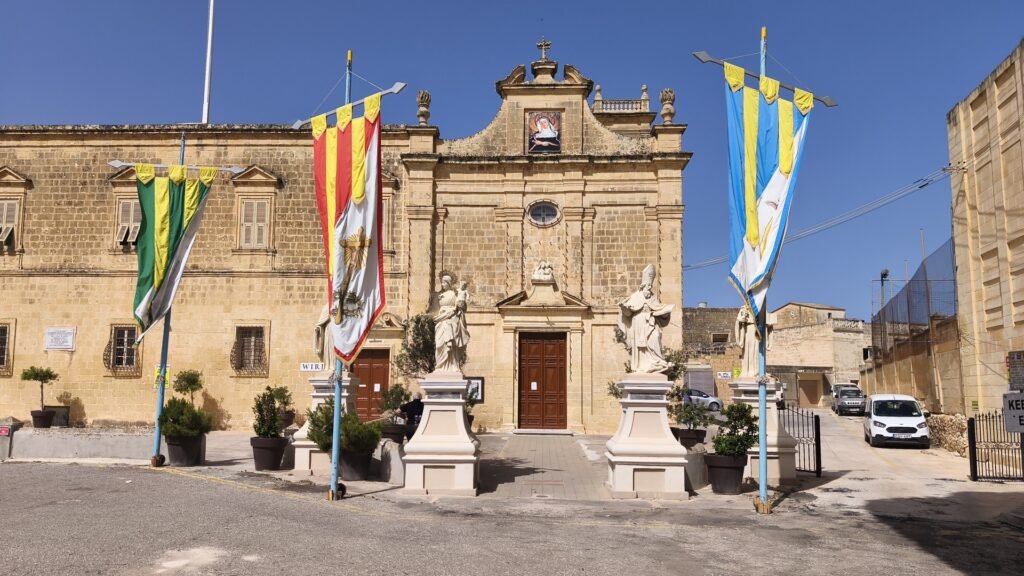
The Church of St Augustine
Located in the heart of Victoria, Gozo, the Church of St Augustine is a hidden gem that reflects the island’s rich spiritual and cultural past. Established in the 15th century by the Augustinian friars, this historic church continues to inspire awe through its art, architecture, and atmosphere of devotion.
Origins in Faith and Community
The Augustinians were the first religious order to settle permanently in Gozo. Originally living as hermits in Xagħra, the friars moved to Victoria (then Rabat) by the 1430s to serve the growing community more directly. Their early presence laid the foundation for a vibrant religious centre that endured sieges, reforms, and reconstruction.
Despite the hardships of the 1551 Ottoman attack and a brief suppression in the 1650s, the Augustinian community was quickly reinstated. With the backing of Grand Master Lascaris of the Knights of St John, the friars rebuilt their presence and renewed their mission.
Baroque Transformation
In 1662, the ageing medieval structure was demolished and replaced with a new Baroque-style church, completed in 1666. Built from traditional Maltese limestone, the church features a curved gable, modest belfry, and thick stone walls suited for monastic life.
The adjacent monastery was expanded after the 1693 earthquake, guided by architect Ferdinando Valletta. This resulted in a cloistered structure that offered both serenity and practicality for the friars’ way of life. The church was consecrated in 1782, though it had already served the community for over a century.
Role in Religious Life
The Church of St Augustine has long been a cornerstone of spiritual life in Gozo. The friars provided education, pastoral care, and a strong sense of devotion, especially to the Virgin Mary. A revered image of Our Lady of Good Counsel, brought from Rome in 1765, remains central to the church’s identity. Her feast is still observed with devotion each year.
The feast of St Nicholas of Tolentino is another long-standing tradition. Known for healing and charity, St Nicholas is honoured with the blessing and distribution of special bread — a custom cherished by generations of Gozitans.
Present-Day Relevance
Though no longer a parish church, St Augustine’s remains active. It is run by a small group of friars who hold regular Masses, support spiritual retreats, and maintain the church and monastery with care and reverence.
In recent years, major restoration projects have revitalised the structure. These included repairing stonework, repainting interiors, restoring statues, and upgrading lighting. The churchyard features prominent limestone statues of St Augustine, Our Lady of the Belt, St Nicholas of Tolentino, and St Thomas of Villanova, all now beautifully conserved.
Legends and Local Lore
Local stories bring a sense of wonder to this sacred space. One tale tells of a woman who evaded a corsair by distracting him with a hidden spring behind the monastery. Another recounts the 1583 pirate raid that stole valuable records, leaving early history shrouded in mystery.
The church also houses a treasured painting of Our Lady of the Seven Joys, believed to have come from the friars’ original hermitage chapel in Xagħra. Such artefacts connect today’s churchgoers with the island’s deep spiritual roots.
Artistic Highlights
Inside, the church reveals a trove of artistic treasures. The main attraction is a 1694 altarpiece by Mattia Preti, depicting St Augustine in celestial glory, joined by St John the Baptist and William of Aquitaine. This Baroque masterpiece is one of Gozo’s most valuable religious artworks.
The main altar, built in 1767, features marble inlay and houses the beloved icon of Our Lady of Good Counsel. Additional artwork includes 20th-century paintings by Giuseppe Briffa, illustrating moments from St Augustine’s life. The church also holds a reliquary containing the remains of St Dionisia, an early Christian martyr, adding another spiritual layer to its heritage.
A Quiet Treasure in Gozo
St Augustine’s Church offers more than history — it offers peace. Whether you’re admiring its sacred art, seeking a moment of reflection, or joining in a devotional tradition, this timeless church invites all who enter to connect with Gozo’s enduring faith.
St Augustine: From Rebel Soul to Sainted Scholar
Saint Augustine of Hippo (354–430 AD) was a towering figure in early Christianity, whose life journey from youthful indulgence to spiritual profundity continues to inspire.
Origins and Early Life
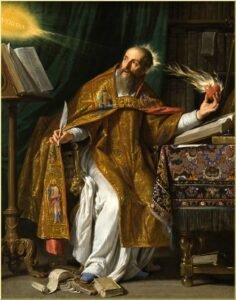 Born Aurelius Augustinus on 13 November 354 in Thagaste (modern-day Souk Ahras, Algeria), Augustine hailed from a Romanised Berber family. His mother, Monica, was a devout Christian, while his father, Patricius, remained a pagan until his deathbed conversion. Augustine received a classical education in rhetoric and philosophy in Carthage, where he also fathered a son, Adeodatus, with a concubine.
The Search for Truth
In his quest for meaning, Augustine explored various philosophies, including Manichaeism and Neoplatonism. His intellectual pursuits led him to Milan, where he encountered the influential bishop Ambrose. Under Ambrose’s guidance and influenced by his mother’s prayers, Augustine experienced a profound spiritual awakening. In 386, he converted to Christianity and was baptised by Ambrose the following year.
Bishop and Theologian
Returning to North Africa, Augustine was ordained a priest in 391 and became Bishop of Hippo in 395. He served in this role until his death in 430. Augustine’s writings, including “Confessions” and “The City of God,” addressed theological debates of his time and laid the foundation for much of Western Christian thought.
Legacy and Influence
Augustine’s teachings on grace, free will, and original sin have profoundly influenced Christian theology. His works continue to be studied for their philosophical depth and spiritual insight. He is recognised as a Doctor of the Church and is venerated across various Christian denominations.
Connection to Malta
The Augustinian Order, inspired by Augustine’s teachings, established a presence in Malta before 1413. They built a friary and church near Mdina, which were later rebuilt after destruction in 1551. In Valletta, the St Augustine Church, founded in 1571, stands as a testament to his enduring influence. Additionally, St Augustine College, established in 1848, continues to provide education rooted in Augustinian values.
