
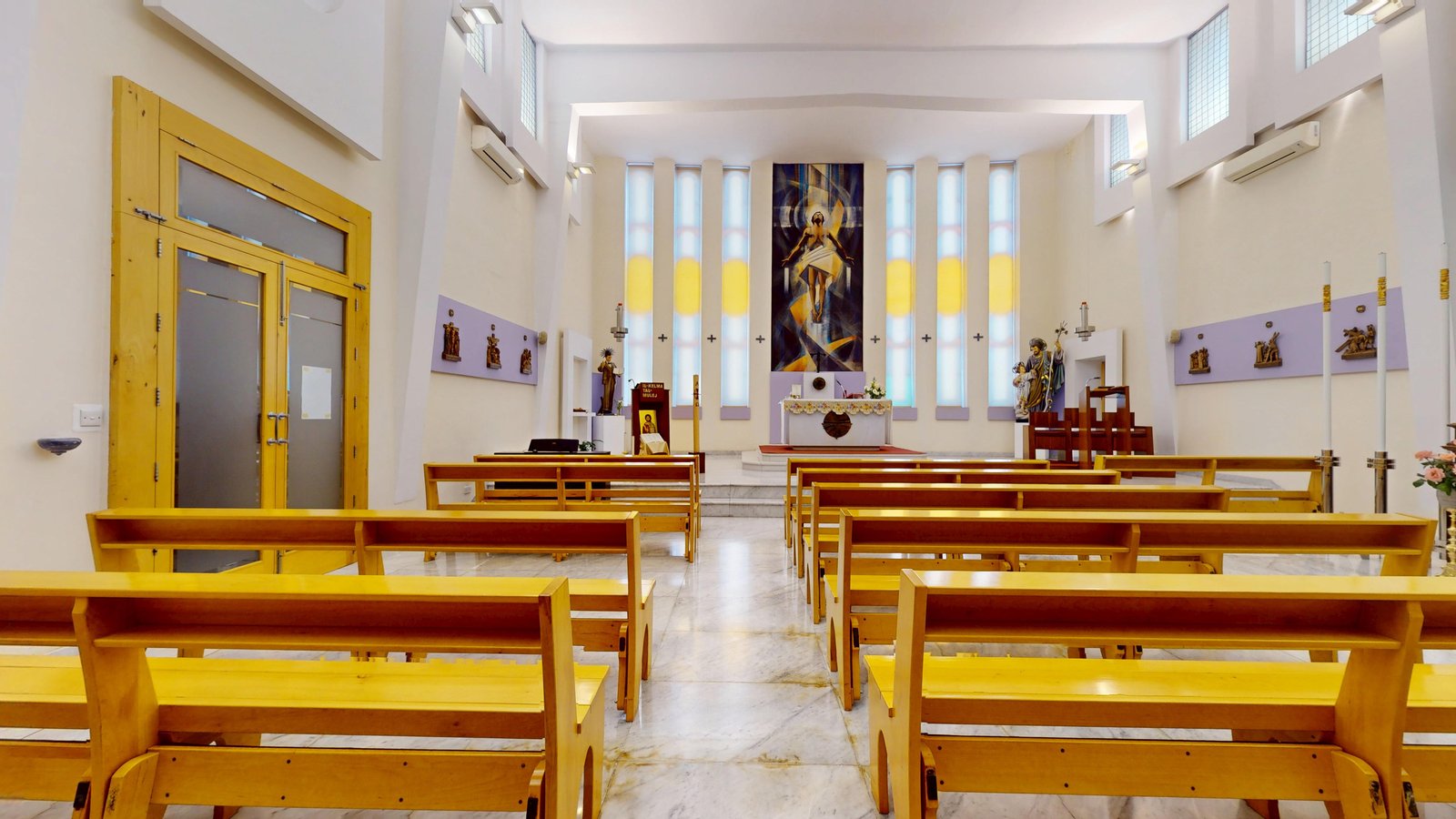
Chapel of St. Joseph (Don Bosco)
The Chapel of St. Joseph at the Don Bosco Oratory in Victoria, Gozo, has its roots in a youth movement started in 1929. That year, informal gatherings and religious activities for young people were organized at the Savina church in Victoria. This initiative was led by Fr. Paul Micallef (Dun Pawl Micallef), a local priest inspired by St. John Bosco’s work with youth. On April 1, 1934, Fr. Micallef established the first Don Bosco Oratory in Gozo, coinciding with Don Bosco’s canonisation on that same day. The oratory initially operated from a small rented house on Triq il-Karità (Charity Street) in central Victoria. Space was so limited that no chapel could be set up inside, and for several years the oratory members attended Sunday Mass at a nearby church (St. James) instead. Despite this humble start, the mission was clear: to provide Gozitan children and youths with a place for spiritual formation, recreation, and community – embodying Don Bosco’s educational philosophy of “home, school, playground, church.”
In 1936, the oratory moved to a larger house on Mons. Giuseppe Farrugia Street. Here, for the first time, a room was designated as a small chapel. Fr. Micallef outfitted it with a simple altar (which he purchased himself) and borrowed candlesticks, placing a picture of Don Bosco above the altar. He also commissioned a statue of Don Bosco from Gozitan sculptor Wistin Camilleri, paying for it out of his own pocket. This period saw the oratory begin annual celebrations in honour of St. John Bosco – a triduum and a feast day Mass held at St. George’s Parish, reflecting the growing prominence of Don Bosco’s patronage in the community.
As the oratory activities expanded, so did the need for a dedicated, purpose-built facility. In 1947, the Don Bosco Oratory relocated to a house at St. Augustine’s Square (Pjazza Santu Wistin) – an area locally nicknamed “Fuq it-Tomba” (“On the Tomb”) because it was the site of a medieval cemetery. The presence of this old cemetery is significant: some ancient tombstones were later discovered during construction and preserved in Gozo’s museum. At the time of the 1947 move, the oratory still lacked its own chapel building. For religious services, the youth and staff made use of two nearby sacred spaces: the small Chapel of Our Lady of Sorrows located in the adjacent former cemetery, and the Church of St. Augustine next door.
Fr. Micallef’s dream of a fully equipped oratory complex materialized after World War II. Construction of a new, permanent Oratory building began in the late 1940s. The first phase of the present Don Bosco Oratory complex was completed in 1949, and the building was officially inaugurated on 8 October 1949. This iconic structure, designed by architect Luigi (Wiġi) Portelli of Għarb, was built through community fundraising and Fr. Micallef’s initiative. It immediately became a landmark in Victoria, featuring recreational halls and what would become one of Gozo’s principal theatres. Notably, however, the initial 1949 construction did not include the chapel that had been planned. Due to financial and logistical constraints, the chapel wing was postponed. In the interim, the oratory improvised a temporary chapel in a large hall on the third floor, just behind the theatre’s balcony. This makeshift chapel served the spiritual needs of the oratory for many years. It was outfitted modestly, with the oratory’s earlier Don Bosco altar and statue likely moved into the space. On 5 November 1949, barely a month after the inauguration, the temporary chapel had the honour of hosting the statue of Our Lady of Fátima during a special visitation to Gozo. Before the pilgrim statue left the oratory, Bishop Giuseppe Pace officially permitted the reservation of the Blessed Sacrament in the oratory’s chapel, thus establishing it as a Sacramentally licensed chapel despite its provisional nature. This development underscored the chapel’s growing importance as “the heart of the oratory,” even before a permanent structure was built.
Throughout the 1950s, the Don Bosco Oratory strengthened its role as a youth centre and spiritual home, all under the patronage of St. John Bosco and with the pastoral care of dedicated priests. By the early 1960s, changes in Victoria precipitated the next step in the chapel’s history. The urban redevelopment of Independence Square (the main piazza in front of St. George’s basilica) between 1955 and 1963 meant the demolition of an old chapel dedicated to St. Joseph, known as San Ġużepp tas-Suq (“St. Joseph of the market”). To compensate the Church for the loss of that historic chapel, the colonial Government granted funds for building a new church elsewhere. Providentially, this occurred just as the Don Bosco Oratory was planning a proper, accessible chapel of its own. In 1964, under the directorship of Fr. Vincent Debono S.D.B., it was decided to use the St. Joseph compensation funds to construct a modern chapel at the Oratory, finally fulfilling the original plan of 1949. In recognition of the source of the funding (and perhaps to carry on the legacy of the demolished chapel), the new oratory chapel was dedicated to Saint Joseph. Thus, the Chapel of St. Joseph at Oratorju Don Bosco was conceived, bridging the legacy of an old Maltese chapel and the future of youth ministry in Gozo.
Construction and Architectural Details
Work on the new chapel began in late 1963 as part of a second phase of the Don Bosco Oratory’s construction. Plans were drawn up by architect Joseph Mizzi, who designed a chapel that would blend with the existing oratory building while also serving as a prominent church on its own. Groundworks commenced in October 1963, and by 8 November 1963 the concrete foundations were laid. Over the following year, local builders and craftsmen laboured to raise the chapel’s limestone walls and roof. Given the era, the architectural style of the Chapel of St. Joseph is a mix of mid-20th-century modernism and traditional Maltese ecclesiastical design. The exterior was plain and functional, in keeping with 1960s aesthetics, but respectful of local architecture through the use of honey-colored Maltese limestone and simple decorative molding. The facade originally featured a modest arched doorway and a cross, without excessive ornamentation – a deliberate contrast to the baroque flourish of Gozo’s older churches. This simplicity reflected the oratory’s identity as a place for youthful spirituality and community rather than a wealthy parish church.
Construction proceeded efficiently, and by the end of 1964 the chapel structure was largely complete. The new Chapel of St. Joseph was solemnly blessed on 31 January 1965 by Bishop Giuseppe Pace of Gozo – an auspicious date, as January 31 is also the feast of St. John Bosco. The inauguration Mass marked the fulfillment of a long-held dream. After three decades of operating in borrowed or improvised spaces, the Don Bosco Oratory finally had a purpose-built sacred space at its core.
The completed chapel is integrated into the oratory complex, occupying one end of the building. It was designed to be easily accessible at street level (unlike the former third-floor hall), emphasizing inclusivity and visibility. The interior layout is that of a small single-nave church, capable of seating a few hundred people. The architectural style can be described as modern-functional: a rectangular hall with a high ceiling and minimal internal columns, maximizing open space for congregation. The ceiling is gently vaulted with a series of broad arches and skylights that diffuse natural light. Plain glass block windows high on the walls (a typical 1960s feature) allow additional daylight to stream in.
Originally, the sanctuary of the chapel was simple, focused on the essentials of Catholic liturgy. A plain main altar was installed, likely made of local stone or marble, and a tabernacle for the Blessed Sacrament placed at its center. The dedication to St. Joseph meant that from its earliest days, the chapel probably displayed some image or statue of St. Joseph. Although details from the 1965 decor are scant, it is common that a titular chapel in Malta would include a titular painting or statue of its patron. It is possible that a painting of St. Joseph or a statue was initially installed above the altar. (In later decades, this would change – see Visual Features below.) Additionally, the statue of Don Bosco crafted in 1936 remained an important devotional item; it may have been placed in the new chapel or within the Oratory halls to remind all of the centre’s spiritual father.
A noteworthy incident in the chapel’s construction phase was its connection to the old cemetery site. During excavation and building works, human remains dating back to the medieval cemetery were uncovered beneath where the chapel’s front portico stands. Archaeologists documented these finds, and the remains were reverently reinterred or preserved by the authorities. Far from deterring the project, this discovery reinforced the chapel’s sacred nature – it quite literally stands on hallowed ground, sanctified by generations of faithful departed.
The total construction cost of the chapel is not fully documented in public sources, but the government compensation formed a substantial part. Additional funding and labor were provided by the Oratory community: parishioners, youths, and benefactors rallied with donations and voluntary work. The spirit of “sjieda” (voluntary community labor) was likely present, as was common in Maltese church projects of the time. Local artisans contributed their skills: stone masons carved the limestone blocks, ironmongers fashioned gates or railings, and carpenters built the timber pews that furnished the nave.
Architecturally, the Chapel of St. Joseph complements the oratory’s other sections (the theatre and youth spaces) yet maintains a distinct identity. It has its own entrance from the street, marked originally by a simple pediment and a cross above the door. Over the years, a small bell and bell-cot were added to call worshippers to prayer. By being dedicated to St. Joseph – a saint associated with familial protection and humble workmanship – the chapel’s very name underlines the ethos of the Don Bosco Oratory: a safe, paternal haven for the young, guided by faith and strong values.
Cultural and Religious Significance
Since its establishment, the Chapel of St. Joseph (Oratorju Don Bosco) has played a vital role in Gozo’s religious and cultural life. Though not a parish church, it functions as a spiritual hub within the community, particularly aimed at children and youth. In the mid-20th century, when the chapel opened, Gozo was a deeply Catholic society where church activities were central to social life. The oratory, under the patronage of St. John Bosco, introduced a new model: a youth centre that combined faith, education, and recreation. The chapel became the stage for implementing Don Bosco’s innovative approach to youth ministry in Gozo.
For the local Catholic community, the chapel served as a training ground for young altar servers, choir members, and future leaders in the Church. Generations of Gozitan youths attended catechism classes and spiritual talks in the oratory’s halls and then gathered in the chapel for Mass, prayers, and the sacraments. The phrase often used is that the chapel is the “heart of the Oratory” – indeed, it’s where the values taught in the classroom and practiced on the playground are solemnized in worship. Major milestones in young people’s lives – first Holy Communions, confirmations, scout promise ceremonies, etc. – have been hosted within this chapel’s walls, reinforcing its significance in personal and collective memory.
The Don Bosco Oratory quickly became known as more than just a religious centre; it was a cultural institution in Gozo. The oratory’s theatre, adjacent to the chapel, put on numerous plays, concerts, and even film screenings (the oratory long ran a popular cinema for family entertainment). Many of these events were tied to religious feasts or moral themes. For example, every January the oratory would celebrate the feast of St. John Bosco (31st January) with not just liturgical observances in the chapel but also socio-cultural activities: theatrical productions about Don Bosco’s life, youth festivals, and band marches through Victoria. The chapel is integral to these celebrations, usually hosting a solemn High Mass and benediction for the feast, often with the Bishop of Gozo or other dignitaries present. Such events reinforce Don Bosco’s legacy and the chapel’s role in maintaining that tradition in Gozo.
Beyond Don Bosco’s feast, the chapel has enriched local devotional life. It held regular novenas and special prayers for youths, such as the devotion to Mary Help of Christians – a Marian title especially dear to Salesian spirituality. The oratory community would celebrate Our Lady Help of Christians (feast on May 24) with fervour, including Masses in the chapel and perhaps a small procession. Likewise, during Lent and Holy Week the chapel serves as a space for youth penitential services and meditations, complementing parish functions. Gozitan parents trusted the oratory and its chapel as a safe environment where their children could grow in faith while also enjoying supervised recreation.
One cannot overlook the chapel’s ecumenical and social impact as well. Over the decades, it opened its doors for inter-parochial events, diocesan youth day Masses, and even international exchanges. When Salesian priests were present (from the 1950s until 1965), the chapel formed part of a network of Salesian oratories, linking Gozo’s youth mission with the worldwide Salesian family. After 1965, when the Salesian fathers departed Gozo, the diocesan clergy and lay volunteers continued the oratory’s work. The chapel then stood as a testament to local initiative and resilience – effectively run by Gozitans for Gozitans, inspired by Don Bosco without direct oversight from the Salesian Order. This local stewardship strengthened the sense of ownership and pride the community felt towards the chapel.
Culturally, the Don Bosco Oratory (chapel and complex) has been at the forefront of promoting arts in Gozo. Its theatre has been one of the island’s leading venues since 1949, hosting countless plays and musicals. Often these theatrical productions had religious or moral storylines, and many were fundraisers to support the oratory’s activities and maintenance of the chapel. For instance, pageants or concerts held in the theatre would be preceded by a short prayer or blessing in the chapel, symbolically uniting culture with spirituality. The oratory’s annual Christmas pageant and Carnival shows are beloved traditions in Gozo – bringing youths together to perform, while the chapel might host a Christmas Eve midnight Mass or a Carnival thanksgiving Mass for participants. This synergy has made the oratory a vibrant place where faith and Maltese festive culture intersect.
In terms of Gozo’s cultural heritage, the Chapel of St. Joseph is part of an interesting continuum. It carries forward the dedication to St. Joseph that once existed at the old market chapel in Victoria (the one demolished in the 1960s). In a way, it preserved that patronage for the city of Victoria, ensuring St. Joseph – a saint deeply loved by the Maltese as patron of workers and the family – still had a shrine in the heart of town. The chapel has also contributed to the preservation of memory: its construction and subsequent renovations unearthed historical layers of Victoria (such as the medieval tombs), thus linking present generations with past ones.
Crucially, the chapel and oratory complex underscore Gozo’s strong tradition of volunteerism and community spirit. The oratory has always been run by committees of laypeople and priests working together. Local benefactors – from humble families to wealthy patrons – have supported it. This collective effort is celebrated at milestones: in 1999 the oratory commemorated 50 years of the building, in 2009 its 60th “youthful” anniversary was marked, and in 2024 the 75th anniversary was celebrated with exhibitions and publications. Each time, tributes are paid in the chapel to those who built and sustained the institution. A memorial plaque to founder Fr. Paul Micallef, installed likely near the chapel, reminds visitors that one person’s vision – coupled with community support – can leave a lasting legacy. The chapel stands as that legacy: a place where faith, youth, and culture have been nurtured for nearly a century.
Present-Day Context and Community Role
Today, the Chapel of St. Joseph and the Don Bosco Oratory remain active and cherished in Gozo. The complex is managed by the Diocese of Gozo through a resident director (priest) and an administrative committee, often composed of “Salesian past pupils” and community volunteers. As of recent years, Fr. Effie Masini has been noted as the priest in charge of the Oratory and chapel, continuing the line of dedicated directors following Mgr. Carmelo Mercieca and others who kept the oratory thriving after the 1960s.
The chapel’s current status is one of both historical monument and living spiritual center. It is in good structural condition, thanks to significant restoration efforts in the early 2000s. In the late 20th century, the chapel had begun to show signs of age and structural strain – small cracks in the walls and ceiling due to building settlement and decades of use. Around 2003, a major refurbishment project was launched, coinciding with the renovation of the entire oratory building. Between July 2003 and April 2005, extensive works were carried out to strengthen and embellish the chapel. Structural reinforcement in the form of steel bands was embedded around the building to bind the old stonework (a preventative measure for earthquake-proofing and stability). A completely new façade was constructed, giving the chapel a fresh outward appearance. Interior renovations included new lighting, updated flooring, and modern artistic touches to enhance the sacred atmosphere. This entire project was guided by artist John Grima’s designs and overseen by the Oratory’s Feast Committee. Upon completion, Bishop Nikol G. Cauchi re-dedicated and blessed the renovated chapel on 18 April 2004, ensuring it was fit for worship for decades to come.
As a result of these efforts, the chapel today looks bright, clean, and welcoming. It features a contemporary façade with a light-colored finish and possibly some symbolic artwork (the new facade, being artist-designed, incorporates a modern aesthetic that still complements the older structure). In front of the chapel, one now finds a poignant monument: a statue of St. John Bosco himself. In 2015, to mark the bicentenary of Don Bosco’s birth and the 50th anniversary of the chapel, a monument created by John Grima was unveiled and placed outside the chapel’s entrance. This life-size statue depicts Don Bosco and young people, and is a replica of a famous monument in Turin. It stands as a testament to the oratory’s mission, greeting visitors and passers-by in St. Augustine’s Square. The square itself, once called “Pjazza Tomba” for its cemetery, is now often associated with the joyful noise of children playing – a transformation that speaks volumes of the oratory’s positive influence.
Inside, the chapel functions daily as a house of prayer. It is open for regular Masses and devotions. While it does not serve as a parish (Victoria already has the Cathedral and St. George’s parish), the oratory chapel supplements the pastoral outreach in the town. For example, children who attend the oratory’s after-school programs or youth meetings often conclude their activities with a moment of prayer or Mass in the chapel. The chapel also hosts a weekly Sunday Mass that is particularly oriented towards youth and families, featuring lively liturgical music often led by the young people. Its feast day – the feast of St. Joseph (Worker) on May 1 – is celebrated with a Mass and sometimes a simple procession or activity for the oratory members, linking to the national significance of St. Joseph as patron of workers (and by extension, educators and mentors like Don Bosco).
The Don Bosco Oratory complex around the chapel continues to serve as a multifaceted community center. There is a large theatre/cinema hall (the Don Bosco Theatre) which regularly screens films and hosts live performances, making the oratory one of the cultural hot-spots of Gozo. There are also classrooms, meeting rooms, and a rooftop playground, reflecting Don Bosco’s holistic approach. Importantly, the chapel complements these by providing a space for the spiritual dimension. During major theatrical productions or events, it’s not uncommon for performers and staff to gather briefly in the chapel to ask for blessing or give thanks. This integration of faith and daily life ensures the chapel is not isolated or forgotten – it’s part of every rhythm of the oratory.
The management of the chapel is under the auspices of the Diocese’s youth ministry framework. As such, there have been ongoing efforts to keep it updated and safe. In recent years, beyond the 2005 refurbishments, the oratory installed solar panels on its roof to reduce energy costs (a nod to environmental stewardship). The complex is kept well-maintained by a small staff and volunteers – everything from the wooden pews to the sound system is looked after. The white and pastel interior of the chapel is frequently decorated with flowers and banners, especially during youth rallies or feast days.
The chapel also remains a site for special events. In the last decade, it has hosted concerts (e.g. as part of the Gaulitana classical music festival, a lunchtime concert was held in the oratory chapel), book launches related to the oratory’s history, and prayer vigils. One notable event was the visit of the relics of St. John Bosco – a casket containing a relic of the saint toured the world and was welcomed in Gozo at the Don Bosco Oratory in 2015, an event that drew many to the chapel in prayer and celebration. This underscores the chapel’s ongoing role as a focal point for not just local but also wider Catholic events.
In essence, the Chapel of St. Joseph today functions as a living church within the community – a place where the youthful spirit of Don Bosco meets the timeless traditions of Maltese faith. Its doors are open to all: the long-time volunteer who stops in to pray, the teenager who seeks solace or guidance, the visitor curious about its history. Meanwhile, the larger Don Bosco Oratory complex continues to be, as it has for over 75 years, a beacon of positive youth development in Gozo. The complex’s motto could well be “Home, School, Church, Playground,” encapsulating its comprehensive care for young people. The chapel is integral to that motto, representing the “Church” – the spiritual home – in the quartet.
Unique Stories, Legends and Anecdotes
Over the years, a number of charming stories and local legends have woven themselves into the narrative of the Don Bosco Oratory and its chapel. These anecdotes humanize the history and are often recounted with pride by those involved with the oratory.
One famous anecdote dates back to the very founding moment in 1934. As mentioned, Fr. Paul Micallef was the driving force behind establishing the oratory. However, when the day came for the official opening of the first oratory in April 1934, Fr. Micallef was notably absent. In an almost cinematic twist, he chose to travel to Rome at that very time – to attend the canonisation ceremony of St. John Bosco, the oratory’s patron saint. He entrusted the opening to Fr. Joseph Spiteri, a Maltese priest from Naxxar who had been assisting him. This selfless decision is often told as a legend of priorities: Fr. Micallef put Don Bosco first, spiritually present in Rome for the glorification of the saint, even as his own project launched in Gozo. It’s a story that highlights the founder’s devotion and faith, and one that young oratory members hear as part of their heritage – a lesson in humility and dedication.
Another tale that older Victoria residents recall is linked to the site’s earlier history. The oratory’s location on “It-Tomba” (the Tombs) gave rise to some ghostly folklore. Before the chapel was built, the plot (being a former graveyard) was said to be haunted or at least the source of superstitions. Children were once afraid to pass through the dimly lit square at night. Fast forward to after the oratory’s establishment, and the narrative changed dramatically: people affectionately joked that Don Bosco had “chased the ghosts away” with the laughter and prayers of youth. The transformation of a once sombre, tomb-filled lot into a vibrant youth centre is itself almost legendary in local memory. Indeed, when human bones were occasionally dug up during the 1960s construction, some saw it as the “dead giving way to the living.” Far from a morbid event, locals treated it with reverence – those remains were carefully collected and some were placed under the new altar, so that the old souls would symbolically continue to partake in the community’s Masses.
The chapel has also been the scene of inspiring incidents. One oft-repeated story involves the period of the 1970s when the oratory experienced financial difficulties. There’s talk of how the oratory nearly had to sell off some property or close some programs due to lack of funds. During that trying time, the community organized a continuous prayer vigil in the chapel, invoking St. John Bosco and St. Joseph for a solution. As the story goes, a benefactor (sometimes identified as a Gozitan emigrant who had fond memories of the oratory) stepped forward just in time with a donation that covered the needed expenses. Many attributed this to the power of prayer and the intercession of the chapel’s patron saints. Whether by coincidence or providence, such anecdotes reinforce the aura of the chapel as a place where needs are entrusted to God and somehow met.
There are lighter anecdotes too, especially involving the theatrical side of the oratory. Because the theatre is adjacent, there were times during a play or film when something would go wrong – a power outage or a technical snag. On a few famous occasions, the audience calmly filed into the chapel and turned the mishap into an impromptu prayer or singing session! One popular memory from the 1980s tells of how during a Christmas play, the lights in the theatre failed. The audience, including many children, were ushered next door into the chapel and began singing Christmas carols by candlelight until power was restored. That spontaneous chorus under the chapel’s arches left such an impression that it became an annual tradition to hold a short carol session in the chapel after the official Christmas show.
In terms of folklore, the oratory’s annual Don Bosco feast procession deserves mention. In earlier decades (especially the 1950s-60s), the oratory would organise a small parade through the streets of Victoria with a statue of St. John Bosco carried by the youths, accompanied by a brass band. This wasn’t a solemn religious procession like those of patron saints, but rather a joyful demonstration. It usually started or ended at the oratory chapel. A legend has sprung up that once, when the procession passed by the market square (where the old St. Joseph chapel had stood), the band struck up an old tune called “San Ġużepp tas-Suq”, which was said to bring a blessing on the market vendors. Whether true or embellished, the anecdote poetically links the new chapel’s patron (St. Joseph) and the old, suggesting that through the oratory’s festivities, the spirit of the former chapel lives on in the town.
A more recent anecdote that shows the chapel’s place in popular devotion happened in 2008 when Gozo experienced an unusually strong storm. The roof of the adjacent theatre suffered damage, but the chapel, though older, miraculously escaped unscathed. In gratitude, the oratory community held a special thanksgiving Mass in the chapel and some youths quipped that St. John Bosco himself must have stood on the roof holding it intact. It became a humorous lesson shared with the catechism classes: trust in Don Bosco’s intercession, but also secure the roof well next time!
Folklore aside, the chapel houses some tangible “legendary” items. One is the statue of St. John Bosco by Wistin Camilleri mentioned earlier. This statue has been part of the oratory’s story since 1936 and is believed to be the first statue of Don Bosco brought to Gozo. It survived the moves from house to house and found a permanent home, likely within the chapel or just outside the sacristy. Locals say that touching the statue or praying in front of it has obtained many graces – a claim common to objects of devotion, but fervently believed by oratory alumni.
Additionally, in the sacristy hangs a simple wooden crucifix with an intriguing backstory: it’s said to have been carved by a young man who turned away from a life of vice through the influence of the oratory. The young man, guided by the priests, learned woodworking as part of his rehabilitation, and his first masterpiece was this crucifix donated to the chapel. This story, often told to adolescents who might be straying, underlines the oratory’s redemptive mission and the chapel’s role as a sanctuary for all who seek to start anew.
In sum, the Chapel of St. Joseph is not just a building of stone but a repository of collective memories and stories. From the visionary absence of its founder at the opening, to playful ghosts turned guardian angels, from emergency carol concerts to symbolic statues – these anecdotes enrich the chapel’s history. They are passed down, adding warmth and personality to the facts, and ensuring that the legacy of Oratorju Don Bosco is as much lived in tales as it is recorded in archives.
Visual and Artistic Features
The Chapel of St. Joseph boasts a blend of simple 20th-century design and meaningful artistic embellishments, both inside and out. While its outward appearance is unassuming compared to Gozo’s older baroque churches, it holds its own unique charm and symbolism that reflect its function as a youth chapel.
Exterior: The façade of the chapel, especially after the 2003-2005 renovation, is clean-lined and modern. The new facade built during that restoration gave the entrance a facelift: it is clad in smooth pale limestone, with a tall rectangular doorway and a minimally decorated front. Above the main door, one can see a sculpted relief of St. Joseph holding the Child Jesus – a subtle nod to the chapel’s patron. This relief was part of the refurbishment’s enhancements, possibly designed by John Grima or another local artist to ensure St. Joseph’s presence greets visitors. A simple cross crowns the roofline. On one side of the entrance, a commemorative stone plaque notes the chapel’s consecration (8 October 1989 by Bishop Nikol Cauchi) and perhaps the names of the architect and benefactors, permanently etching its history in stone.
Flanking the doorway or in a niche on the façade, there may also be a small statue of Don Bosco or an inscription of his famous words. The open space before the chapel is part of St. Augustine’s Square, and since 2015 it is dominated by the bronze-like Monument of St. John Bosco created by John Grima. This monument group, showing Don Bosco with two youths, stands on a pedestal facing the chapel. It visually ties the exterior together: the spiritual father (Don Bosco) seemingly guiding young people towards the chapel (the house of God). During daylight, the square and monument provide an attractive foreground; at night, the chapel’s façade is softly illuminated, and the Don Bosco statue is lit as well, creating a tranquil scene in the heart of Victoria.
Interior Layout: Stepping inside, one is met with a sense of brightness and intimacy. The chapel’s single nave has plain off-white walls and a series of broad concrete arches spanning the ceiling. These arches (painted in white or light pastel) give a rhythmic, modernist feel to the space. Between the arches, sections of roof with glass block skylights allow sunlight to filter in during the day. The floor is a polished marble or terrazzo in light tones, installed during the refurbishment to replace older tiles. The overall effect is airy and youthful, avoiding the heavy gloom that older churches sometimes have. Instead of ornate baroque vault paintings, the ceiling here is smooth, drawing the eye towards the front where the main artistic focal point resides.
Sanctuary and Altarpiece: The sanctuary is slightly raised, with a set of white marble steps leading up from the nave. At its heart is the main altar, which since Vatican II stands free so that Mass can be concelebrated facing the people. The altar table is of white marble with a simple modern design, likely carved locally. Behind it on the back wall is the highlight of the chapel’s interior: the large titular painting known as “Kristu Rxoxt” – the Risen Christ. This imposing painting was installed in 2001 and created by Gozitan artist John Grima. It serves as the altarpiece and immediately commands attention with its contemporary sacred art style. Grima’s painting depicts the Glorious Christ emerging in victory, full of light and dynamic movement. Unlike traditional resurrection images that might show Christ holding a flag, Grima’s work is more symbolic and abstract in its composition, intended to inspire love, faith, and hope in the viewers. The canvas is dominated by a figure of Christ in radiant white, rising above suggestions of tomb-like darkness and a hint of the cross behind him, all rendered in bold brushstrokes and modern lines. The artist titled it “Tribute to Christ,” emphasizing it as an offering of praise. However, locals affectionately refer to it simply as Kristu Rxoxt, and it has indeed become the central visual attraction of the chapel. Set in a frame that complements the chapel’s aesthetics, this painting replaced what may have been a simpler previous altarpiece, significantly elevating the artistic caliber of the interior.
Beneath the painting is the tabernacle, a secure gilded box which holds the Blessed Sacrament. The tabernacle is set into or against the wall on a pedestal behind the altar, with a sanctuary lamp nearby (an eternal red candle indicating the presence of the Eucharist). The design of the tabernacle is likely modern as well – possibly a polished brass or bronze cube with an engraved host symbol on the door.
Above the painting and tabernacle, on the wall or arch above, one might notice a carved stone inscription or a dedicatory marble slab mentioning Saint Joseph. It’s common in Maltese chapels to have the patron’s name or a biblical quote engraved. Given the dedication, a phrase about St. Joseph’s virtues or his role as Patron of the Universal Church could be present.
Statues and Side Decor: Although a small chapel, there are a few niches and stands for statues. On one side of the sanctuary stands a statue of St. Joseph himself, likely the one carried over from the old “San Ġużepp tas-Suq” chapel or acquired in the 1960s. This statue depicts St. Joseph in a traditional manner, holding the child Jesus in one arm and a lily (symbol of purity) in the other. It’s a painted statue, life-sized, and stands on a pedestal with an inscription. This is the patron’s statue brought out on March 19 or May 1 for any feast honors. On the opposite side of the sanctuary, balancing the symmetry, is the statue of St. John Bosco by Wistin Camilleri (the one commissioned by Fr. Micallef in 1936). Remarkably well-preserved, it portrays Don Bosco in priestly cassock, perhaps with a few boys around him or holding a Bible. Placing St. John Bosco’s image within the chapel alongside St. Joseph beautifully marries the oratory’s dual patronage – heavenly father and earthly patron of youths together.
Along the side walls of the chapel, the refurbishers added artistic panels and the Stations of the Cross. The Way of the Cross plaques are modern bronze or ceramic reliefs, not the typical elaborate carvings, in keeping with the chapel’s style. They are spaced evenly on the walls, guiding the faithful in Lenten devotions. In between these, there are decorative acoustic panels in pastel colors (visible in photographs of the chapel’s interior). These panels serve both to break the monotony of the walls and to improve sound quality, and they feature minimalist sacred symbols – for instance, a cross, a dove (Holy Spirit), a chalice, etc., painted or in low relief.
Lighting in the chapel is provided by contemporary fixtures. Notably, a large circular light fixture or chandelier hangs from the center of the ceiling, a ring-like modern design that also holds speakers for the sound system, blending form and function. During festive times, the chapel is adorned with additional decorations: green garlands and fairy lights for Christmas, red damask drapes and silver for feast days, and special banners (like Don Bosco’s image) during oratory celebrations.
Artistic Highlights: Besides the Risen Christ painting, another significant artwork is the titular painting of St. Joseph that once adorned the chapel. When the chapel was consecrated and named after St. Joseph, an altarpiece of St. Joseph with the Child Jesus was likely installed (possibly a copy of a classic master or something sourced from the closed 1950s chapel). It might have been relocated to a side wall or the sacristy after 2001 to make way for the new painting. The oratory’s archives mention that an old painting representing “The Flight of St. Joseph to Egypt” (attributed to late Renaissance artist Filippo Paladini) was historically in a previous St. Joseph chapel in Victoria. A copy of this painting was made in 1980 and placed in a chapel in the Citadel. It’s possible the Oratory’s chapel had a different St. Joseph image; however, today the focus is clearly on the Risen Christ piece. Still, St. Joseph’s presence is ensured by his statue and by the very dedication of the chapel that is announced on a plaque at the entrance.
The flooring of the sanctuary is worth noting: the 2004 renovation gave it a polished white marble finish, and just in front of the altar, set into the floor, is likely a small square brass marker indicating the spot where the chapel was consecrated. Beneath that spot may lie relics of saints (common practice is to place relics in the altar during consecration).
In the nave, wooden benches provide seating. These pews were updated during renovation – sturdy yet simple, with book racks for hymnals. At the back is a modest choir loft or balcony (actually an extension of the third-floor hall), although given the small size, the choir often sings from near the altar or a side area instead. A compact pipe organ or electric organ is installed for musical accompaniment, reflecting the oratory’s musical inclination (the youth choir is often lively).
Finally, subtle decorative elements abound. The color scheme inside is dominantly light – whites, creams, pale blues – which symbolizes purity and youth. This makes the colorful elements like the Risen Christ painting stand out even more vividly. When one stands in the center aisle and looks toward the altar, the scene is uplifting: Christ triumphant above, flanked by Joseph and Don Bosco’s statues, with the tabernacle glowing below. It’s a blend of old and new: classical statuary next to modern art, encapsulating the continuity of faith in changing times.
The chapel’s aesthetic is intentionally unpretentious yet inspiring. It was built for young people and remains adaptable to their forms of expression. Whether decorated with balloons for a children’s Mass or candlelit for a Taizé prayer night, the space is versatile. It is solemn enough to instill reverence, yet simple enough not to intimidate – a hallmark of Don Bosco’s style of welcoming youth.
In conclusion, the Chapel of St. Joseph (Oratorju Don Bosco) in Gozo presents a unique visual narrative. Externally modest, internally it houses artistic treasures like Grima’s Tribute to Christ painting, alongside devotional images cherished for generations. Every architectural line and artwork inside serves a purpose: to uplift the soul, educate the young in beauty, and honor the saints who guide the oratory’s mission. It’s a place where art and architecture meet pedagogy and piety – truly reflecting the Salesian spirit that “beauty, prayer, and play” all have a home under one roof.
References:
- Oratorju Don Bosco Għawdex – Storja tal-Kappella: Timeline of the Don Bosco Oratory chapel’s history in Maltese (Diocese of Gozo official site)
- Times of Malta (Oct 2024), “Don Bosco oratory in Gozo celebrates 75th anniversary” – Details the oratory’s inauguration in 1949, founder Dun Pawl Micallef’s initiative, and the building’s functions (chapel, theatre, playground).
- Malta Independent (Apr 2024), “90th anniversary of official opening of first Don Bosco Oratory in Gozo” – Describes the first oratory opened in 1934, Fr. Micallef’s absence to attend Don Bosco’s canonisation, and early oratory activities in Victoria.
- Times of Malta (June 2011), report on St Augustine Square renovations – Confirms the Don Bosco Oratory was built over a medieval cemetery (Pjazza Tomba), and that tombstones from the site were preserved in the Gozo Museum.
- Oratorju Don Bosco Għawdex – Ħjiel Storiku: Maltese article by Joe Camilleri (2012) on the titular painting “Kristu Rxoxt” in the chapel, explaining John Grima’s artwork and its impact.
- Times of Malta (Jan 2005), “Chapel refurbished” – Notes that Bishop Nikol Cauchi blessed the refurbished Don Bosco Oratory chapel after structural repairs and interior redesign by artist John Grima; also mentions chapel built 1964-65 and Fr. Effie Masini as director.
- Times of Malta (Nov 2015), “St John Bosco monument unveiled” – Announces the installation of John Grima’s Don Bosco monument in front of the chapel to mark the chapel’s 50th anniversary and Don Bosco’s bicentenary.
- Gozo Diocese – Il-Knisja f’Għawdex (2023), “Rabat Don Bosco Oratory” – Descriptive overview of the Don Bosco Oratory as a youth centre, including its objectives and the fact that it offers a nurturing environment for youths in Victoria (accessed via Church in Gozo archives).
- Times of Malta (Apr 2004), “Memories of the Salesians in Gozo” by Fr. S. Micallef – Provides historical context of the Salesian presence in Gozo and Mgr. Carmelo Mercieca’s leadership after 1965; includes a photo of Fr. Paul Micallef, founder.
- Gozo News (Nov 2015), “New Don Bosco monument to be inaugurated in Gozo” – Press release detailing the monument’s significance and dedication to two Gozitan Salesian priests, and noting the 50th anniversary of the Oratory chapel.