
Oratory of The Immaculate
(Please allow a few seconds for the video to load)
Welcome to
“The Oratory of The Immaculate” digital experience where history and technology intertwine to bring you an immersive experience.
Explore the Chapel
Below, you will find a ‘Paywall’ feature, requesting you to make a donation to be able to enter the page.
Once you are in, you will find
360° Panorama
Zoom to full screen to view
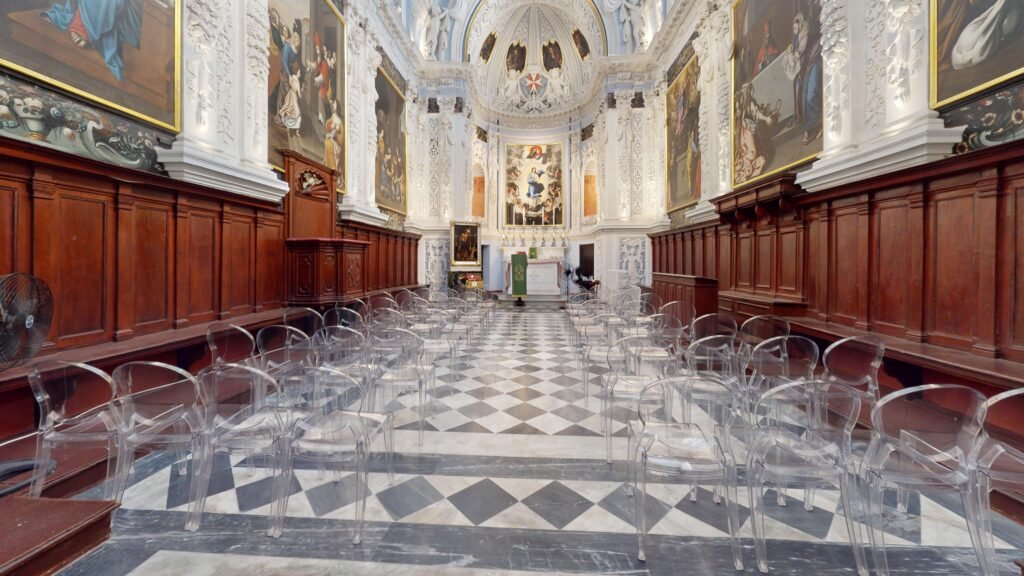
Oratory of The Immaculate ( L-Immakolata)
Historical background
Tucked alongside the Jesuits’ Church (Church of the Circumcision of Our Lord) in Merchants/Archbishop Street, the Oratory of the Immaculate was created as a dedicated space for a confraternity of Knights from all Langues attached to the Jesuit College (the Collegio Melitense). The congregation was formally instituted in 1600 and soon aligned its patronage to the Immaculate Conception “per giusti motivi”. Works on the oratory were under way in the 1640s and complete by 1651, placing it among Valletta’s earliest Baroque devotional interiors. While the original architect is undocumented, attribution is often proposed to the Italian Baroque master Francesco Buonamici, active on the Jesuit complex after the 1634 explosion that damaged the main church.
Construction and architecture
Architecturally, the oratory forms part of the Jesuit ensemble’s side entrance on Archbishop Street, where two confraternal spaces—the Immacolata and the Onorati—replace a typical chapel bay. Inside, the oratory is an intimate Baroque jewel: a concave reredos frames the titular painting, walls carry an early monumental cycle on the Life of the Virgin, and the upper registers are ringed with painted floral panels. Rich high-relief stonework—traditionally linked to the Maltese Casanova family of sculptors—binds the iconographic scheme into a unified Baroque décor.
Artistic programme
The pictorial cycle was executed around the mid-seventeenth century, with commissions engaging local masters and their workshops: the mature Filippino Dingli is credited with major parts of the scheme, while his gifted assistant Stefano Erardi contributed decisively; Alessio Erardi continued the thread into the later Baroque. Subjects include the Birth and Presentation of Our Lady, the Annunciation, the Visitation, the Presentation of the Lord, and the Assumption—together with the titular Immaculate Conception set into the curved altar surround. The ensemble is considered among the first monumental Baroque cycles in Malta, marking a step-change in local art history.
Cultural and religious significance
The oratory embodied the devotional life of a high-status lay confraternity within the scholarly and spiritual orbit of the Jesuit College—today’s University of Malta’s predecessor. It offered a disciplined setting for prayer, catechesis and charitable works tied to Marian devotion at the very heart of the new capital. The Immakolata’s art and architecture placed Maltese painters and craftsmen on a footing with continental taste, helping to seed Valletta’s reputation as a Baroque city of learning and worship.
Present-day context
After decades of accumulated grime, water ingress and outdated services, a comprehensive conservation programme began in 2021. Works included cleaning walls and ceiling (removing later grey overpaint), restoring the altar, marble flooring, balustrade and windows, introducing discreet lighting, fire-detection and public-address systems, and reinstating the historic colour scheme—down to the “Immacolata blue”. Conservation of the floral panels, choir stalls and the Life of the Virgin canvases was carried out by specialist studios, under a project delivered by AX Holdings with support from the Archdiocese and patrons. Contract values published by the Jesuits’ Church Foundation show over €1.25 million across sacristy and oratories, with line items for timber, M&E, and painting conservation. Today the Foundation manages the reopened oratories with regular liturgy, Latin Mass, guided visits, concerts and lectures.
Unique stories and archival notes
Early relations between the Jesuits and the Knights’ confraternity were complex—initial reluctance gave way to formal recognition and a flourishing Marian congregation. Archival studies also note that, for a period, the Congregation of the “Montrificatis” resided in the Immacolata oratory—one of several lay groups that animated the space across the seventeenth century. Such details illuminate the oratory as a living hub of disciplined lay piety rather than a static side-chapel.
Visual highlights to look for
- The Immaculate Conception titular painting set in a concave reredos—Mary robed in white and blue with the Franciscan girdle and crescent moon, encircled by putti bearing Marian litanies.
- Six large canvases narrating the Virgin’s life, attributed to Filippino Dingli with substantial input by Stefano Erardi (and later Alessio).
- Painted floral friezes in oil on wood around the upper walls, and finely carved Baroque stone ornament in high relief credited to the Casanova atelier.
The Immaculate Virgin: A Timeless Story of Purity and Devotion
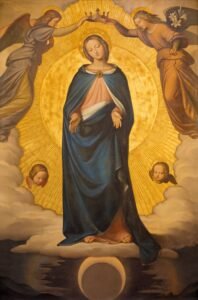
Rome – The Immaculate Conception paint by Phillip Veit (1830) in church Chiesa della Trinita dei Monti.
The title “Immaculate Virgin” refers to the Blessed Virgin Mary, revered in Christian tradition as free from original sin from the moment of her conception. This belief, known as the Immaculate Conception, was celebrated in the early centuries of the Church and gradually spread throughout Christendom. Eastern theologians such as St. Ephrem and St. Andrew of Crete spoke of Mary’s extraordinary holiness, while Western devotion grew steadily during the Middle Ages, particularly under the influence of the Franciscans.
By the fifteenth century, the feast of the Immaculate Conception was celebrated widely, and devotion to Mary under this title was deeply embedded in Catholic culture. In 1854, Pope Pius IX solemnly defined the dogma in the papal bull Ineffabilis Deus, affirming that Mary, by a singular grace of God, was preserved from the stain of original sin in view of the merits of Christ.
Although the Gospels provide only glimpses of Mary’s life, Christian tradition paints her as the humble young woman of Nazareth who accepted the angel Gabriel’s message at the Annunciation. Her “yes” to God made her the Mother of Jesus, the central figure of salvation history. She is present at key moments: the Nativity, the Presentation in the Temple, the Wedding at Cana, and at the foot of the Cross. After Christ’s Ascension, Mary continued her quiet life of prayer with the Apostles, becoming the spiritual mother of the early Church.
Her purity and unwavering faith set her apart as the model disciple. The image of Mary as the Immaculate Virgin—clothed in white and blue, standing upon a crescent moon, often surrounded by cherubs—became one of the most beloved symbols of Catholic devotion.
Malta’s devotion to the Immaculate Virgin runs deep. The feast of the Immaculate Conception, celebrated on 8 December, is a national holiday. Churches and oratories dedicated to the Immacolata are found across the islands, with Valletta, Cospicua, and other towns keeping the tradition alive through processions and solemn liturgies.
In 1942, during the Second World War, Malta was consecrated to the Immaculate Conception by Archbishop Mikiel Gonzi, entrusting the islands to her protection. The devotion was renewed again in 2016 by Archbishop Charles Scicluna. These acts demonstrate how Maltese faith in the Immaculate Virgin is woven into both the religious and national identity of the islands.
Across history, Mary under the title of the Immaculate Virgin has been associated with victories, miracles, and protection. In Spain, the Immaculate Conception was declared the patroness of the nation. In Malta, seafarers, soldiers, and families invoked her intercession for safety and peace. Her iconography appears in statues, paintings, and churches throughout the islands, reinforcing her role as both a spiritual and cultural guardian.
Artistic depictions of the Immaculate Virgin are rich in symbolism. She is often shown as a youthful woman, clothed in a flowing white tunic and blue mantle, standing on a globe with a serpent beneath her feet—symbolising triumph over sin. In Maltese churches, these images are often paired with gilded Baroque frames, marble altars, and colourful festal banners, creating a setting of splendour befitting her purity.
