
Church of St. Catherine of Italy
(Please allow a few seconds for the video to load)
Welcome to
“The Church of St. Catherine of Italy” digital experience where history and technology intertwine to bring you an immersive experience.
Explore the Church
Below, you will find a ‘Paywall’ feature, requesting you to make a donation to be able to enter the page.
Once you are in, you will find
Support a Mission, Explore a Treasure
Your entry helps Missio Malta continue their vital work in missionary lands overseas. By donating, you directly support communities in need while gaining 24-hour full access to this chapel's 3D experience and history.
Learn more about Missio's workAccess is valid for 1 Chapel for 24 hours from the time of donation
OR
360° Panorama
Zoom to full screen to view
Church of St. Catherine of Italy
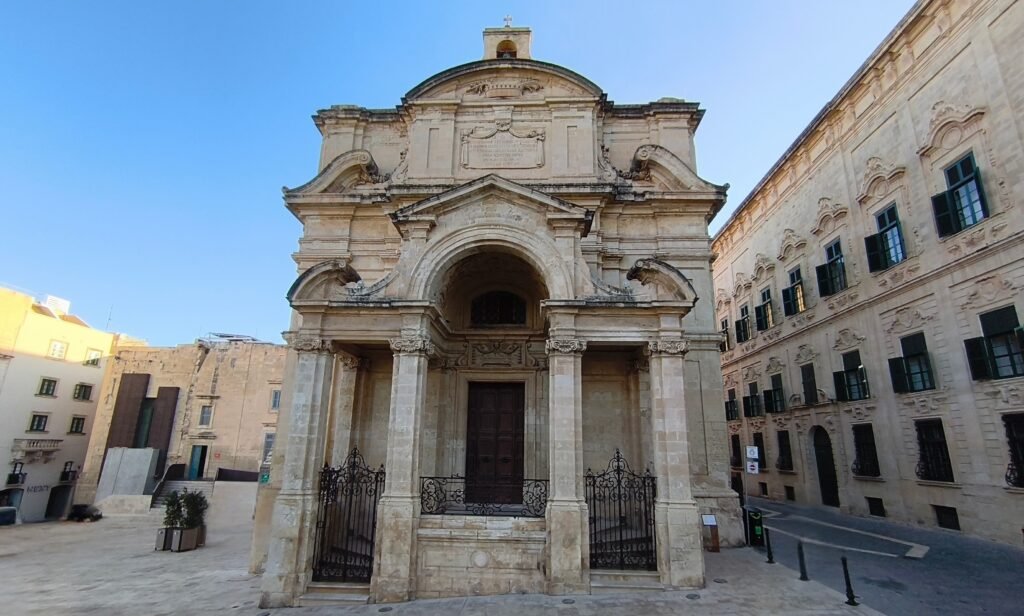
Standing beside the former Auberge d’Italia on De Valette Square, the Church of St Catherine of Italy is one of Valletta’s most characterful Knights-era churches. Built for the Italian Langue of the Order of St John, it blends a 16th-century core with a refined early-18th-century Baroque façade and a richly painted interior. Today it remains the spiritual home of Malta’s Italian community and a landmark of Maltese Baroque.
Historical Background
The church began as the Italian Langue’s private oratory, designed by the Order’s chief architect Girolamo Cassar in the late 1570s. It was commissioned under Fra’ Ludovico Folchi, who endowed the sanctuary to house relics of St Catherine of Alexandria. In 1607–1627 it was comprehensively rebuilt to plans attributed to the knight-architect Fra’ Fulvio Tassoni, creating the distinctive large octagonal nave while the earlier chapel became the presbytery. The main entrance was re-oriented in 1626, opening towards Our Lady of Victory opposite and closing the original Merchants Street doorway. In the late 1650s, the Calabrian master Mattia Preti supervised decorative works and, in 1659, gifted the superb Martyrdom of St Catherine as the high-altar painting. The church survived the 1693 earthquake and, in 1713, received its present Baroque façade and porch under Romano Carapecchia, one of the foremost architects active in Malta in the early 18th century.
Construction Details & Architectural Features
- Architects & phases: Cassar’s late-16th-century oratory; Tassoni’s octagonal enlargement (1607–1627); Carapecchia’s façade and projecting portico (1713).
- Plan & structure: A centralised octagon articulated by eight robust semi-pilasters that carry full-height arches, admitting light through thermal windows to a drum and large ribbed dome with a slender lantern. The original square chapel forms the sanctuary with its own small dome.
- Façade & porch: Carapecchia created a scenographic freestanding Baroque front and portico, enriched with carved garlands, festoons and palm-leaf trophies symbolising the martyr-saint—an early statement of mature Baroque taste in Valletta.
- Materials: Local globigerina limestone with painted and gilded interior finishes.
- Incidents & conservation: On 3 January 1999 fragments fell from the main dome’s lantern, forcing closure and launching a multi-year restoration. Exterior works began in 2000; the interior, including dome decoration and the Preti altarpiece, was restored from 2008–2011 by Italian conservators, with significant support from public and private Maltese–Italian sponsors. (Documented project costs are not publicly itemised.)
Cultural & Religious Significance
St Catherine of Italy was the church of the Italian Langue, hosting its solemn liturgies and feast-day devotions; historically, the Feast of St Catherine (25 November) drew high ceremonial participation from the Order. In modern times it functions as the parish church for Malta’s Italian community, with Mass and sacraments in Italian. For two decades it also nurtured Valletta’s cultural life through recital series that helped fund conservation—an early model for pairing heritage care with live performance. The church is listed on the National Inventory of the Cultural Property of the Maltese Islands, underlining its architectural and historical value.
Present-Day Context
Following the 2001–2011 conservation campaign, the church reopened for worship and visits. In February 2025, the Archdiocese of Malta and Heritage Malta signed an agreement to restore further and integrate St Catherine of Italy into the MUŻA visitor experience via the adjacent Auberge d’Italia, promising extended opening hours and enhanced public access. Notably, it is the only surviving Hospitaller church still annexed to its original auberge, strengthening its interpretive role within Valletta’s UNESCO-inscribed urban ensemble.
Unique Stories & Anecdotes
- Near-miss in 1999: Falling stone from the lantern during Sunday Mass triggered the closure that eventually saved the interior through comprehensive conservation.
- Community persistence: Years of concerts, advocacy and cross-border sponsorship—from local banks to Italian maritime firms—kept the restoration moving until completion in 2011.
- A door that moved: Traces of the blocked original entrance on Merchants Street remain visible in the masonry—an architectural footnote to the 1626 re-orientation towards De Valette Square.
Visual & Artistic Highlights
- Titular altarpiece: The Martyrdom of St Catherine (1659), Mattia Preti—a dramatic Baroque canvas donated by the artist to the Italian Langue on his first Maltese visit.
- Dome decoration: The great cupola is adorned with Preti’s grisaille (monochrome) narratives of the saint in painted stucco relief with gilded accents—an illusionistic tour-de-force newly legible after conservation.
- Presbytery cupola: Preti’s Glory of God the Father crowns the smaller sanctuary dome, anticipating motifs he later expanded on the vault of St John’s Co-Cathedral.
- Carapecchia’s porch: A compact stage-set of Maltese Baroque—paired columns, broken pediments and sculpted festoons—framing the church’s ceremonial threshold.
St Catherine of Italy: Malta’s Tribute to the Alexandrian Saint
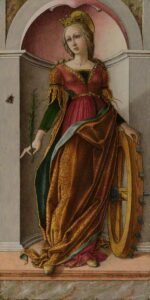 St Catherine of Alexandria is believed to have lived in the 3rd–4th century AD in Alexandria, one of the great centres of learning in the Roman Empire. Tradition holds that she was of noble birth, possibly a princess, and was exceptionally well-educated. She is said to have studied philosophy, rhetoric, and science, becoming renowned for her intelligence and eloquence.
According to legend, Catherine had a vision of the Virgin Mary and the Christ Child, which led her to embrace Christianity. At the time, Christians were heavily persecuted under Emperor Maxentius. Catherine’s conversion compelled her to confront the Emperor directly, denouncing him for his cruelty and idol worship.
One of the most famous episodes in her story is her debate with fifty pagan philosophers, summoned by Maxentius to disprove her faith. Catherine, through reason and clarity, argued so convincingly for Christianity that many of the philosophers converted on the spot — a decision that led to their execution.
Refusing the Emperor’s offers of wealth and marriage, Catherine was condemned to death. Tradition says she was to be executed on a spiked wheel, but when she touched it, the wheel shattered — hence the “Catherine Wheel” firework, named in memory of her. Finally, she was beheaded around the year 305 AD.
Her relics are believed to have been miraculously transported by angels to Mount Sinai, where a monastery — St Catherine’s Monastery — was later established and remains a major centre of Christian pilgrimage.
Catherine of Alexandria became one of the most venerated saints in Christendom. She was seen as a patron of scholars, philosophers, and unmarried women, admired for her wisdom, courage, and steadfastness in faith. During the Middle Ages, devotion to her spread widely across Europe, and she became one of the “Fourteen Holy Helpers”, saints invoked for special aid.
Why She is Known as St Catherine of Italy in Malta
In Malta, the reference to “St Catherine of Italy” is directly linked to the Italian Knights of the Order of St John. When Valletta was being built after the Great Siege of 1565, each langue (national division) of the Order constructed its own church.
- The Italian Knights dedicated theirs to St Catherine of Alexandria in 1576.
- Over time, this church, located next to the Auberge d’Italia, became known locally as the Church of St Catherine of Italy — not because the saint herself was Italian, but because she was the chosen patroness of the Italian community of knights.
- Thus, in the Maltese context, “St Catherine of Italy” refers to St Catherine of Alexandria under the title given by the Italian langue.
This naming convention sometimes causes confusion, but it reflects the strong cultural and devotional ties the Italian knights had to her.
