
Chapel of Our Lady of Damascus
(Please allow a few seconds for the video to load)
Welcome to
“The Chapel of Our Lady of Damascus” digital experience where history and technology intertwine to bring you an immersive experience.
Explore the Chapel
Below, you will find a ‘Paywall’ feature, requesting you to make a donation to be able to enter the page.
Once you are in, you will find
Support a Mission, Explore a Treasure
Your entry helps Missio Malta continue their vital work in missionary lands overseas. By donating, you directly support communities in need while gaining 24-hour full access to this chapel's 3D experience and history.
Learn more about Missio's workAccess is valid for 1 Chapel for 24 hours from the time of donation
OR
360° Panorama
Zoom to full screen to view
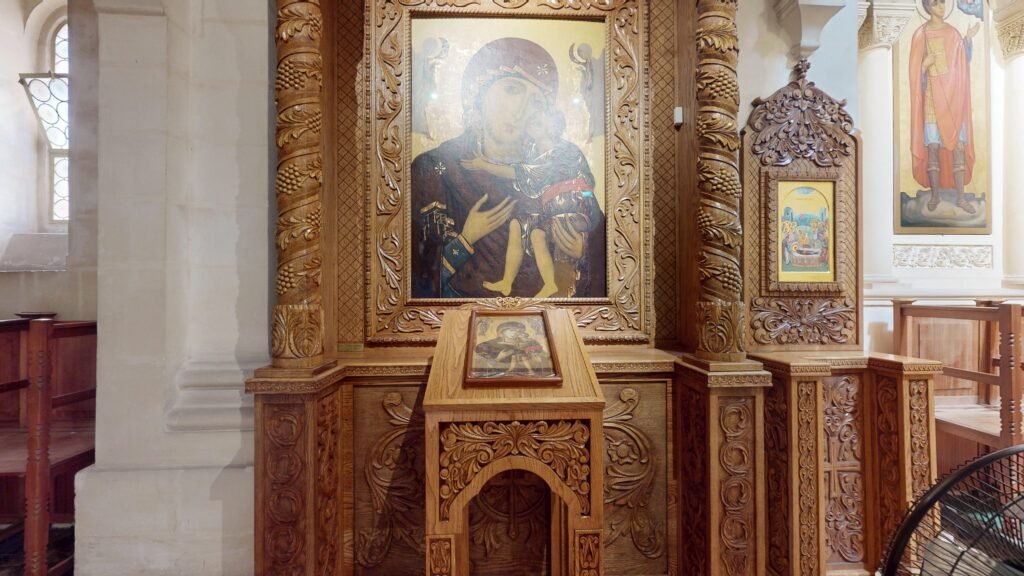
Chapel of Our Lady of Damascus
Historical background
The Greek-Catholic community that came to Malta with the Knights of St John after the fall of Rhodes (1522) brought with it a venerated icon known as Our Lady of Damascus. Giovanni Calamia (Joannes Calamias) commissioned a new church in the nascent city of Valletta specifically to house this icon; the building was completed in 1580, and in 1587 the icon was carried in solemn procession from Vittoriosa to its new home.
Construction and architecture
The original church was obliterated during an air raid on 24 March 1942. In the post-war years it was rebuilt in a compact Neo-Byzantine idiom and reconsecrated on 15 August 1951. The reconstruction was advanced under the leadership of Papàs Gjergji Schirò, with the architectural design attributed to the Maltese architect Orazio Diacono.
A notable feature of the rebuilt façade is the bronze-and-iron portal beneath the portico on Archbishop Street. Its 28 relief panels—modelled on the medieval doors of Monreale—were installed around 1950–51; archival notes record the maker settling accounts for the “portone,” with a total cost reported at approximately £2,000.
Cultural and religious significance
The church (popularly Id-Damaxxena) has long embodied the island’s bridge between Latin and Byzantine traditions. It remains the spiritual centre of Malta’s Greek-Catholic faithful and is also used by other Eastern Christian communities for worship, reflecting Valletta’s cosmopolitan religious life.
Veneration of the Damascene icon is centuries-deep. It was already famed in Rhodes and was solemnly crowned in Malta in 1931 to mark the 1,500th anniversary of the Council of Ephesus—an event that further cemented its national devotional profile.
Present-day context
Today the church is an active parish and a small but resonant landmark facing the Grand Master’s Palace. The titular icon underwent a multi-year conservation led by Atelier del Restauro and was officially unveiled in 2022, ensuring its continued public veneration. Parish life includes the regular celebration of the Divine Liturgy and community events within the Greek-Catholic rite.
Unique stories and anecdotes
Tradition recounts that, after arriving in Malta, the icon was first borne to a conventual church in great festivity—only to “disappear” overnight and be found in the Greek church, a sign (to the faithful) of the Virgin’s wish to dwell among her Greek devotees. Another cherished episode links Grand Master La Valette, who prayed before the icon during the 1565 Siege and offered his hat and sword in thanksgiving.
A distinctive Paschal rite also survives: the priest thrice strikes the bronze portal with a staff before the doors are opened and the faithful process inside singing that “Christ is Risen,” using the doorway as a powerful symbol of passing from death to life.
Visual and artistic features
Inside, the focal point is the 12th-century icon of Our Lady of Damascus (Damaskinì), accompanied by the 14th-century Eleimonitria (Our Lady of Mercy), the latter painstakingly reassembled from wartime fragments. The iconostasis carries icons of Christ, the Theotokos, St John the Baptist and St Nicholas by Russian iconographer Grigorij Maltzev; other treasures include a 16th-century Epitaphios attributed to Emanuel Lambardos, an icon of the Nativity of Mary by the Ukrainian monk-iconographer Fr Juvenalij, and a Crucified Christ by Maltese artist Anton Inglott.
Our Lady of Damascus: From the Byzantine World to Malta’s Spiritual Heart
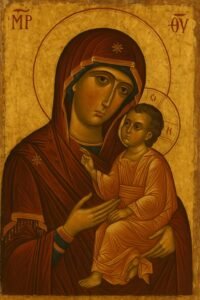
The story of Our Lady of Damascus is deeply tied to the Byzantine tradition of Marian devotion. The icon, known in Greek as Damaskiní, is believed to date back to the 12th century and originates from the great Christian city of Damascus. It belonged to a wider tradition of miraculous Marian icons that were revered across the Eastern Mediterranean. Icons of the Virgin were considered protectors of cities and peoples, and this particular image soon gained renown as a symbol of intercession and divine presence.
The icon depicts the Mother of God holding the Christ Child, with stylistic traits common to Byzantine art—solemn, luminous faces framed in gold, conveying majesty, compassion, and the eternal bond between Mother and Son. Such icons were not merely decorative but living windows into the divine, objects before which both public processions and private prayers unfolded.
The most dramatic chapter in its history began in the early 16th century. When the Ottoman Turks captured Rhodes in 1522, the Knights of St John were forced into exile. With them travelled the Greek-Catholic community, who carried their cherished icon of Our Lady of Damascus for safekeeping.
In 1530, when the Knights were granted Malta, the community settled there, and the icon found a new home. At first it was housed in Vittoriosa, where it remained a focus of devotion. But when the new city of Valletta was founded after the Great Siege of 1565, a church was constructed specifically to enshrine the icon. Completed in 1580 through the patronage of Giovanni Calamia, the building soon became the spiritual centre for the Greek-Catholics of Malta. In 1587, the icon was borne in solemn procession from Vittoriosa to Valletta, a moment that symbolised not only continuity but also the rebirth of their community on Maltese soil.
The icon carried profound cultural and religious meaning. In an island dominated by the Latin rite, Our Lady of Damascus provided a spiritual home for Christians of the Byzantine rite. It represented harmony between traditions and served as a reminder of the universality of the Virgin’s protection.
In 1931, to mark the fifteenth centenary of the Council of Ephesus, which had proclaimed Mary as Theotokos—Mother of God—the icon was solemnly crowned in Malta. This act elevated its status as one of the most important Marian images on the island.
During the Second World War, Valletta endured heavy bombardment, and the church of Our Lady of Damascus was destroyed in 1942. Remarkably, fragments of the icon of Our Lady Eleimonitria (Our Lady of Mercy), another precious work kept in the same church, were recovered and painstakingly restored. The Damaskiní icon itself survived and became an emblem of resilience for both the Greek-Catholic faithful and the wider Maltese people.
The church was rebuilt in 1951 in a Neo-Byzantine style, complete with a bronze and iron portal decorated with relief panels inspired by Monreale’s medieval doors. It remains the parish church of Malta’s Greek-Catholic community, ensuring the continuity of Byzantine worship traditions in the heart of Valletta.
For the Maltese, the icon has come to embody themes of protection, endurance, and divine favour. Grand Master Jean de Valette himself is said to have prayed before the image during the Great Siege of 1565, later offering his hat and sword in thanksgiving. Another tradition tells of the icon mysteriously relocating itself overnight to the Greek church, interpreted as a sign that the Virgin wished to dwell among her Eastern faithful.
Today, the icon remains an object of profound veneration. Restored in recent years, it draws both locals and visitors who seek a link to Malta’s Byzantine past. The annual liturgical celebrations, including the distinctive Easter rite of striking the bronze doors before entering in song, keep ancient customs alive. In this way, Our Lady of Damascus continues to serve as a bridge—between East and West, past and present, devotion and heritage.
