
Chapel of St. Francis De Paule
(Please allow a few seconds for the video to load)
Welcome to
“The Chapel of St. Francis De Paule” digital experience where history and technology intertwine to bring you an immersive experience.
Explore the Chapel
Below, you will find a ‘Paywall’ feature, requesting you to make a donation to be able to enter the page.
Once you are in, you will find
360° Panorama
Zoom to full screen to view
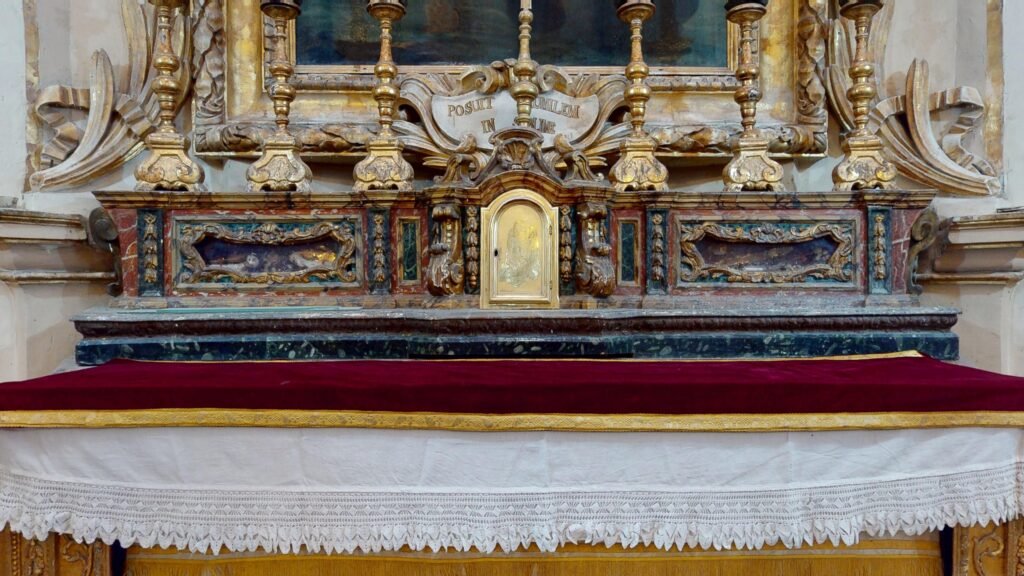
The Chapel of St Francis de Paule in Qormi: A Baroque Landmark
Standing in Pjazza San Franġisk, the Chapel of St Francis de Paule was built in 1707 during the rule of the Order of St John. It was designed by Qormi master mason and architect Indrì Psaila and financed by Franġisk Casha Cuschieri Testaferrata and his son, the Reverend Ġorġ Casha Cuschieri Testaferrata. The chapel remained under the founders’ family patronage, reflecting the private foundations through which Maltese families supported worship and neighbourhood life.
The dedication is to St Francis of Paola, founder of the Order of Minims, not St Francis of Assisi. As patron of mariners, he inspired strong Mediterranean devotion. Ship graffiti on the external masonry, including hulls, anchors, masts and the possible date 1874, provide personal evidence of prayers or thanksgiving connected with seafaring.
The chapel is a refined example of early eighteenth-century Maltese Baroque. Its centralised plan, limestone façade, curved pediments, pilasters and raised entrance give it a monumental presence within Qormi’s narrow historic streets. A cupola crowns the building and supplies its principal natural light. Its architectural language closely follows the influence of Lorenzo Gafà.
No reliable record of the original cost or individual craftsmen has been identified. Inside are a principal altar dedicated to St Francis and a lateral altar of Our Lady of Lourdes with a papier-mâché statue. The artist of the present titular painting is unknown. Other works portray the Immaculate Conception, St Aloysius Gonzaga, St Catherine, St Mark, St Andrew, St Anne, St George and St Anthony the Abbot.
Tradition holds that French troops entered the chapel during the 1798 occupation and pierced the painting of the Immaculate Conception with sword points. During the Second World War, the building served as a store for essential food supplies. The surrounding square and neighbourhood took the name San Franġisk from the chapel, demonstrating its lasting influence on Qormi’s identity.
Rising damp, ageing stone and inappropriate cement repairs eventually caused serious deterioration. A restoration costing more than €68,000 was completed and inaugurated in 2016 by Qormi Local Council, largely through the Planning Authority’s Environment Initiative Partnership Programme. Work included cleaning, biocide treatment, stone repair and replacement of damaged masonry. Although not generally used for regular worship, it remains family-administered and opens on special occasions, preserving one of central Qormi’s finest small Baroque monuments.
St Francis of Paola: The Hermit of Charity, Patron of Sailors and His Malta Connection
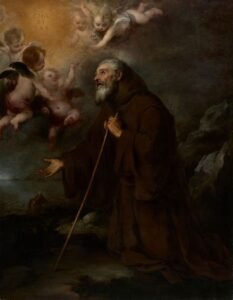 St Francis of Paola, known in Italian as Francesco di Paola and in Maltese as San Franġisk de Paola, was a fifteenth-century Calabrian hermit, religious reformer and founder of the Order of Minims.
He should not be confused with St Francis of Assisi, after whom he was named, or with the much later French priest St Vincent de Paul. The form “Francis de Paule” comes from the French rendering of his birthplace.
Francis was born at Paola in Calabria on 27 March 1416. At the time, southern Italy formed part of the Kingdom of Naples, a region marked by poverty, political rivalry, heavy taxation and the power of local nobles.
His parents had prayed for a child through the intercession of St Francis of Assisi. When their son suffered a serious eye infection that threatened his sight, they promised that he would spend a year wearing the Franciscan habit if he recovered.
A Boy Drawn to Solitude
Francis fulfilled his parents’ vow by spending a year at the Franciscan convent of San Marco Argentano. The friars reportedly wished him to remain, but he felt called to a more austere life.
After travelling with his family to Assisi, Rome, Loreto, Monte Cassino and other religious centres, Francis returned to Calabria. The splendour he encountered in Rome appears to have disturbed him. According to tradition, he contrasted the wealth of churchmen with the poverty of Christ.
Still in his teens, Francis withdrew first to family land and then to a cave near the coast. He lived there for several years in prayer, fasting and physical labour, sleeping on the ground and eating very little.
His solitude did not last. Other men began seeking his guidance and joined him. In 1435, a small community formed around the young hermit. Cells, a chapel and eventually a larger church and monastery were constructed. Local residents provided materials, while labourers and even members of the nobility reportedly helped carry stone.
The Founding of the Order of Minims
Francis wanted his followers to consider themselves lower than the Friars Minor established by St Francis of Assisi. He therefore called them the Minims, meaning the smallest or least.
Humility was not simply their name. It shaped their rule of life. The Minims observed poverty, chastity and obedience, together with an unusual fourth vow known as the Lenten life.
This required permanent abstinence from meat and animal products, including eggs and dairy foods, except in serious illness. For the Minims, Lent was not limited to the weeks before Easter. It became a lifelong practice of restraint, conversion and compassion.
The community received official papal recognition from Pope Sixtus IV in 1474. Pope Alexander VI approved Francis’s rule in 1493, while Pope Julius II confirmed the definitive form of the rule in 1506. Separate branches were created for Minim nuns and lay people belonging to the Third Order.
The word most closely associated with Francis is Charitas, meaning charity or self-giving love. It became the motto of the Minims and is commonly shown in paintings of the saint as a radiant word surrounded by flames or heavenly light.
Defender of the Poor
Francis was not an educated court theologian. He was a lay hermit who spoke plainly and was willing to confront powerful men.
He criticised abuses within the Kingdom of Naples and defended ordinary people against unjust treatment. His reputation became especially strong among those burdened by taxation, poverty and the behaviour of local rulers.
One famous story concerns money offered to him by King Ferdinand I of Naples. Francis is said to have broken a coin, causing blood to flow from it. He then declared that it represented the blood of the king’s oppressed subjects.
The incident belongs to religious tradition rather than securely documented political history, but it expresses something central to Francis’s reputation. Charity, in his understanding, required more than private kindness. It demanded justice and the courage to challenge those who profited from suffering.
Miracles, Prophecies and Popular Stories
Francis became one of the most celebrated miracle workers of late medieval Europe. Accounts associated with him include healings, multiplication of food, protection from fire, knowledge of hidden events and the raising of the dead.
During a famine in 1464, he reportedly asked a group of hungry labourers to examine their empty bags. They found them filled with warm bread, which continued to multiply as they ate.
He was also believed to have predicted the Ottoman capture of Otranto in 1480 and its later recovery by Christian forces.
Another story concerns Martinello, a lamb kept by Francis. Workmen building the monastery supposedly killed and ate the animal, throwing its remains into a furnace. Francis called the lamb by name, whereupon Martinello emerged alive from the flames.
Such accounts form part of his hagiography, the devotional tradition built around a saint’s life. They reveal how his followers understood him: as a protector of the poor, a friend of animals and a man whose authority came from prayer rather than rank.
The Cloak That Became a Boat
The best-known story about St Francis of Paola took place at the Strait of Messina.
Francis and two companions wished to cross from Calabria to Sicily, where he intended to establish a religious community. A boatman refused to take them, reportedly because they could not pay.
Francis spread his cloak upon the sea, tied part of it to his staff like a sail and crossed the strait with his companions standing or kneeling beside him. The image became one of the most recognisable scenes in southern Italian religious art.
Painters often show the elderly saint travelling over dark water beneath the glowing word Charitas. Boats and astonished sailors appear in the background, while his cloak floats like a small vessel.
The story made Francis a natural patron of boatmen and sailors. In 1943, Pope Pius XII formally proclaimed him patron of Italian seafarers. He is also invoked by mariners, naval personnel and travellers facing danger at sea.
The crossing even entered European musical culture. Franz Liszt composed St Francis of Paola Walking on the Waves, a dramatic piano work inspired by the miracle.
Called to the Court of France
By the early 1480s, Francis’s fame had reached King Louis XI of France, who was seriously ill and deeply afraid of death. The king hoped that the Calabrian hermit would cure him.
Francis initially refused to leave his community. He went only after Pope Sixtus IV ordered him to undertake the journey.
He departed Calabria in 1483 and travelled through Naples and Rome before sailing to France. Tradition records that he tended plague victims in Provence during his journey.
When Francis arrived at Plessis-les-Tours, Louis XI knelt before him and begged for healing. Francis did not promise a cure. Instead, he prepared the king to face death and encouraged him to place his trust in God.
Louis died later that year. Francis remained in France, where successive rulers valued his judgement. His presence also helped improve diplomatic relations between France, the papacy and the Kingdom of Naples.
The hermit who had once sought to disappear into a Calabrian cave now found himself advising kings, nobles, scholars and diplomats.
Death, Canonisation and Relics
Francis spent approximately twenty-five years in France. During the final months of his life, he withdrew into solitude and prepared for death.
He died at Plessis-les-Tours on 2 April 1507, which was Good Friday that year. He was ninety-one years old. His feast is therefore celebrated on 2 April.
Pope Leo X canonised him on 1 May 1519, only twelve years after his death.
In 1562, during the French Wars of Religion, Huguenots broke open his tomb. Accounts state that his body was found largely incorrupt before being burnt. Some remains were recovered and preserved as relics in Minim churches, including those in Calabria and Sicily.
Recognising St Francis of Paola in Art
St Francis of Paola is generally depicted as an elderly, bearded hermit wearing a dark hooded habit. He may carry a wooden staff, rosary or book.
His most important attribute is the radiant word Charitas. He may also be shown standing upon his cloak at sea, accompanied by fellow friars and watched by sailors.
Other paintings portray him healing the sick, levitating in prayer, advising Louis XI or protecting labourers from accidents.
Artists who treated his life include Peter Paul Rubens, Bartolomé Esteban Murillo, Francisco de Zurbarán, Jusepe de Ribera, Luca Giordano and Giovanni Battista Tiepolo. Their works helped spread his image far beyond Calabria.
St Francis of Paola and Malta
The Maltese connection is particularly appropriate because Malta’s history, economy and religious imagination have always been closely tied to the sea.
A saint believed to have crossed the Strait of Messina upon his cloak would have possessed immediate meaning for Maltese sailors, fishermen, merchants and naval families. The cultural links between Malta, Sicily and southern Italy also allowed Calabrian and Sicilian devotions to reach the islands easily.
The principal Maltese monument dedicated to him is the Chapel of St Francis de Paule in central Qormi. Built in 1707 and designed by the Qormi architect Indrì Psaila, it occupies a prominent position in what became known as Pjazza San Franġisk.
Its dedication may have held special significance for people seeking protection during sea journeys. Ship graffiti survive on the chapel’s external stonework. Among them are several hulls, anchors and a three-masted vessel with flags. The number 1874, carved beneath one ship, may record the year of a voyage, thanksgiving or personal act of devotion.
Ship carvings on Maltese churches are often interpreted as prayers for protection, records of safe return or maritime ex-votos. Their presence on a chapel dedicated to the patron of seafarers forms a particularly fitting link between the saint’s legend and Maltese experience.
Devotion to St Francis of Paola was not limited to Qormi. Altars or works dedicated to him have also been recorded in the Gozo Cathedral, the parish churches of Senglea, Kirkop, Tarxien, Għargħur and Nadur, and the Church of St Lucy in Valletta.
Was Paola in Malta Named After the Saint?
Despite the similarity, the Maltese town of Paola was not named after St Francis of Paola.
The locality was founded in the seventeenth century by Grand Master Antoine de Paule of the Order of St John. It was originally known as Casal Nuovo and later Casal Paola, taking its name from the Grand Master’s family.
The connection is therefore one of language rather than dedication. The saint came from Paola in Calabria, while the Maltese locality commemorates Antoine de Paule. The two names are frequently confused.
Why His Story Still Matters
Francis of Paola lived between two worlds. He belonged to the medieval tradition of caves, fasting and miracle stories, yet he also operated within the political courts of Renaissance Europe.
He never sought royal influence, but rulers sought him. He founded an order by calling his followers not the great or the powerful, but the least. His emblem was not a crown, sword or coat of arms, but a single word: charity.
For Malta, his role as protector of seafarers gives his story a special resonance. The carved ships on the walls of his Qormi chapel turn a distant Calabrian legend into something local and personal. They recall generations who faced the Mediterranean with little more than skill, prayer and hope of returning home safely.
