
The Old Church of St. Sebastian
(Please allow a few seconds for the video to load)
Welcome to
“The Old Church of St. Sebastian” digital experience where history and technology intertwine to bring you an immersive experience.
Explore the Chapel
Below, you will find a ‘Paywall’ feature, requesting you to make a donation to be able to enter the page.
Once you are in, you will find
Support a Mission, Explore a Treasure
Your entry helps Missio Malta continue their vital work in missionary lands overseas. By donating, you directly support communities in need while gaining 24-hour full access to this chapel's 3D experience and history.
Learn more about Missio's workAccess is valid for 1 Chapel for 24 hours from the time of donation
OR
360° Panorama
Zoom to full screen to view
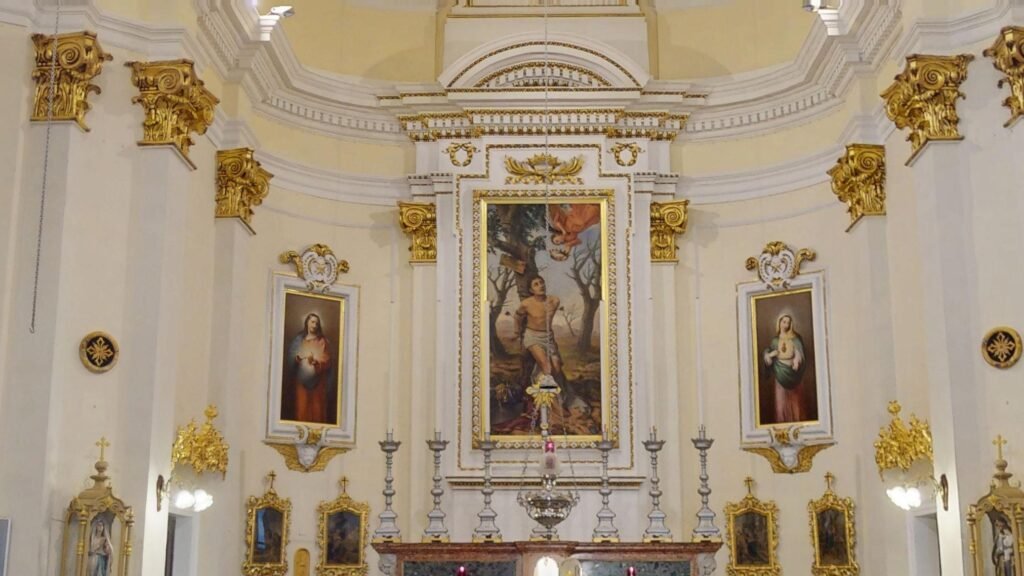
The Old Parish Church of St Sebastian
Known locally as Il-Knisja ż-Żgħira, the Old Church of St Sebastian grew from Qormi’s devotion to the plague saint. During the epidemic of 1813 to 1814, 723 Qormi residents died from a population of about 4,500. In thanksgiving, a stone statue of St Sebastian was erected near the town’s edge in 1815.
As the district expanded, residents lived increasingly far from St George’s parish church. In 1873 master builder Michelangelo Azzopardi petitioned Archbishop Gaetano Pace Forno for a church to serve them. Permission was granted that July, and Azzopardi provided the site through property he acquired and exchanged.
Building began in 1880 under Azzopardi and Kola Pulis. Architectural historian Michael Ellul identified Ġużeppi Borg, known as “tal-Lira”, as the probable architect. Lack of funds slowed the project and work apparently stopped around 1884 to 1885. Money was raised through collections and even by breeding livestock for sale. No reliable total construction cost is known.
Completed and blessed in 1890, the church has a tall Baroque-influenced façade adapted to a restricted site. Composite, Corinthian and Ionic elements, twin angled bell towers and carved symbols of St Sebastian’s martyrdom enrich the exterior. A planned dome was never completed, leaving only its octagonal drum.
The church became sacramental in 1893, a vice-parish on 19 June 1918 and the first parish church of St Sebastian Parish from January 1936. It remained the community’s principal church until services transferred to the crypt of the new parish church in 1952.
A well-known local story recounts that a shopkeeper refused to surrender part of the proposed site. His premises were reportedly dismantled overnight by workers, who afterwards compensated him.
The three altars are dedicated to St Sebastian, Christ the Redeemer and Our Lady of the Rosary. The Martyrdom of St Sebastian and Christ the Redeemer are by Lazzaro Pisani. The Rosary painting was reportedly brought from Naples. Later works include Gerolamo Dingli’s Risen Christ of 1981 and Alfred Camilleri Cauchi’s 1985 Jesus Falling beneath the Cross.
Restored and reopened in 2011, the church was formally consecrated by Archbishop Charles Scicluna on 25 October 2019. It remains under St Sebastian Parish and is used for Eucharistic adoration.
St Sebastian: The Roman Soldier Who Defied an Emperor and Became a Protector Against Plague
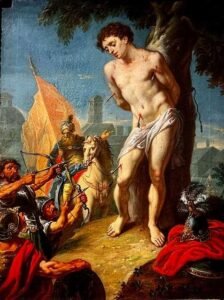 Few Christian saints possess an image as instantly recognisable as St Sebastian, the young man bound to a tree or column, his body pierced by arrows. Yet the famous arrows tell only half his story. According to Christian tradition, Sebastian survived that execution, deliberately returned to confront the Roman emperor responsible and was condemned to death a second time.
His extraordinary story eventually made him one of Christianity’s great protectors against plague, creating a powerful connection with Malta and, above all, Qormi.
What Do We Really Know About St Sebastian?
Sebastian lived during the later third century, when Christianity was still periodically persecuted within the Roman Empire. Precise details of his birth and early life cannot be established with certainty.
The historical foundation for his existence is nevertheless ancient. He appears in the Roman Depositio Martyrum, preserved within the fourth-century Chronography of 354, while St Ambrose of Milan referred to Sebastian later in the same century.
The much fuller account of his life comes from the Passio Sancti Sebastiani, written several generations after his death. It is therefore better understood as an early Christian martyr tradition rather than a modern biography.
According to this tradition, Sebastian was born around AD 250, with family connections to Narbonne in Roman Gaul and Milan, where he was raised.
A Christian Inside the Imperial Army
Sebastian travelled to Rome and entered military service. Tradition portrays him not merely as a soldier but as an officer of considerable standing, eventually serving among the imperial guards of Emperors Diocletian and Maximian.
His Christianity was initially concealed.
This placed Sebastian in an extraordinary position. While apparently serving the Roman state, he was secretly assisting imprisoned Christians, encouraging those facing execution and helping the families of martyrs.
Stories surrounding him tell of conversions brought about through his courage. Among the best known are the brothers Marcus and Marcellianus, who were supposedly preparing to abandon Christianity when Sebastian persuaded them to remain faithful.
Other traditions associate him with miraculous healing and the conversion of Roman officials, soldiers, prisoners and their families.
Eventually, his secret could no longer remain hidden.
The Execution That Failed
When Sebastian’s Christianity became known, Diocletian reportedly regarded it as a personal betrayal.
The emperor ordered him tied to a stake or tree and used as a target by archers.
This is the scene that would make Sebastian one of the most frequently painted saints in European art. Artists including Botticelli, Perugino, Mantegna, El Greco, Rubens and countless others returned to the subject.
But according to the ancient tradition, the arrows did not kill him.
The soldiers left Sebastian believing him dead. A Christian woman named Irene, later honoured as St Irene of Rome, came to recover his body for burial and discovered that he was still alive.
She took him away and nursed him back to health.
Sebastian now had an opportunity to escape Rome.
He chose not to.
Sebastian Confronts the Emperor
Instead of disappearing, Sebastian returned to confront Diocletian publicly.
He condemned the persecution of Christians and challenged the emperor over the cruelty being inflicted upon them.
This time there would be no chance of survival.
Sebastian was beaten to death, traditionally with clubs, and his body was thrown into Rome’s Cloaca Maxima, the great sewer system of the ancient city.
According to tradition, a Christian woman named Lucina was shown the location of his body in a vision. She recovered it and arranged for Sebastian to be buried beside the Via Appia.
The site became associated with the Catacombs of St Sebastian, and the Basilica of St Sebastian Outside the Walls eventually developed there as an important centre of pilgrimage.
His feast is celebrated on 20 January.
Why Did St Sebastian Become the Saint of Plague Victims?
The connection between Sebastian and disease produced one of the most fascinating developments in Christian symbolism.
In the ancient world and the Bible, arrows could symbolise sudden divine punishment or pestilence. Sebastian had been struck by a shower of arrows and survived.
Medieval Christians therefore began to see him as a heavenly defender capable of protecting communities from the invisible “arrows” of epidemic disease.
His reputation strengthened considerably after his intercession was credited with helping to end an epidemic in Rome in AD 680.
During later outbreaks of plague, images of Sebastian appeared throughout Europe. People prayed before them, carried his image and commissioned churches, paintings and statues in thanksgiving for survival.
He became particularly associated with plague victims, soldiers and archers, while later traditions also adopted him as a patron of athletes because of the endurance represented by his martyrdom.
St Sebastian and Malta
Malta’s connection with Sebastian is particularly meaningful because the islands repeatedly suffered epidemics.
Devotion to him in Qormi can be traced back at least to the sixteenth century. A chapel dedicated to St Sebastian was recorded during the 1575 Apostolic Visit associated with Pietro Dusina, demonstrating that Qormi’s devotion existed centuries before its present parish.
Then came catastrophe.
The plague of 1813 struck Qormi with exceptional severity, killing hundreds of inhabitants. Sebastian’s traditional role as protector against pestilence suddenly acquired immediate meaning.
After the epidemic subsided, a stone statue of St Sebastian was erected on the outskirts of Qormi in 1815, publicly commemorating deliverance from the disease.
The location eventually became the centre of an expanding neighbourhood.
Between 1880 and 1890, the church now affectionately known as Il-Knisja ż-Żgħira, the Old Church of St Sebastian, was built nearby. It eventually became the first parish church of the new St Sebastian Parish.
The parish was formally established in 1935, beginning its independent pastoral life in January 1936.
The Sebastian Malta Knows Today
Qormi later acquired another striking representation of its patron.
Maltese sculptor Ġorġ Borg, created the processional statue of St Sebastian between 1936 and 1938. Instead of portraying Sebastian almost naked and pierced by arrows, as European painters so often did, Borg presented him magnificently dressed as a Roman soldier.
The statue first appeared in procession through Qormi on 9 July 1944, its public debut having been delayed during the Second World War.
That interpretation is particularly appropriate. It remembers Sebastian not simply as a victim, but as the soldier who knowingly placed himself between persecutors and their victims.
Nearly seventeen centuries after his death, the arrows remain his symbol. In Qormi, however, they carry another memory too: of disease, survival, thanksgiving and a community that turned an ancient Roman martyr into one of the defining figures of its own identity.
