
MDH Chapel of The Holy Cross
(Please allow a few seconds for the video to load)
Welcome to
“The Chapel of The Holy Cross” digital experience where history and technology intertwine to bring you an immersive experience.
Explore the Chapel
Below, you will find a ‘Paywall’ feature, requesting you to make a donation to be able to enter the page.
Once you are in, you will find
Support a Mission, Explore a Treasure
Your entry helps Missio Malta continue their vital work in missionary lands overseas. By donating, you directly support communities in need while gaining 24-hour full access to this chapel's 3D experience and history.
Learn more about Missio's workAccess is valid for 1 Chapel for 24 hours from the time of donation
OR
360° Panorama
Zoom to full screen to view
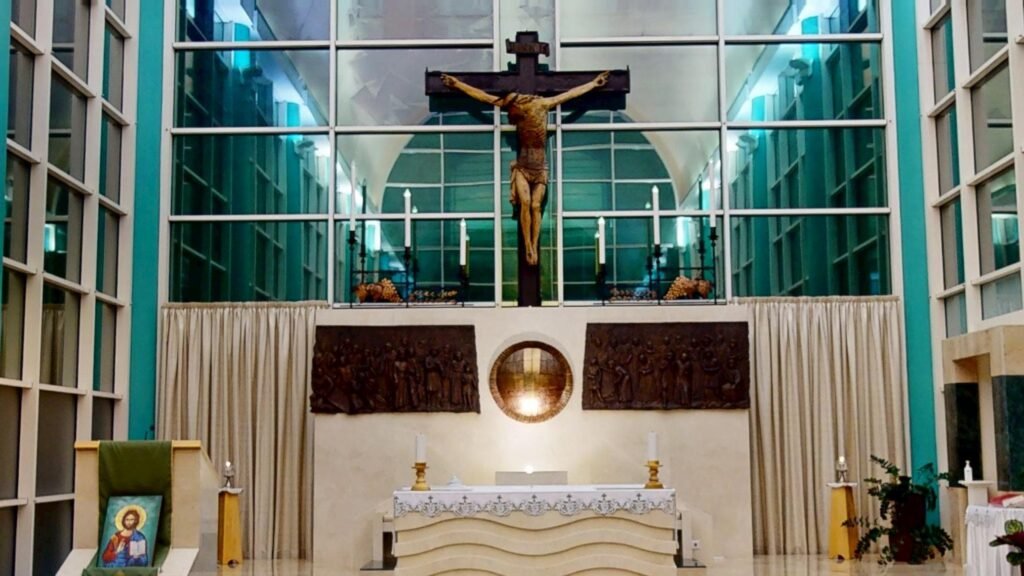
Mater Dei Hospital Chapel, Msida: Faith, Healing and Malta’s Historic Crucifix
History and Sacred Dedication
The Roman Catholic chapel inside Mater Dei Hospital was created as part of Malta’s national acute hospital, inaugurated in June 2007. Commissioned by the Maltese Government through the Foundation for Medical Services, it succeeded the chapel at St Luke’s Hospital.
Official Church listings call it simply the Chapel of Mater Dei Hospital and publish no separate titular dedication. Its sacred identity is centred on the Holy Cross, expressed through its historic crucifix and the observance of the Exaltation of the Holy Cross. Mater Dei, meaning Mother of God, also gives the hospital a strong Marian identity.
Construction and Architecture
The chapel formed part of the hospital design-and-build project undertaken by Skanska Malta Joint Venture. Architectural sources attribute its design to Professor Richard England. No separate chapel cost, artisan list or chapel-specific construction incident appears in public records. The wider hospital project experienced repeated redesigns, contractual disputes and major cost escalation.
Unlike Malta’s ornate Baroque churches, the chapel is modern, restrained and luminous. Extensive glazing, a high vaulted form, pale surfaces and simple timber seating create calm within the hospital. The visual axis leads towards the altar, tabernacle and monumental crucifix.
Art, Heritage and a Remarkable Journey
The chapel’s greatest treasure is a life-sized polychrome wooden crucifix believed to date from the sixteenth century. Formerly associated with the Knights of St John’s Sacra Infermeria, it later moved to the Floriana Central Hospital and St Luke’s Hospital. In October 2007, it was ceremonially transferred to Mater Dei and installed above the tabernacle.
This four-century journey between Malta’s principal hospitals links modern medicine with the Hospitaller tradition of caring for the sick. No established folklore is reliably recorded, although the crucifix has long been regarded as a source of comfort and devotion. Heritage Malta has monitored it for conservation purposes.
Present-Day Significance
Located on the ground floor behind the main entrance, the chapel hosts Masses, permanent Eucharistic adoration, remembrance services and pastoral care. Chaplaincy responsibility passed from the Capuchin Friars to the Archdiocese of Malta in 2023, with spiritual assistance available around the clock. It was designated a Jubilee church for the Holy Year 2025.
The Exaltation of the Holy Cross: From Jerusalem to Malta’s Mater Dei Hospital
The Story Behind the Feast of the Holy Cross
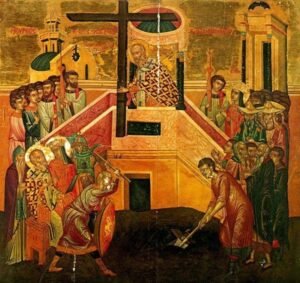 The Exaltation of the Holy Cross, celebrated on 14 September, is one of Christianity’s oldest and most significant feasts. It does not commemorate a saint or a single event. Instead, it brings together the Crucifixion of Christ, the transformation of the Cross into a sign of salvation, the traditional discovery of the True Cross in Jerusalem and its recovery after it was taken during a Persian invasion.
At Mater Dei Hospital in Msida, the feast has particular meaning. The historic crucifix overlooking the hospital chapel once belonged to the Sacra Infermeria, the great hospital operated by the Knights of St John. Its presence links the modern hospital with more than four centuries of healthcare, prayer and service to the sick in Malta.
From an Instrument of Death to the Sign of Christianity
Crucifixion was one of the Roman world’s most degrading punishments. It was generally reserved for slaves, rebels and people considered enemies of the state. Victims were exposed publicly, turning their death into a warning to others.
The first Christians therefore proclaimed something extraordinary. They taught that Jesus had transformed an instrument of humiliation into the means of humanity’s redemption.
The Cross gradually became the principal symbol of Christianity. Early believers made the sign of the Cross over themselves, although representations of the crucified Christ remained uncommon during Christianity’s earliest centuries. Public devotion increased after the conversion of the Emperor Constantine and the legalisation of Christianity within the Roman Empire.
The word “exaltation” means lifting up or raising high. It recalls the physical elevation of the Cross for the faithful to see, but it also expresses the belief that Christ’s apparent defeat on Calvary became his victory over sin and death.
Constantine, Helena and the Holy Land
The story of the feast begins during the reign of Constantine the Great. Following his victory at the Battle of the Milvian Bridge in 312, Constantine increasingly favoured Christianity. In 313, the Edict of Milan granted Christians freedom to worship openly.
Constantine ordered the recovery of the places associated with Christ’s Crucifixion and Resurrection in Jerusalem. A Roman sanctuary dedicated to a pagan deity had been constructed over the area traditionally identified as Calvary and Christ’s tomb. It was demolished, the ground was cleared and a monumental Christian complex was built.
Constantine’s mother, Helena, travelled to the Holy Land during this period. Christian tradition places her at the centre of the discovery of the True Cross, probably around 326.
According to the familiar account, excavators found three crosses near the site of Calvary. Since the Gospels state that Jesus was crucified between two criminals, the problem was determining which cross had carried Christ.
Bishop Macarius of Jerusalem is said to have brought the crosses to a gravely ill woman. She remained unchanged after touching the first two but recovered when she came into contact with the third. Another version states that the Cross restored a dead man to life. The miraculous sign identified it as the Cross of Christ.
Helena reportedly left part of the sacred wood in Jerusalem and sent another part to Constantine. Traditions also claimed that the nails of the Crucifixion were discovered and incorporated into imperial objects.
History, Tradition and the Missing Detail
The discovery story must be approached with some historical caution.
Eusebius of Caesarea, a contemporary of Constantine, described the clearance of the site and the construction of the church in Jerusalem. However, he did not mention Helena discovering the Cross. The complete story of the three crosses and the miraculous healing appeared in written accounts later in the fourth century.
This does not mean that devotion to a relic of the Cross was a late medieval invention. Around the middle of the fourth century, Cyril of Jerusalem wrote that pieces of the sacred wood had already travelled throughout the Christian world.
The pilgrim Egeria, who visited Jerusalem during the 380s, described the public veneration of the Cross on Good Friday. The bishop held the relic while deacons guarded it closely as worshippers approached to bow and kiss it.
Their caution had a remarkable explanation. According to Egeria, someone had once pretended to kiss the relic and had bitten off a piece to carry away. The incident shows how highly fragments associated with the Crucifixion were already valued.
The Birth of the Feast
Constantine’s great church complex in Jerusalem included the Martyrium, built near Calvary, and the Anastasis, constructed around Christ’s tomb. The buildings were dedicated in September 335.
The Cross was presented for public veneration on the day following the dedication. This ceremony, traditionally associated with 14 September, became the foundation of the Feast of the Exaltation of the Holy Cross.
Clergy raised the relic so that the assembled faithful could see it. The people responded with prayers and acclamations. From Jerusalem, the celebration spread throughout the Christian world.
In the West, two separate observances eventually developed. The Finding of the Holy Cross was kept on 3 May, while the Exaltation was celebrated on 14 September. The May observance was removed from the general Roman calendar in 1960, although it survives in certain local traditions, including Birkirkara in Malta.
The Cross Taken by the Persians
A second dramatic chapter began in 614, when the forces of the Persian Sasanian Empire captured Jerusalem. The city suffered considerable destruction, the Church of the Holy Sepulchre was damaged and the relic of the Cross was carried away.
Its loss shocked the Christian world. The Cross was not merely a devotional object. It had become a visible symbol of Jerusalem, the Christian Roman Empire and Christ’s victory.
The Byzantine emperor Heraclius eventually defeated the Persians after a long and exhausting war. The relic was recovered and restored to Christian possession, traditionally in 628 or 629, before being returned ceremonially to Jerusalem around 629 or 630.
Later legend added a lesson about humility. Heraclius attempted to carry the Cross into Jerusalem while dressed in imperial robes and mounted as a victorious emperor. He found himself unable to proceed. Only after removing his crown, exchanging his splendid clothing for simple garments and walking barefoot could he carry the Cross into the city.
The story appeared centuries after Heraclius and cannot be treated as contemporary history. Its message, however, became inseparable from the feast. No earthly ruler could approach the Cross through pride or military triumph. Christ’s victory was achieved through sacrifice and humility.
The Meaning of the Exaltation of the Holy Cross
The feast does not celebrate suffering for its own sake. Nor does it glorify the cruelty of crucifixion. It celebrates the Christian belief that divine love can transform suffering, defeat and death.
The Gospel read during the feast recalls Christ’s words to Nicodemus. Jesus compares himself to the bronze serpent raised by Moses in the desert. Those who looked upon the serpent were healed, just as those who look towards the crucified Christ in faith receive spiritual life.
The second reading, from the Letter to the Philippians, describes Christ humbling himself and accepting death on a Cross. Because of this obedience, God exalted him and gave him the name above every other name.
Red vestments are worn in the Roman Catholic liturgy, representing Christ’s Passion and the blood of martyrdom. The feast is followed on 15 September by the memorial of Our Lady of Sorrows, creating a close liturgical relationship between the sacrifice of Christ and the grief of his mother.
In the Eastern Orthodox Churches, the Exaltation is one of the great feasts of the year and is observed with fasting. A cross is placed upon flowers and solemnly raised during the service. The priest turns towards the different directions of the church while prayers are offered for the world and its people.
The True Cross and Its Relics
Fragments believed to belong to the True Cross were distributed widely throughout the Christian world. They were placed in churches, monasteries, royal chapels and elaborate reliquaries.
The authenticity of individual fragments is usually impossible to establish scientifically. Some pieces presented as relics may be ancient, while others entered collections many centuries after the time of Christ.
For believers, their importance has never depended solely upon archaeological proof. Relics serve as physical points of contact with the events of the Passion and with generations of Christians who prayed before them.
The Cross also shaped medieval art and literature. Cycles depicting Helena, the discovery at Jerusalem, the Persian capture and Heraclius’s return appeared in churches throughout Europe. Among the most famous are the paintings of the Legend of the True Cross by Piero della Francesca in Arezzo.
Saint Helena and the Holy Cross in Birkirkara
Malta’s clearest connection with Helena and the discovery of the Cross is found in Birkirkara.
The Basilica of St Helen is dedicated to the emperor’s mother, who is traditionally shown carrying or standing beside the Cross. The church’s titular painting, completed by Francesco Zahra in 1763, presents Helena with the sacred symbol that defines her place in Christian tradition.
Birkirkara retains the feast of the Finding of the Holy Cross on or around 3 May. Known locally as Santu Kruċ, the celebration preserves the older Western observance that disappeared from the general Roman calendar.
The feast is distinct from Birkirkara’s major summer celebration of St Helen. Together, however, the two observances show how closely the saint and the Cross are joined in Maltese religious culture.
The basilica itself became a major centre of Maltese devotion and sacred art. Its paintings, processional statue and architectural decoration repeatedly present Helena not simply as an empress, but as the woman who sought the places associated with Christ’s Passion.
The Knights of St John and the Cross in Malta
The Knights of St John made the Cross one of the most recognisable symbols in Malta. The Order’s white eight-pointed cross was different from a representation of the True Cross, but both expressed service, sacrifice and Christian identity.
The Knights arrived in Malta in 1530 and established a religious state whose original purpose remained the care of the sick. Their great hospital in Valletta, the Sacra Infermeria, combined medical care with prayer and pastoral attention.
A life-sized wooden crucifix, believed to date from the sixteenth century, was placed in the Sacra Infermeria. Patients, hospital workers, chaplains and members of the Order prayed before it.
The crucifix followed Malta’s principal hospital services as they moved from one institution to another. It passed from the Sacra Infermeria to the hospital in Floriana, later entered St Luke’s Hospital and was finally transferred to Mater Dei Hospital in 2007.
Few objects express the continuity of Maltese healthcare so clearly. Hospitals changed, governments changed and medical science advanced, but the crucifix remained with the sick.
Holy Cross Devotion in the Three Cities and Valletta
Confraternities dedicated to the Holy Cross or the Holy Crucifix appeared in several Maltese communities. These brotherhoods organised prayer, charitable assistance, burials, processions and devotional ceremonies.
Vittoriosa possesses a historic Oratory of the Holy Cross connected with devotion to the Ta’ Kandja crucifix. The confraternity developed within a city already closely associated with the Knights of St John and Malta’s early Hospitaller period.
Senglea also had a confraternity and oratory linked with devotion to the Crucifix. In Valletta, the revered Ta’ Ġieżu crucifix became the focus of penitential and national pilgrimages, particularly during periods of war, illness and public anxiety.
These traditions demonstrate that devotion to the Cross in Malta was never confined to one feast day. It became part of Lent, Holy Week, personal prayer, public processions and appeals for protection during national emergencies.
The Holy Cross at Mater Dei Hospital
The Exaltation of the Holy Cross has a particularly appropriate place within Mater Dei Hospital. In September 2023, Archbishop Charles Scicluna celebrated the feast in the hospital chapel and reflected upon the connection between the raised bronze serpent, the crucified Christ and healing.
The historic crucifix dominates the chapel sanctuary. For patients and relatives, it can express anguish, fear and uncertainty. For doctors, nurses and carers, it recalls service offered in difficult circumstances. For Christians, it points beyond suffering towards compassion, redemption and hope.
Its setting inside a hospital also restores something of the feast’s original human meaning. The Cross is not presented as a distant imperial trophy. It is placed among people experiencing vulnerability, pain, recovery, grief and the limits of medicine.
The crucifix that once watched over patients in the Knights’ hospital now fulfils the same purpose at Malta’s national hospital. It connects the Sacra Infermeria with Mater Dei, the Hospitallers with modern healthcare, and the ancient Feast of the Cross with the daily experiences of patients and their families.
A Sign Raised Above Suffering
The Exaltation of the Holy Cross carries several stories within one celebration: an execution outside Jerusalem, an emperor who changed the religious direction of the Roman world, a mother searching for sacred places, a relic guarded from an overenthusiastic pilgrim, an invasion, an imperial recovery and centuries of devotion.
Its message remains the same. The Cross does not deny suffering or offer an easy explanation for it. Instead, it places love, sacrifice and hope at the centre of suffering.
That meaning is especially powerful at Mater Dei Hospital. Beneath its historic crucifix, the ancient words of the feast acquire a deeply personal significance: what appears to be defeat need not have the final word.
