
Chapel of St. Anthony of Padua
(Please allow 3 seconds for the video to load)
Welcome to
“The Chapel of St. Anthony of Padua” digital experience where history and technology intertwine to bring you an immersive experience.
Explore the Chapel
Below, you will find a ‘Paywall’ feature, requesting you to make a donation to be able to enter the page.
Once you are in, you will find
360° Panorama
Zoom to full screen to view
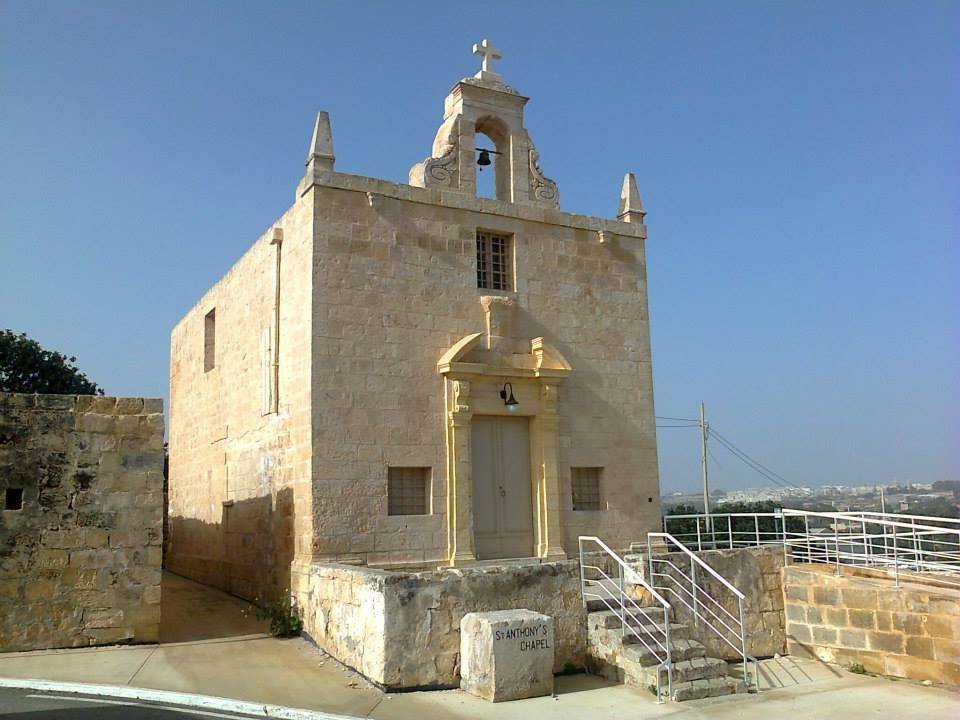
Notarial records from the same year suggest that priest Andrea Polladino was the most likely person to have constructed this chapel in the year 1675. Before being taken over by the Parish of Wied il-Għajn, it was under the care of the Parish of Santa Katerina in Żejtun.
The façade of this chapel is generally unadorned, with the exception of a few ornaments that can be seen via the doorway. It is built upon two fundamental pillars, and it also has two conspicuous points on the side. A divided segmental pediment can be found over the door. In the middle of this pediment is a small stone that has not been sculpted in any way. There was a good chance that it was a family crest. There is a window on either side of the doorway, as well as one above the door, for a total of three windows in this area. The bell tower has an exquisite design and can accommodate just one bell. At either of the extreme ends of the facade are a pair of little pyramids. The steps leading up to the chapel’s tiny parapet provide access to the street below.
The inside of the chapel is in the shape of a rectangle, and it features a high ceiling that is supported by five ribs that extend upward from a cornice. Between the fourth and fifth ribs, there are two windows that let light into the altar area. This is encircled by a wonderful baroque perspective that was made with great ability by a sculptor who worked during the historical period but remained unidentified. They have most certainly paid for this perspective, as there are two columns, each with two arms of the Brancato family.
The titular painting is a stunning piece of art created by a painter whose identity is unknown. Father Marius Zerafa O.P., who is the Director of the Art Museum, has finished renovating it lately. The Madonna and Child, along with Saint Anthony and Saint Filippo Neri, are depicted in the painting.
Saint Anthony of Padua
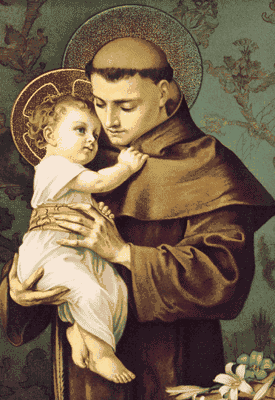 Saint Anthony of Padua was born in the year 1195 at Lisbon, the capital of Portugal, where his father was a captain in the royal army. Already at the age of fifteen years the youth had entered the Congregation of Canons Regular of St Augustine, and was devoting himself with great earnestness to study and to the practice of piety in the monastery at Coimbra, when a significant event, which occurred in the year 1220, changed his entire career.
The relics of St Bernard and Companions, the first martyrs of the Franciscan Order, were being brought from Africa to Coimbra. At the sight of them, Saint Anthony of Padua was seized with an intense desire to suffer martyrdom as a Franciscan missionary in Africa. In response to his repeated and humble petitions, the permission of his superiors to transfer to the Franciscan Order was reluctantly given. At his departure, one of the canons said to him ironically, “Go, then, perhaps you will become a saint in the new order.” Saint Anthony of Padua replied, “Brother, when you hear that I have become a saint, you will praise God for it.”
In the quiet little Franciscan convent at Coimbra Saint Anthony of Padua received a friendly reception. In the very same year his earnest wish to be sent to the missions in Africa seemed to be fulfilled, but God had actually decreed otherwise. Anthony had scarcely set foot on African soil when he was seized with a grievous illness. Even after recovering from it, he was so weak that, resigning himself to the will of God, he boarded a boat back to Portugal. But a storm drove the ship to the coast of Sicily, and Anthony went to Assisi, where the general chapter of the order was held in May, 1221.
As Saint Anthony of Padua still looked weak and sickly, and gave no evidence of his scholarship, no one paid any attention to the stranger until Father Gratian, provincial of Romagna, had compassion on him and sent him to the quiet little convent near Forli. There Anthony remained nine months occupied in the lowliest duties of the kitchen and convent, and practiced to his heart’s content interior as well as exterior mortification.
The hidden jewel was soon to appear in all its brilliance. Saint Anthony was sent to Forli with some other brethren, to attend the ceremony of ordination. At the convent there the superior wanted somebody to give an address for the occasion. Everybody excused himself, saying that he was not prepared, until Anthony was finally asked to give it. When he, too, excused himself most humbly, his superior ordered him by virtue of the vow of obedience to give the sermon. Anthony began to speak in a very reserved manner; but soon holy animation seized him, and he spoke with such eloquence, learning, and unction that everybody was fairly amazed.
When St Francis was informed of the event, he gave Saint Anthony of Padua the mission to preach all over Italy. At the request of the brethren, Anthony was later commissioned also to teach theology, “but in such a manner, St Francis distinctly wrote, “that the spirit of prayer be not extinguished either in yourself or in the other brethren.”
Saint Anthony of Padua himself placed greater value on the salvation of souls than on learning. For that reason he never ceased to exercise his office as preacher along with the work of teaching. The concourse of hearers was sometimes so great that no church was large enough to accommodate the audiences and he had to preach in the open air. He wrought veritable miracles of conversion. Deadly enemies were reconciled with each other. Thieves and apologized, usurers made restitution of their ill gotten goods. He was so energetic in defending the truths of the Catholic Faith that many heretics re-entered the pale of the Church, so that Pope Gregory IX called him “the ark of the covenant.”
