
Chapel of Our Lady of The Rosary
(Please allow a few seconds for the video to load)
Welcome to
“The Chapel of Our Lady of The Rosary” digital experience where history and technology intertwine to bring you an immersive experience.
Explore the Chapel
Below, you will find a ‘Paywall’ feature, requesting you to make a donation to be able to enter the page.
Once you are in, you will find
360° Panorama
Zoom to full screen to view
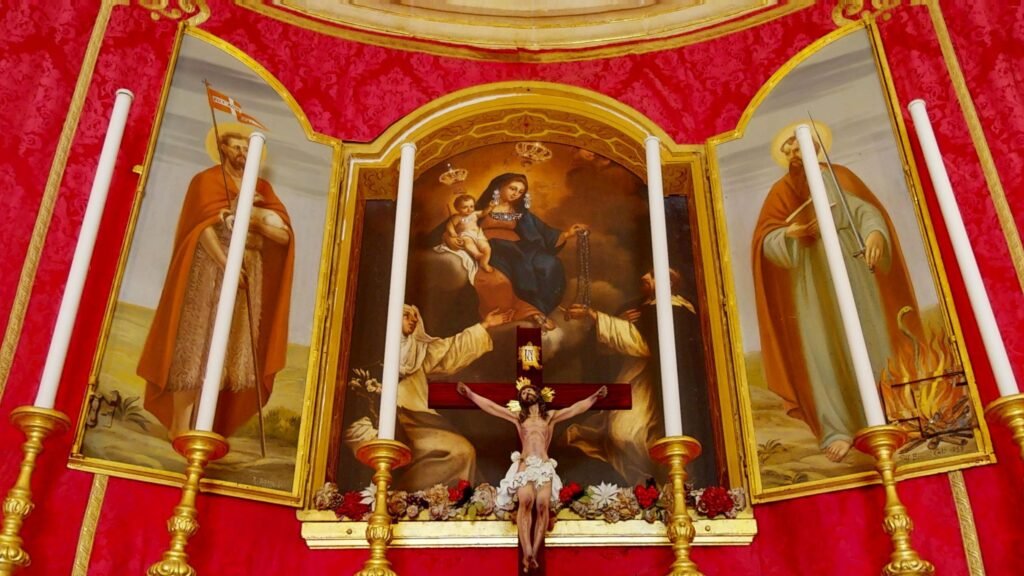
Chapel of Our Lady of the Rosary, Marsaskala
The Chapel of Our Lady of the Rosary stands beside Villa Apap Bologna on elevated ground overlooking central Marsaskala. It was built in 1856 by the noble Lwiġi, or Luigi, dei Conti Manduca, shortly after the villa was founded around 1855. When Marsaskala was still a small coastal settlement, the chapel probably served the Manduca household, estate workers and nearby residents.
In 1997, the family donated the villa, chapel and furnishings to the Archdiocese of Malta. The property was intended for pastoral purposes, including possible accommodation for retired priests, and later came under parish responsibility.
Built in Maltese limestone, the compact Baroque chapel has a formal façade centred upon a doorway crowned by a triangular pediment. Corner pilasters, a projecting cornice, decorative finials and a small bell-cote surmounted by a cross give the building dignity and vertical emphasis.
The intimate interior accommodates approximately 20 to 30 worshippers. Its balanced arrangement leads towards the altar and Marian titular image, while the curved upper structure forms a strong devotional focus. No reliable published record identifies the architect, builders, artists, construction cost or difficulties encountered during the works.
Known locally as Tal-Barunissa, the chapel preserves the memory of the noble families connected with Villa Apap Bologna. It also illustrates Marsaskala’s development from a sparsely settled coastal area into a permanent community with an organised religious life.
The chapel has hosted Rosary devotions, Masses for benefactors, youth liturgies, Holy Week prayer and services for Marsaskala’s English-speaking Catholic community. October observances associated with Our Lady of the Rosary have included prayer, Mass and local processional traditions.
The chapel remains active within the Archdiocese and appears on current Mass listings. It is included in Malta’s National Inventory of cultural property as monument 01727. No recent chapel-specific restoration campaign is clearly documented, although volunteers and the parish have carried out maintenance and restoration within the wider villa complex.
No established legend is securely documented. Its most distinctive story is one of continuity: a private aristocratic chapel became a welcoming place of worship for residents and visitors of different nationalities. The restrained façade, bell-cote, finials, intimate altar and Marian imagery give the chapel its enduring character.
Our Lady of the Rosary: The Prayer that Shaped History and Malta’s Enduring Devotion
Who Is Our Lady of the Rosary?
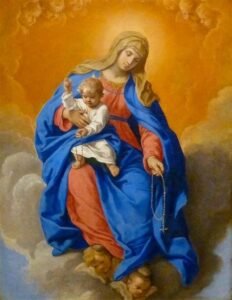 Our Lady of the Rosary is a title given to the Blessed Virgin Mary in recognition of her place within the Rosary, one of the best-known devotional prayers in Christianity. It does not refer to a separate period in Mary’s life or to one particular apparition. Instead, it presents Mary as the mother who leads the faithful through the life, death and resurrection of Jesus Christ.
In traditional images, Mary is usually shown holding the Christ Child while either she or Jesus presents a rosary to St Dominic. Other representations include St Catherine of Siena, angels, roses, crowns and medallions illustrating the mysteries of the Rosary.
The title is also known as Our Lady of the Most Holy Rosary and was formerly associated with Our Lady of Victory. Her liturgical feast is celebrated on 7 October.
Mary’s Life Through the Mysteries of the Rosary
The Rosary is sometimes mistaken for a prayer concerned entirely with Mary. Its principal subject is actually the life of Jesus, contemplated in the company of his mother.
The Joyful Mysteries recall the Annunciation, Mary’s visit to Elizabeth, the birth of Jesus, his presentation in the Temple and his discovery among the teachers in Jerusalem. They reveal Mary as a young Jewish woman of Nazareth whose acceptance of God’s call changed the course of Christian history.
The Luminous Mysteries follow the public ministry of Jesus through his baptism, the wedding at Cana, his proclamation of the Kingdom of God, the Transfiguration and the institution of the Eucharist. Mary appears directly at Cana, where she notices that the wedding household has run out of wine and tells the servants to follow her son’s instructions.
The Sorrowful Mysteries recount the agony in the garden, the scourging, the crowning with thorns, the carrying of the Cross and the Crucifixion. They lead the worshipper towards Calvary, where Mary remained near Jesus during his final suffering.
The Glorious Mysteries celebrate the Resurrection, Ascension, descent of the Holy Spirit, Assumption of Mary and her coronation as Queen of Heaven. Together, the mysteries form a journey from Nazareth and Bethlehem to Jerusalem, Calvary and the hope of eternal life.
How the Rosary Developed
The word rosary comes from the Latin rosarium, meaning a rose garden or garland of roses. Medieval Christians frequently described prayers offered to Mary as spiritual roses.
Before books became widely available, monks and clergy prayed the 150 Psalms. Many ordinary people could neither read nor afford manuscripts, so they developed simpler forms of repeated prayer. Groups of 150 Our Fathers or Hail Marys became known as the Psalter of Mary.
Beads were already used for counting prayers before the familiar Rosary appeared. The prayers, beads and meditations gradually came together during the Middle Ages.
Dominican tradition holds that the Virgin Mary entrusted the Rosary to St Dominic during his preaching in the early thirteenth century. The account became widely known through the work of the fifteenth-century Dominican preacher Alan de la Roche. While the precise development took place over several centuries, the Dominican Order unquestionably became the Rosary’s most influential promoter.
Alan encouraged the creation of Rosary confraternities whose members prayed for one another and took part in organised devotions. These associations helped carry the Rosary from monasteries into parish churches, family homes and public processions.
In 1569, the Dominican Pope St Pius V formally described the traditional structure of the Rosary. It consisted of 150 Hail Marys, arranged in fifteen decades and accompanied by meditation on events from the lives of Jesus and Mary.
The present form generally includes twenty mysteries. Pope St John Paul II proposed the five Luminous Mysteries in 2002, adding a fuller meditation on the public ministry of Christ.
The Rosary and the Battle of Lepanto
The event most closely associated with Our Lady of the Rosary took place on 7 October 1571.
The Ottoman Empire had become the leading naval power in the eastern Mediterranean. Its expansion placed enormous pressure upon Christian territories and maritime routes. Pope St Pius V brought together the Holy League, which included Spain, Venice, Genoa, the Papal States and the Order of St John based in Malta.
As the opposing fleets approached one another near Lepanto, in present-day Greece, the Pope called upon Rosary confraternities and the Christian population to pray. Processions were held in Rome while the naval battle was fought.
The Holy League won a major victory. Pope Pius V attributed the outcome to the intercession of the Virgin Mary and established a commemoration under the title Our Lady of Victory. Pope Gregory XIII later authorised a feast of the Holy Rosary in churches possessing a Rosary altar.
After another Christian victory over Ottoman forces at Petrovaradin in 1716, Pope Clement XI extended the feast to the universal Church. It eventually became fixed on 7 October and is now known as the Memorial of Our Lady of the Rosary.
Lepanto did not destroy Ottoman naval strength permanently, but it ended the belief that the Ottoman fleet was unbeatable. It also transformed the Rosary into a powerful symbol of shared prayer during danger.
Malta at Lepanto
Malta’s connection with the Battle of Lepanto was direct and costly.
Only six years had passed since the Great Siege of 1565. The Order of St John and the Maltese population remained conscious of the possibility of another Ottoman attack. When the Holy League was formed, the Order sent its naval squadron under Admiral Fra Pietro Giustiniani.
Three galleys of the Order took part, carrying approximately 600 soldiers, most of whom were Maltese. The Order’s flagship was surrounded, rammed and boarded during the fighting. Most of its defenders were killed, although other Christian vessels eventually recovered the ship.
For the Knights and the Maltese sailors who survived, the victory had both military and religious meaning. Their return strengthened devotion to the Rosary throughout Malta, while the Dominicans encouraged the formation of confraternities in towns and villages.
The Dominicans and the Rosary in Malta
The Dominican friars arrived in Malta from Sicily around 1450 and established themselves in Rabat. Their presence gave organised Marian devotion an important new centre.
A chapel dedicated to Our Lady of the Rosary existed in Vittoriosa by 1547, and a confraternity appears to have been active there before the Battle of Lepanto. Donations recorded in 1572 confirm that the association was already established.
Rabat also had an early chapel dedicated to Our Lady of the Psalter, another name connected with the Rosary. The feast was celebrated there with considerable ceremony, and a Rosary confraternity was founded shortly after the one in Vittoriosa.
In Valletta, the Knights of St John requested the establishment of a Rosary confraternity in the Dominican church of Our Lady of Porto Salvo. The Dominican community accepted the request on 24 October 1576 with the approval of Grand Master Jean de la Cassière.
Unlike the confraternities of Vittoriosa and Rabat, which admitted members from different levels of society, the Valletta confraternity was initially reserved for knights, members of the clergy, noblemen and graduates.
It also carried out an unusual work of mercy. Members accompanied and assisted prisoners condemned to death. For this reason, it became associated with the name tal-Miżerikordja, meaning of Mercy.
Processions, Earthquakes and Public Prayer
Rosary confraternities became part of Malta’s religious and social organisation. Their members maintained chapels and altars, commissioned paintings and statues, arranged funerals, supported charitable work and organised public processions.
The principal procession took place on the first Sunday of October. Some Dominican communities also held smaller indoor processions on the first Sunday of every month.
The statues and paintings of Our Lady of the Rosary were brought out during periods of public fear. In March 1658, after a series of earthquakes alarmed the population, the Bishop of Malta ordered a general procession in Valletta. The statue of Our Lady of the Rosary and an image of St Dominic were carried through the city as prayers were offered for protection.
These events show that the Rosary was not regarded merely as a private devotion. It became a public language through which Maltese communities responded to war, earthquakes, disease, bereavement and uncertainty.
The Spread of Rosary Confraternities Across Malta and Gozo
By the early seventeenth century, confraternities dedicated to Our Lady of the Rosary had appeared in many Maltese and Gozitan parishes.
Records indicate foundations at the Citadel in Gozo, Siġġiewi, Żebbuġ, Birmiftuħ, Żurrieq, Birkirkara, Attard, Mellieħa, Naxxar, Kirkop, Mqabba, Tarxien, Senglea, Żejtun, Safi, Qormi, Lija, Cospicua, Mosta and Għargħur.
The Rosary altar often occupied an important position within the parish church. Its confraternity possessed banners, lanterns, silverware, vestments and processional equipment. Members wore distinctive robes and participated in religious ceremonies as an organised body.
Through these confraternities, the Rosary became rooted in everyday Maltese Catholic life. It was prayed in churches, in village streets, beside the beds of the sick and around the bodies of the deceased.
Our Lady of the Rosary in Maltese Art
The devotion produced several significant works of Maltese religious art.
In 1615, the Dominican community in Valletta commissioned a wooden statue showing Mary with the Christ Child, both holding Rosary beads. It was made by Giuseppe Mazzeo de Rizzini and is believed to have been one of the earliest processional statues of its type in Malta.
A particularly important statue was created in 1661 by the Maltese sculptor Melchiorre Gafà for the Dominican church in Rabat. Gafà later worked in Rome and became one of Malta’s most distinguished Baroque sculptors. His statue of Our Lady of the Rosary became influential, serving as a model for later Marian statues across the islands.
In 1864, Vincenzo Bonnici produced another statue for the Rosary confraternity in Vittoriosa. It received first prize at an exhibition held in the same year.
Typical Maltese Rosary paintings show Mary seated or standing upon clouds, holding Jesus while presenting beads to St Dominic and St Catherine of Siena. Angels may carry crowns or roses, while small medallions represent the fifteen traditional mysteries.
The rosary itself is not simply an accessory. It identifies the subject of the artwork and visually connects the Virgin, Christ, the Dominican saints and the worshipper.
The Chapel of Our Lady of the Rosary in Marsaskala
Marsaskala’s chapel beside Villa Apap Bologna belongs to this much older Maltese tradition.
The villa was founded by the noble Lwiġi Manduca around 1855, when central Marsaskala remained only lightly developed. The adjoining Baroque-style chapel was dedicated to Our Lady of the Rosary and became known locally as Tal-Barunissa.
Its dedication would have been immediately familiar to nineteenth-century Maltese Catholics. By then, Rosary confraternities, October devotions and family recitation of the Rosary had been established in Malta for generations.
The chapel gave the villa’s residents, estate workers and nearby inhabitants a place for Mass and Marian devotion. Although originally connected with a noble residence, it later passed into the care of the Church and became available to the wider community.
Its small scale reflects the domestic character of the Rosary itself. The prayer requires no pilgrimage, elaborate ceremony or large congregation. It can be recited in a chapel, around a family table, beside a hospital bed or while walking alone.
The Meaning of the Rosary Beads
A rosary usually begins with a crucifix, followed by one large bead, three smaller beads and another large bead. The circular section contains five groups of ten smaller beads, each separated by a larger bead.
The crucifix places the death and resurrection of Christ at the centre of the prayer. The larger beads mark the Our Father, while the smaller beads are used for the Hail Mary. Each decade concludes with the Glory Be and may be followed by an additional prayer.
The circular arrangement suggests continuity and repeated contemplation. Passing the beads through the fingers gives the prayer a physical rhythm, helping concentration while the mind reflects upon each mystery.
Repetition is not intended to empty the words of meaning. It creates a steady background against which the Gospel scenes can be considered slowly.
The Rosary in the Home
For centuries, Maltese families recited the Rosary together in the evening. The practice often took place before a religious picture, statue or small domestic altar.
The prayers were offered for relatives at sea, migrants overseas, expectant mothers, the sick and the dead. During wartime, the Rosary provided comfort in shelters and damaged homes. At funerals, it gave mourners a familiar structure when ordinary conversation seemed inadequate.
Radio and television later brought communal Rosary prayers into homes, particularly for elderly people and those unable to attend church. The form has also moved onto digital platforms, but its basic rhythm has remained unchanged.
Our Lady of the Rosary as a Symbol of Peace
Although the feast became linked with a naval battle, modern Catholic teaching places strong emphasis upon the Rosary as a prayer for peace rather than military triumph.
The mysteries confront violence directly through the arrest, torture and Crucifixion of Jesus, but they end with resurrection and reconciliation. The prayer invites the believer to consider suffering without allowing suffering to have the final word.
Pope Leo XIII strongly promoted the Rosary during the nineteenth century and encouraged its recitation throughout October. Later popes recommended it during world wars, political crises and threats to family life.
The apparitions associated with Lourdes and Fatima also strengthened Rosary devotion. At Fatima in 1917, the three shepherd children reported repeated requests for the daily Rosary and prayers for peace.
Why the Devotion Has Endured
The Rosary has survived because it is both structured and adaptable. It may be spoken, whispered or sung. It can be prayed alone or in a congregation. A complete Rosary may take considerable time, but a single decade can be offered in a few minutes.
Its mysteries give the worshipper a sequence of recognisable human experiences: expectation, birth, family anxiety, celebration, betrayal, pain, death, hope and joy.
For Maltese communities, these themes became inseparable from village chapels, parish confraternities, processions and family memories. The beads passed from one generation to another were often treated as personal heirlooms.
Our Lady of the Rosary therefore represents more than a devotional title. She embodies a way of remembering the Gospel through repeated prayer. From medieval monasteries to the galleys at Lepanto, from Dominican churches to the small chapel at Villa Apap Bologna, the devotion has travelled across centuries while remaining centred upon Mary’s invitation to look towards Christ.
