
Chapel of St. Cajetan
(Please allow a few seconds for the video to load)
Welcome to
“The Chapel of Saint Cajetan” digital experience where history and technology intertwine to bring you something that is immersive and entertaining.
Explore the Chapel
Below, you will find a ‘Paywall’ feature, requesting you to make a donation to be able to enter the page.
Once you are in, you will find
Support a Mission, Explore a Treasure
Your entry helps Missio Malta continue their vital work in missionary lands overseas. By donating, you directly support communities in need while gaining 24-hour full access to this chapel's 3D experience and history.
Learn more about Missio's workAccess is valid for 1 Chapel for 24 hours from the time of donation
OR
360° Panorama
Zoom to full screen to view
Chapel of St. Cajetan
The Chapel of St. Cajetan of Thiene is a modest yet historically significant structure that reflects the rich tapestry of Maltese religious and cultural heritage.
Historical Background
Constructed in 1657 by George Mamo, the chapel stands in close proximity to the Mamo Tower, a defensive structure built by the same family just fifty meters away. The Mamo family’s initiative in building both the tower and the chapel underscores their influence and commitment to the spiritual and defensive needs of the area during that period.
Construction Details
While specific details regarding the construction costs and the artisans involved remain scarce, the chapel’s architecture is indicative of the period’s style. Designed to accommodate approximately fifty individuals, it features a simple yet functional layout typical of rural chapels of that era. The choice of materials and construction techniques would have been influenced by local availability and the Mamo family’s resources.
Cultural and Religious Significance
Serving as a spiritual haven for the local community, the Chapel of St. Cajetan has been integral to the religious life of Marsascala’s residents. Its establishment provided a dedicated space for worship and community gatherings, reinforcing the town’s religious traditions. Over the centuries, the chapel has witnessed numerous local events, from regular masses to special ceremonies, embedding itself in the cultural fabric of the area.
Present-Day Context
As of recent reports, the chapel remains a cherished landmark within the Marsascala community. In mid-2024, the chapel sustained damage when a vehicle collided with its structure, leading to concerns about its preservation. This incident highlighted the chapel’s vulnerability and underscored the need for ongoing maintenance and restoration efforts to ensure its longevity for future generations.
Unique Stories or Legends
While specific legends or folklore directly associated with the Chapel of St. Cajetan are not well-documented, its proximity to the Mamo Tower suggests a shared history. The Mamo family’s dual contributions to the area’s defence and spiritual life may have given rise to local tales emphasising their role in safeguarding both the physical and moral well-being of the community.
Visual and Artistic Features
The chapel’s exterior is characterised by its unadorned façade, reflecting the simplicity typical of rural ecclesiastical architecture in 17th-century Malta. Inside, while detailed descriptions of its interior artworks are limited, the chapel likely features traditional religious iconography and design elements consistent with its era. The intimate space, designed for a small congregation, would have fostered a close-knit worship experience, with any artistic features serving both devotional and aesthetic purposes.
In summary, the Chapel of St. Cajetan of Thiene stands as a testament to Marsascala’s rich historical and cultural heritage. Its enduring presence offers insight into the town’s past and continues to serve as a focal point for community identity and spiritual life.
Saint Cajetan of Thiene: A Legacy of Faith, Reform, and Devotion in Malta and Beyond
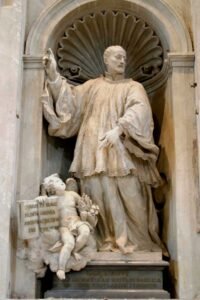 Saint Cajetan of Thiene, born Gaetano dei Conti di Thiene in October 1480 in Vicenza, Italy, was a prominent Catholic priest and reformer during the Counter-Reformation. Despite his noble lineage, he dedicated his life to spiritual service and aiding the less fortunate. After earning degrees in civil and canon law at 24, he served as a diplomat for Pope Julius II, contributing to the reconciliation with the Republic of Venice. Ordained as a priest in 1516, Cajetan founded hospitals in Vicenza and Venice, focusing on both physical and spiritual healing. He joined the Oratory of Divine Love in Rome, aiming to combine monastic spirituality with active ministry.
In 1524, alongside Giovanni Pietro Carafa (later Pope Paul IV), he co-founded the Theatine Order, emphasising clerical reform and poverty. During the 1527 sack of Rome, Cajetan was tortured by soldiers but later escaped to Venice. He established a bank to assist the poor, which evolved into the Banco di Napoli. Cajetan died on August 7, 1547, in Naples, where his remains are enshrined in the church of San Paolo Maggiore. Canonised in 1671, he is the patron saint of Argentina, the unemployed, and job seekers.
In Malta, Saint Cajetan holds a special place of veneration. The Parish Church of St. Cajetan in Ħamrun, designed by Giorgio Costantino Schinas, was constructed between 1869 and 1875. This church, with its distinctive architectural style, serves as a focal point for the local community’s spiritual activities. In August 2023, Rev. Fr. Salvador Rodea Gonzalez visited Ħamrun during the St. Cajetan celebrations, highlighting the enduring significance of the saint in Maltese religious culture.
An interesting anecdote involves the titular statue of St. Cajetan in Ħamrun. This polychromed statue, crafted between 1885 and 1888 by Karlu Darmanin, depicts the saint in a posture of devotion. The statue’s pedestal was created by Giovanni Farrugia, and the detachable platform by Antonio Sciortino. This statue remains a central element in the annual feast celebrations, symbolising the deep-rooted devotion of the Maltese people to St. Cajetan.
These connections underscore the lasting impact of Saint Cajetan’s legacy, both in his native Italy and in Malta, where his life and works continue to inspire the faithful.
