
Chapel of The Annunciation
(Please allow a few seconds for the video to load)
Welcome to
“The Chapel of The Annunciation” digital experience where history and technology intertwine to bring you an immersive experience.
Explore the Chapel
Below, you will find a ‘Paywall’ feature, requesting you to make a donation to be able to enter the page.
Once you are in, you will find
Support a Mission, Explore a Treasure
Your entry helps Missio Malta continue their vital work in missionary lands overseas. By donating, you directly support communities in need while gaining 24-hour full access to this chapel's 3D experience and history.
Learn more about Missio's workAccess is valid for 1 Chapel for 24 hours from the time of donation
OR
360° Panorama
Zoom to full screen to view
Chapel of The Annunciation
A small chapel with a long memory
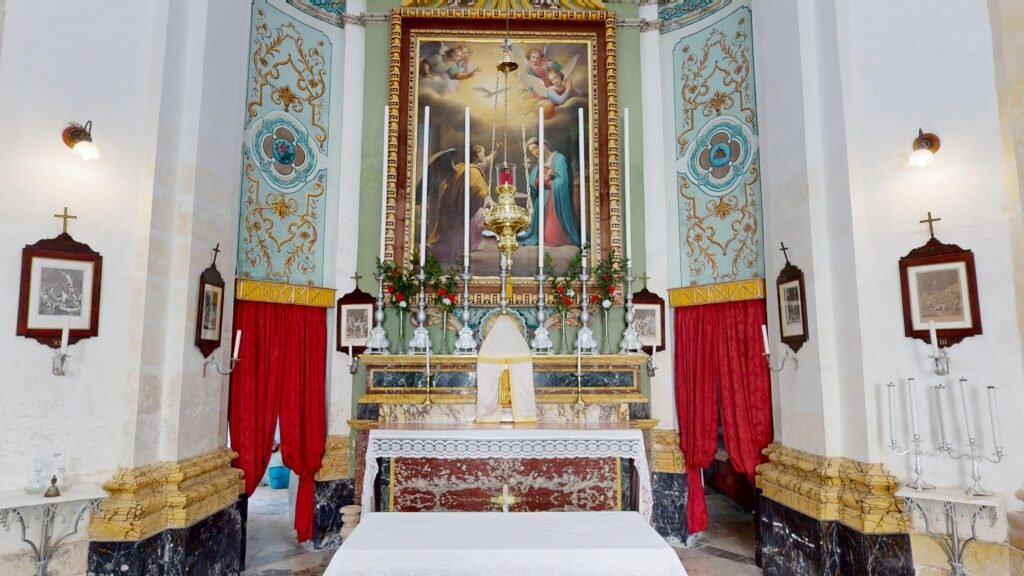
The Annunciation Chapel in Gudja is an eighteenth-century Marian chapel built on a site that had already hosted earlier places of worship, making the present building the third known chapel there. The existing structure was commissioned in 1754 by Dun Gwann Barbara, who financed the work himself with further support from local residents. It was blessed on 6 April 1755 by the parish priest Fr John Paul Balzan. Its purpose was clear from the start: to provide a local setting for prayer, Mass and devotion to the Annunciation of the Virgin, a theme with deep roots in Maltese religious life.
Construction and architectural character
Although no surviving source appears to record the total construction cost, the chapel’s funding model is unusually clear: a principal benefactor led the project, while the village community helped carry it through. The present building was planned on a Greek-cross layout and originally included a cylindrical dome, giving it a more ambitious spatial form than many small rural chapels. Its façade is restrained but elegant, with Doric pilasters framing the front, a simple portal, a triangular pediment and a prominent Baroque window above the door. That upper window, together with the square belfry, was added later by Anglu Dalli to designs by Carlo Farrugia. The stone statues of Saint Anne and Saint Joachim on the façade, and the figure of the Archangel Gabriel on the belfry, are attributed to Antonio Zammit.
Inside, the main altar is made entirely of marble and was funded by one of the chapel’s benefactors. The titular painting of the Annunciation, showing the Virgin Mary and the Archangel Gabriel, is set within a stone frame and is the work of the Italian artist Giovanni Gagliardi.
Religious and cultural importance
The chapel reflects a wider Maltese habit of shaping village identity around small sacred buildings. Earlier visitation records show that the older chapel on the site already served as an important local centre, with regular Masses, annual feast observances and food distributed to the poor on the titular feast. That charitable detail is especially revealing: the chapel was not simply devotional, but part of Gudja’s social and religious fabric.
Present-day status
By the early twenty-first century, the exterior stonework had suffered badly after more than 250 years of exposure. Restoration of the external fabric was completed in 2006 under the supervision of the government restoration authorities, with financial assistance from Bank of Valletta. The chapel remains part of Gudja’s heritage landscape and stands as one of the village’s notable historic religious buildings.
Enduring significance
What gives the Annunciation Chapel its lasting appeal is the way it combines modest scale with layered history. It is a chapel of continuities: one site, several buildings, generations of patrons, and an unbroken Marian theme that still speaks to Gudja’s memory and identity.
The Annunciation of Our Lady: The Moment That Changed History
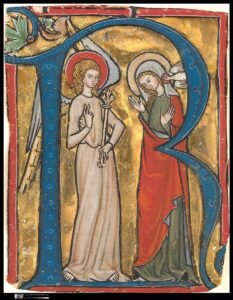
The Annunciation of Our Lady marks the moment when the Archangel Gabriel announced to the Virgin Mary that she would conceive and bear Jesus Christ. This event is recorded in the Gospel of Gospel of Luke and has been celebrated by Christians since the earliest centuries. It is observed on 25 March, exactly nine months before Christmas, symbolising the beginning of the Incarnation.
From the early Church onwards, this moment was understood not simply as a message, but as a turning point in human history. Mary’s acceptance—her quiet and resolute “yes”—became a central theme in Christian theology, representing obedience, humility, and trust in divine will.
Life and times of the Virgin Mary
Virgin Mary is traditionally believed to have lived in Nazareth, a small town in Galilee. She was likely a young Jewish woman betrothed to Joseph when Gabriel appeared to her. The setting was simple, yet the significance immense.
The narrative describes Gabriel greeting her as “full of grace”, announcing that she would conceive by the Holy Spirit. Despite her uncertainty, Mary accepted the message, marking the beginning of Christ’s earthly life. This moment, known as the “Fiat” (“let it be done”), has echoed through centuries of Christian devotion.
Mary’s life thereafter unfolds quietly within the Gospels—at the Nativity, during Christ’s ministry, and ultimately at the Crucifixion. Yet it is the Annunciation that defines her role as the bridge between the divine and human story.
Cultural and artistic influence
The Annunciation has inspired some of the most celebrated works in Western art. From the serene compositions of Fra Angelico to the refined interpretation by Leonardo da Vinci, artists have sought to capture the stillness and gravity of the moment.
Typical imagery shows Mary seated or kneeling, often reading, as Gabriel enters with a gesture of greeting. Symbols such as lilies represent purity, while light descending from above signifies divine presence. In Baroque art, the scene becomes more dramatic, filled with movement, light, and emotion.
The Annunciation in Malta
In Malta, devotion to the Annunciation has long been embedded in both parish life and local traditions. Several chapels, including those in Gudja and elsewhere, are dedicated to this mystery. The feast of 25 March is observed with liturgical celebrations, reflecting the island’s strong Marian identity.
Historically, the Annunciation also resonated with Malta’s rural communities, where chapels served not only as places of worship but as centres of charity and social life. The theme of acceptance and humility found in the Annunciation continues to shape Maltese religious expression.
Symbolism and enduring meaning
The Annunciation is rich in symbolism. The lily represents purity, the enclosed garden signifies Mary’s untouched nature, and the dove symbolises the Holy Spirit. Light, often depicted as a ray descending from heaven, marks the moment of divine intervention.
More than a historical or religious event, the Annunciation speaks to a universal idea—the power of a single decision. Mary’s acceptance transformed the course of history, making the scene one of quiet yet profound significance.
