
Chapel of Our Lady of Patronage
(Please allow a few seconds for the video to load)
Welcome to
“The Chapel of Our Lady of Patronage” digital experience where history and technology intertwine to bring you an immersive experience.
Explore the Chapel
Below, you will find a ‘Paywall’ feature, requesting you to make a donation to be able to enter the page.
Once you are in, you will find
Support a Mission, Explore a Treasure
Your entry helps Missio Malta continue their vital work in missionary lands overseas. By donating, you directly support communities in need while gaining 24-hour full access to this chapel's 3D experience and history.
Learn more about Missio's workAccess is valid for 1 Chapel for 24 hours from the time of donation
OR
360° Panorama
Zoom to full screen to view
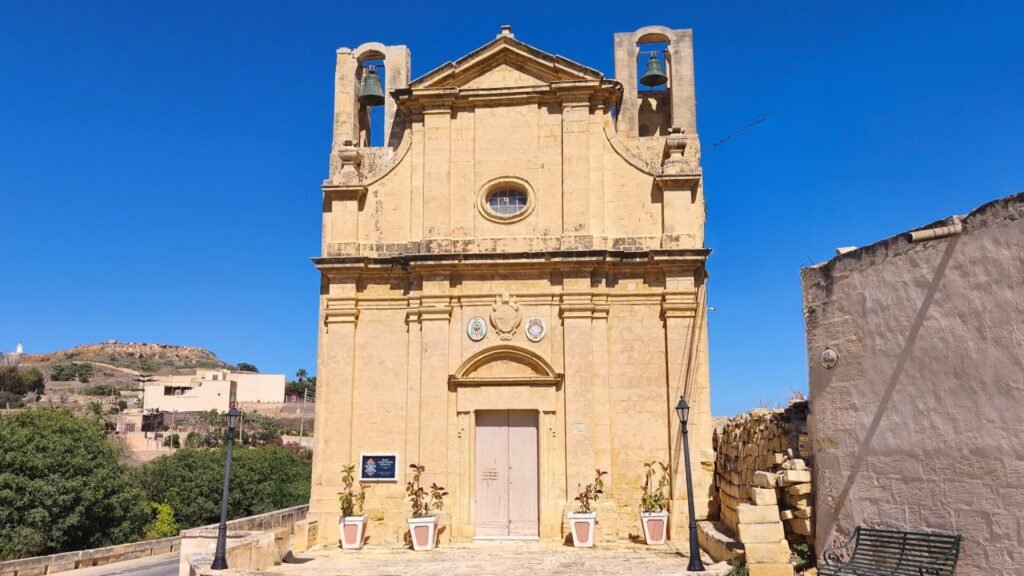
Chapel of Our Lady of Patronage
Historical background
Set on the road that descends towards Wied il-Għasri, this rural shrine occupies a site of devotion dating to the early 1500s, when a small chapel dedicated to the Assumption was raised by the Cini family. The present dedication reflects a seventeenth- and eighteenth-century wave of Marian piety: the Feast of the Patronage of Our Lady, promoted in Spain and Italy, took firm root in Gozo. A new chapel rose here in 1737–1739 and soon drew pilgrims from across the islands.
Construction details
The eighteenth-century rebuilding was driven by Rev. Tumas (Thomas) Saliba, who also obtained a larger plot from the Order of St John to extend the site. The chapel was blessed on 8 May 1739, enlarged and re-blessed on 5 October 1754, and solemnly consecrated by Bishop Vincenzo Labini on 10 May 1789—Gozo’s first consecrated countryside chapel, a distinction it held for 161 years. In a further mark of honour it was affiliated to the Papal Basilica of Santa Maria Maggiore, with sources noting dates of either 1768 or 3 September 1786 for this affiliation.
Cultural and religious significance
For generations the chapel served as the spiritual heart of the scattered farming community of Tal-Wied. From October 1872 to December 1921 it functioned as the vice-parish church for Għasri until the new parish church was completed. The annual village feast of Our Lady of the Patronage—celebrated on the second Sunday of October—sustains a distinctive strand of Marian devotion within Gozo’s religious calendar, while the valley setting keeps the shrine central to local processions, countryside pilgrimages, and family petitions.
Present-day context
Today the basilica-chapel forms part of Għasri Parish and remains open for regular worship, including Sunday Mass. Recent years have seen parish-led conservation efforts, volunteer initiatives, and routine maintenance to preserve both the limestone fabric and the devotional life of the site. Its position at the head of the picturesque valley makes it a natural waypoint for cultural itineraries in Gozo, welcoming parishioners, walkers, and heritage visitors alike.
Unique stories and traditions
The titular devotion is captured in the main altarpiece: the Virgin spreads her protective mantle over an individual pursued by Satan—a vivid image of intercession that resonated with farming families living close to the elements. Weekly Marian observances and the October feast reinforce this protective theme, entwining the chapel’s identity with prayers for safety, good harvests, and family wellbeing.
Visual and artistic features
The façade presents calm Baroque classicism: plain pilasters rise to an entablature and triangular pediment, centred on an oval window. The building is crowned by an uncommon dome without a lantern and flanked by two small bell-towers (one a later addition). A broad parvis introduces the doorway, framing the shrine against the valley landscape. Inside, the 1739 titular painting is attributed to Malta’s foremost eighteenth-century painter, Francesco Zahra. A honey-coloured Gozitan alabaster main altar—blessed in 1789—anchors the sanctuary, complemented by two side altars dedicated to St Paul and St Joseph, silver sanctuary lamps, and a restrained array of rural Baroque artworks. The overall impression is one of quiet dignity, marrying local stonecraft with a confident yet modest devotional aesthetic.
Under the Mantle: Our Lady of the Patronage and Gozo’s Basilica at Wied il-Għasri
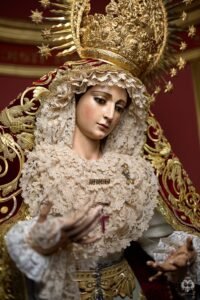
“Our Lady of the Patronage” (Latin: Patrocinium B.M.V.; Italian/Spanish: Patrocinio) is a Marian title that presents Mary as a protective patron who shelters the faithful. Its core image is the Virgin spreading her mantle over people in need, a Western iconography known as the “Virgin of Mercy,” and closely related in the East to the Feast of the Protection (Pokrov) of the Mother of God.
As a liturgical feast, the Patronage of Our Lady was first authorised for Spain by the Sacred Congregation of Rites on 6 May 1679. From there it spread widely and, in the Papal States and elsewhere, was commonly observed on a Sunday in November (often the third). Though never a universal feast, it became a beloved local observance in many regions.
The title itself sits within a much older devotional current. Medieval Europe cherished Mary’s protective care under the ancient prayer Sub tuum praesidium (“Under your protection we take refuge”), and artists gave that theology a vivid form in the mantle motif—Mary towering above the faithful and drawing them beneath her cloak. The East articulated the same intuition in Pokrov icons and hymnody.
In Italian and Iberian art from the 13th to 16th centuries, the Virgin of Mercy scene became a favourite: confraternities, widows, rulers and ordinary townsfolk kneel in miniature beneath Mary’s mantle, sometimes held open by angels. Piero della Francesca’s Madonna della Misericordia is the classic Renaissance statement of this theme. In the Eastern tradition, Pokrov images show Mary unfurling a veil in intercession for the world—two parallel visual languages for the same protective idea.
Seventeenth- and eighteenth-century Europe, marked by war, plague and shifting empires, proved fertile soil for Marian patronage titles. In Spain the name Nuestra Señora del Patrocinio took firm root; in Seville the Hermandad del Cachorro venerates a sorrowful Virgin under this title, rebuilt after a devastating chapel fire in 1973 and periodically restored for public veneration. In Italy, sanctuaries and artworks titled Madonna del Patrocinio appear from Lombardy to Emilia-Romagna, showing how the mantle image translated easily into local histories and art.
Gozo preserves one of the clearest Maltese links to this title. The Basilica-Chapel of the Patronage of Our Lady at Wied il-Għasri—popularly Bażilika tal-Wied—rose in 1737–1739 and was solemnly consecrated in 1789, becoming Gozo’s first consecrated countryside church. Its titular painting, attributed to Francesco Zahra, shows Mary sheltering a figure from Satan beneath her mantle—an explicit “patronage” image. The church served as Għasri’s vice-parish from 1872 to 1921; the local feast remains the second Sunday of October, keeping the devotion alive in village life.
The title resonates because it is pastoral, concrete and communal. It speaks to families praying for protection, to harvest communities facing the elements, and to cities seeking a motherly patron in times of trial. Across centuries and cultures—Latin and Byzantine—the mantle/veil image remains a simple, unforgettable catechesis in paint, wood and song.
