
Chapel of St. Publius
(Please allow a few seconds for the video to load)
Welcome to
“The Chapel of St. Publius” digital experience where history and technology intertwine to bring you an immersive experience.
Explore the Chapel
Below, you will find a ‘Paywall’ feature, requesting you to make a donation to be able to enter the page.
Once you are in, you will find
Support a Mission, Explore a Treasure
Your entry helps Missio Malta continue their vital work in missionary lands overseas. By donating, you directly support communities in need while gaining 24-hour full access to this chapel's 3D experience and history.
Learn more about Missio's workAccess is valid for 1 Chapel for 24 hours from the time of donation
OR
360° Panorama
Zoom to full screen to view
Chapel of St. Publius
A modest countryside sanctuary set on the Ta’ Għammar ridge between Għarb and Għasri, the Chapel of St Publius blends rural simplicity with deep devotion to Malta’s first bishop. Although the chapel stands within the locality of Għasri, it belongs to the neighbouring parish of Għarb, a reminder of the historic bonds binding Gozo’s western villages.
The present chapel replaced an earlier church on the site dedicated to St Leonard, built around 1550 by George Tewma. That medieval chapel was deconsecrated by Bishop Miguel Juan Balaguer Camarasa in 1654 and demolished a few years later, leaving the area without a sacred building for nearly two centuries. A renewed initiative led by Rev. Fr Guzepp Cassar (1803–1866) saw the laying of the foundation stone on 26 July 1850. The new chapel was blessed on 10 October 1852 by Għarb’s archpriest, Rev. Fr Salv Mizzi. Contemporary notes also credit the rector of nearby Ta’ Pinu with underwriting much of the cost.
Built in local limestone, the chapel follows the typical single-cell plan of Gozitan wayside churches. Its plain façade, topped by a small bell-cot, sits back from a narrow lane just off L-Għammar Street—a rural siting that preserves the building’s intimate scale within cultivated fields. Two bells, affectionately named “Publiju” and “Pawlu”, complete the profile. No archival figure for the construction cost has surfaced, but the concise two-year build and community-backed patronage are well documented.
St Publius holds a special place in Maltese Christianity as the first bishop of Malta according to early tradition, and the chapel helps anchor that cult in Gozo’s west. Its feast is celebrated on the third Sunday of January, drawing parishioners from Għarb and nearby hamlets. The chapel’s association with the Għarb parish—despite standing within Għasri’s limits—illustrates longstanding pastoral arrangements on Gozo and the habit of sharing sacred sites across village boundaries.
Today the chapel remains a cherished landmark on the Ta’ Għammar paths that fan out towards Ta’ Pinu and Wied il-Mielaħ. While it is not generally open on a daily schedule, visitors occasionally find it unlocked during local observances or maintenance, and it continues to be cared for under the parish of Għarb with support from the local community.
The site’s shift in dedication—from St Leonard in the sixteenth century to St Publius in the nineteenth—captures a broader nineteenth-century revival of local devotions tied to national Christian identity. The naming of the two bells “Publiju” and “Pawlu” echoes Acts 28 and the Maltese memory of Publius welcoming St Paul, binding the chapel’s soundscape to a foundational story in Malta’s faith.
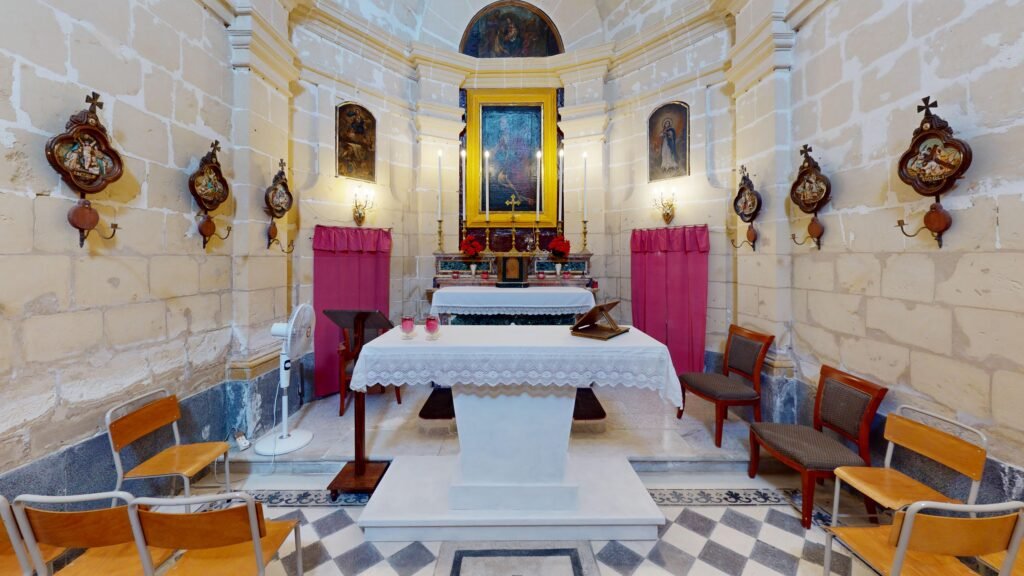
Inside, a single marble altar focuses the sanctuary. A devotional painting of St Publius presides over the space, complemented by two Marian canvases—one of the Assumption and one of the Immaculate Conception—attesting to nineteenth-century Gozo’s artistic piety. Externally, the unadorned masonry, flaglike façade and petite bell-cot exemplify the restrained vernacular of Gozo’s roadside chapels, harmonising with the terraced landscape of Ta’ Għammar.
Saint Publius: Malta’s First Bishop and Host of Saint Paul
Saint Publius is a figure of great reverence in Malta’s Christian heritage, remembered as the island’s first bishop and the man who welcomed Saint Paul after the Apostle’s shipwreck on Malta around the year AD 60. His story connects the Maltese Islands to the earliest days of Christianity and remains a defining part of the nation’s religious identity.
Publius was the Roman governor of Malta, known as the chief man of the island in the Acts of the Apostles. As a Roman official, he represented imperial authority, but his reputation is built on an act of profound hospitality. According to tradition, when Paul was shipwrecked on Malta, Publius received him warmly, offering shelter and provisions for three days.
The New Testament recounts that Paul healed Publius’ father, who lay gravely ill with fever and dysentery. This miracle led to many other Maltese seeking Paul’s intercession and, in turn, to the spread of Christianity throughout the island. Publius himself was converted and baptised by Paul, becoming the first Christian bishop of Malta.
Historical tradition suggests that after serving the Maltese community, Publius went on to Athens, where he became bishop and continued his pastoral mission. He is believed to have suffered martyrdom during the persecutions of Emperor Hadrian around AD 125, sealing his witness with his life.
Saint Publius remains a central figure in Maltese devotion. He symbolises both the origins of Christianity on the island and the values of hospitality and faith. His legacy is honoured in the Parish Church of St Publius in Floriana, one of Malta’s most important churches, as well as in smaller chapels across Malta and Gozo, including the rural chapel at Ta’ Għammar in Għarb. Every January, his feast day brings communities together in celebration of his example of leadership, charity, and courage.
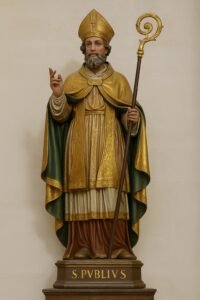
Saint Publius is often depicted in ecclesiastical art wearing episcopal robes, sometimes accompanied by imagery of Saint Paul or the shipwreck. In Maltese churches, his iconography highlights his role as the island’s protector and spiritual father. Paintings, statues, and dedications to Publius are enduring reminders of Malta’s unique place in Christian history.
The story of Saint Publius is more than a tale of hospitality; it represents the birth of a Christian community on the island and the beginning of a tradition that has shaped Malta’s religious and cultural fabric for nearly two millennia. His name continues to inspire devotion, pride, and a sense of belonging among Maltese people at home and abroad.
