
Chapel of St. Demetrius
(Please allow a few seconds for the video to load)
Welcome to
“The Chapel of St. Demetrius” digital experience where history and technology intertwine to bring you an immersive experience.
Explore the Chapel
Below, you will find a ‘Paywall’ feature, requesting you to make a donation to be able to enter the page.
Once you are in, you will find
Support a Mission, Explore a Treasure
Your entry helps Missio Malta continue their vital work in missionary lands overseas. By donating, you directly support communities in need while gaining 24-hour full access to this chapel's 3D experience and history.
Learn more about Missio's workAccess is valid for 1 Chapel for 24 hours from the time of donation
OR
360° Panorama
Zoom to full screen to view
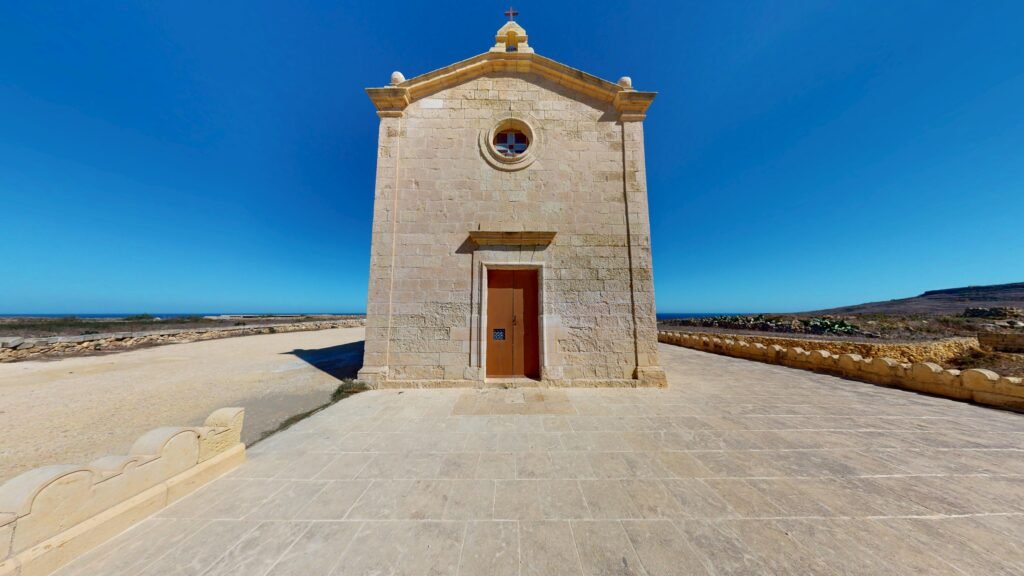
Chapel of St. Demetrius
Historical background
Perched on the westernmost reaches of Gozo at Ras San Mitri, the Chapel of St Demetrius is the only Maltese church dedicated to the soldier-martyr of Thessaloniki. The first chapel on the site is traditionally attributed to Dun Franġisk Depena in the 15th century and was recorded during Inquisitor Pietro Dusina’s visitation in 1575. Found dilapidated, it was deconsecrated by Bishop Miguel Juan Balaguer on 24 May 1657. A successor chapel rose in 1694 but later fell into ruin. The present oratory was rebuilt around the turn of the 19th century through the initiative of Dun Mario Vella, who in 1796 endowed funds for its upkeep; construction was resumed under parish priest Dun Publio Refalo and the chapel was blessed on 11 April 1809.
Construction and fabric
San Dimitri is a small, rural limestone chapel with a restrained late-Baroque façade: a simple portal, circular oculus, flanking pilasters capped by spherical finials, and a modest bell-cot. Inside, a barrel-vaulted nave leads to a shallow, curved sanctuary with a sacristy to the rear. The parvis in front of the doorway was added in 1930. The interior was retiled and a sculpted stone altar by Wenzu Gatt installed in 1935; a mosaic zoccolo followed in 1950, and liturgical adjustments after the Second Vatican Council brought a new freestanding altar. An endowment of five scudi per annum (1796) underscores the modest but continuous patronage that kept this wayside chapel alive.
Cultural and religious significance
For centuries San Dimitri has anchored devotion on Gozo’s wind-carved coast, a point of prayer for farmers, shepherds and seafarers. Its dedication to a Greek saint reflects historic links with the eastern Mediterranean and episodes of corsair threat that shaped local piety. On the eve of the Second World War a Byzantine-rite Mass was celebrated here for Malta’s Greek community—an evocative nod to the saint’s origins. The chapel today is active under Għarb parish, serving for occasional liturgies, weddings and retreats, with the village feast of St Demetrius kept annually on the second Sunday of October. Its presence within terraced fields and stone-walled lanes contributes richly to Gozo’s rural cultural landscape.
Present-day context
The chapel is listed on the National Inventory of the Cultural Property of the Maltese Islands. After a nearby fireworks factory explosion in 2010 shattered some glazing but spared the structure, San Dimitri underwent a Council-led restoration completed in 2012 and inaugurated in 2013, supported by EU and Government funds. The works refreshed masonry, timber and finishes while respecting the building’s simple character. Though not regularly open, it remains carefully maintained and cherished by the Għarb community; the site’s quiet parvis and sweeping coastal views make it a favourite waypoint for walkers.
Legends and folklore
San Dimitri is inseparable from the legend of Żgugina (Natalizja Cauchi) whose only son—named Mattew or Pawlu in variants—was abducted by corsairs. Żgugina vowed to keep a lamp burning before the saint if he would bring the boy home. According to tradition the titular painting came alive: St Demetrius leapt from the canvas on horseback, pursued the corsair ship over sea and returned the captive to his mother before re-entering the painting. A companion tale says a section of the cliff collapsed in an earthquake and the earlier chapel slid into the sea, yet fishermen sometimes glimpsed Żgugina’s lamp still glowing beneath the waves. The stories, recorded by scholars and celebrated in poems, distil Gozitan resilience and maternal devotion.
Visual and artistic features
The titular altarpiece (dated 1810; artist unknown, restored in 1937 by Wistin Camilleri) shows St Demetrius as armoured horseman, with Żgugina in her għonnella to one side and the chained youth to the other—an image that fuses hagiography with local lore. Flanking canvases depict Saint Aristarchus and the Assumption of Mary; elsewhere hang scenes of St Paul, the martyrdom of St Demetrius and a Via Sagra. A relic of the saint, brought from Rome on 14 February 1898, is conserved within the chapel. The ensemble, set against pale Maltese stone, creates an intimate devotional space where narrative, art and place intertwine.
St. Demetrius of Thessaloniki: Martyr, Protector, and Malta’s Legendary Rider
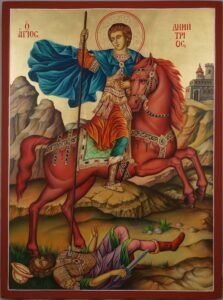 Saint Demetrius, also known as Demetrios, was born around the year 270 AD in the city of Thessalonica, then part of the Roman Empire. He came from a Christian family of high social standing, possibly of senatorial rank, at a time when Christians often had to practise their faith in secret due to widespread persecution. From an early age, he was nurtured in Christian teaching and baptised into the faith.
Because of his noble birth, Demetrius is often described as having been appointed to a high civic or military position, perhaps as a proconsul, under the rule of the Roman emperors Diocletian, Maximian, and Galerius. Despite his position in the imperial system, Demetrius used his influence to defend and encourage fellow Christians in a climate of hostility and danger.
Around 305–306 AD, during renewed waves of persecution, Demetrius was arrested for openly professing his Christian faith. Accounts tell that he was executed by being pierced with spears in Thessalonica. His death quickly inspired devotion among the Christian community, and miraculous events were reported at his burial site.
Demetrius became widely known as the Myroblyte, or “myrrh-gusher”, because it was said that a fragrant, healing liquid flowed from his tomb. Pilgrims travelled to venerate his relics, and many cures were attributed to this holy substance. Over his burial place a great basilica was built, dedicated to him and still standing in Thessaloniki today, making it one of the most important centres of Christian pilgrimage in the Eastern Mediterranean.
Through the centuries, Demetrius came to be revered not only as a martyr but as the heavenly patron and defender of Thessalonica. His intercession was believed to have saved the city repeatedly during sieges and invasions, particularly during the attacks of Slavs, Avars, and later Ottoman forces. He was often invoked as a warrior-saint, riding in armour to defend the faithful.
In Christian art, Demetrius is usually shown as a soldier wearing armour, sometimes mounted on a red horse, armed with a spear or lance. He is often depicted confronting pagan enemies or defeating a gladiator figure named Lyaeus, representing his triumph of faith over oppression. In many traditions he is paired with Saint George, both of them being warrior-saints who embody courage and divine protection.
The feast of Saint Demetrius is celebrated on 26 October in the Eastern Orthodox calendar and widely observed in both East and West. His veneration spread across the Byzantine Empire and beyond, into the Balkans, Russia, and the wider Orthodox world. Over time, he also came to be associated with agriculture and the cycles of rural life, taking on echoes of older Mediterranean traditions, such as those connected to the goddess Demeter.
In folk culture, particularly in Greece and Bulgaria, his feast marked a turning point in the agricultural year. In Bulgaria, for example, Dimitrovden (St Demetrius’s Day) was traditionally seen as the beginning of winter. His cult therefore combined elements of soldierly strength, civic protection, and seasonal renewal.
Although Demetrius himself never had direct links to Malta, his cult reached the islands through the Mediterranean devotion to Eastern saints. The most remarkable testimony to this is the Chapel of St Demetrius (San Dimitri) in Għarb, Gozo. This is the only church in Malta dedicated to the Thessalonian martyr.
The chapel is closely tied to one of Gozo’s most enduring legends. It tells of Żgugina, a local woman whose only son was taken by Barbary corsairs. In her despair she prayed to St Demetrius. According to tradition, the saint leapt out of his altarpiece on horseback, pursued the corsair ship across the sea, and returned the boy safely to his mother before riding back into the painting. Another version claims that when part of the cliff collapsed into the sea, taking the earlier chapel with it, fishermen could still see Żgugina’s lamp burning beneath the waves.
This legend echoes the Thessalonian traditions of Demetrius as a protector and defender, adapted into the lived fears of Gozitan villagers, who often faced raids by pirates. The chapel, rebuilt in its present form in 1809, continues to bear witness to the saint’s enduring appeal in Malta.
Saint Demetrius of Thessaloniki embodies the union of courage, faith, and protection that resonated deeply across the Mediterranean world. From a noble youth who faced martyrdom in the early fourth century, to the miraculous “myrrh-gusher” whose relics became a source of healing, to the warrior-saint invoked against invaders and pirates, his story has crossed centuries and cultures. In Gozo, as in Thessalonica, he remains a figure of hope and intercession, remembered in stone, story, and devotion.
