
Chapel of Christ the Priest
(Please allow a few seconds for the video to load)
Welcome to
“The Chapel of Christ the Priest” digital experience where history and technology intertwine to bring you an immersive experience.
Explore the Chapel
Below, you will find a ‘Paywall’ feature, requesting you to make a donation to be able to enter the page.
Once you are in, you will find
360° Panorama
Zoom to full screen to view
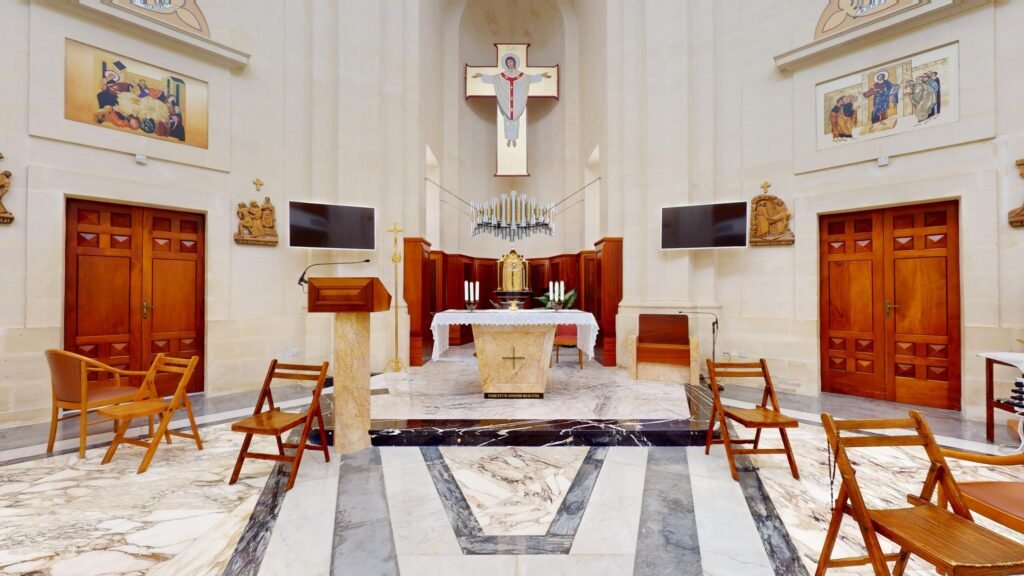
Chapel of Christ the Priest
The Chapel of Christ the Priest forms the spiritual heart of Dar tal-Kleru, officially named Christus Sacerdos, in Fleur-de-Lys, Birkirkara. The residence opened on 8 May 1964 through the vision of Monsignor Professor Salvatore Grima, who sought to provide elderly, infirm and convalescent priests with permanent care, companionship and continued spiritual life.
The project developed from meetings begun by Monsignor Grima in Zejtun during 1958. Several young women inspired by his teaching later became the Qaddejja taċ-Ċenaklu, the religious community established to pray for priests and care for residents.
The Church provided the site after a remaining emphyteutical grant was transferred to Archbishop Michael Gonzi for a seminary or charitable institution. Financial and practical assistance reportedly came from Monsignor Grima’s brother Angelo, a building contractor.
Construction was supervised by an architect identified as C. Micallef. Published records do not provide a confirmed building cost, full contractor list or names of the original artisans.
The chapel is incorporated into the residential complex rather than standing independently. Its most recognisable feature is the tall octagonal drum and dome, constructed in Maltese limestone and pierced by narrow arched windows. The dark red roof has become so closely associated with Dar tal-Kleru that it appears in the residence’s modern visual identity.
Internally, the chapel combines pale stone surfaces, high arches and a patterned marble floor. Its spacious arrangement accommodates elderly worshippers, wheelchairs and movable seating. The sanctuary contains a central altar and tabernacle, while carved Stations of the Cross, religious paintings and priestly imagery reinforce its purpose.
The dedication to Christ the Priest expresses Catholic belief in Christ as the eternal High Priest and reflects the lifelong ministry of the residents. Daily Mass, the Rosary and Holy Communion for those confined to their rooms ensure that worship remains central to community life.
The chapel has hosted priestly jubilees, retreats, meetings and Archdiocesan celebrations, including Masses marking sixty years of priestly ordination and the residence’s sixtieth anniversary.
In 2022, a striking cross by Father Peter Paul Sultaana was installed and blessed by Archbishop Emeritus Paul Cremona. Painted on plastered wood in a Byzantine-inspired style, it portrays the wounded Christ rising rather than remaining suspended in death. Gold represents divinity, while the upward position of Christ’s hands evokes the Resurrection.
No established folklore is associated with the chapel. Its most moving story is Monsignor Grima’s own. After creating a home for ageing priests, he eventually became one of its residents and spent his final years there before his death in 1990.
Christ the Priest: The Eternal Mediator Between God and Humanity
Who Is Christ the Priest?
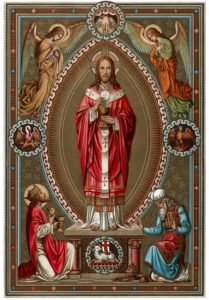 Christ the Priest is not a separate saint, biblical character or episode in the life of Jesus. It is one of the most profound titles given to Jesus Christ and describes his role as the eternal mediator between God and humanity.
The word *Christ* comes from the Greek *Christos*, meaning “the Anointed One”. In ancient Israel, priests and kings were anointed with oil when appointed to sacred office. Christian belief holds that Jesus fulfils these roles completely as priest, prophet and king.
Unlike an ordinary priest, however, Jesus does not simply present another offering to God. He offers himself. He is therefore understood as priest, sacrifice and altar, bringing together the person who offers, the gift being offered and the place where reconciliation is achieved.
Jesus and the World of the Temple
Jesus lived during the Second Temple period, when Jerusalem’s Temple stood at the centre of Jewish religious life. Priests offered sacrifices, maintained the sanctuary and led public worship. The high priest held the most senior religious office and alone entered the Holy of Holies on the annual Day of Atonement.
The high priesthood also carried political influence. Judaea was under Roman authority, while the Temple authorities had to maintain a difficult relationship with the occupying administration. This tension forms part of the setting for the arrest and trial of Jesus.
Jesus was not a Temple priest in the conventional sense. The priesthood of Israel descended through Aaron and the tribe of Levi, whereas Jesus belonged to the tribe of Judah. He did not serve at the altar of the Jerusalem Temple, wear the high priestly garments or inherit a recognised priestly office.
His priesthood was understood differently. It arose from his identity, mission, obedience and complete offering of himself.
The Priesthood of Melchizedek
The Letter to the Hebrews provides the fullest biblical explanation of Christ’s priesthood. Its author presents Jesus as the great High Priest who passes beyond the earthly sanctuary and enters the presence of God.
To explain a priesthood outside the descendants of Aaron, Hebrews turns to the mysterious figure of Melchizedek.
Melchizedek appears briefly in the Book of Genesis as the king of Salem and priest of God Most High. He meets Abraham, blesses him and brings out bread and wine. Abraham then gives him a tenth of what he possesses.
Melchizedek’s sudden appearance, with no genealogy or recorded death, made him a powerful symbol of an enduring priesthood. Psalm 110 later speaks of a royal figure who would remain a priest for ever according to the order of Melchizedek.
Christian tradition applies this passage to Jesus. His priesthood is not inherited through ancestry and does not end with death. It is eternal because the risen Christ lives eternally.
The bread and wine offered by Melchizedek also came to be seen as a foreshadowing of the Eucharist.
A Priest Who Shared Human Suffering
The priesthood of Christ is closely connected with his humanity. Jesus did not remain distant from suffering, fear, rejection or temptation. He experienced hunger, exhaustion, grief, betrayal and physical pain.
Hebrews presents him as a compassionate High Priest precisely because he shared the weakness and suffering of human life while remaining faithful to the Father.
The Gospel accounts repeatedly show this compassion. Jesus touches those considered unclean, forgives sinners, eats with the rejected, welcomes children and restores dignity to people pushed aside by society. His priesthood is therefore not presented as privilege or status, but as service.
This understanding is captured vividly when Jesus washes the feet of his disciples. He assumes the task of a servant and tells them to follow his example. Christian priesthood would consequently be judged not by prestige, but by sacrifice, humility and care for others.
The Last Supper and the New Covenant
The Last Supper is central to the story of Christ the Priest.
On the night before his death, Jesus took bread, gave thanks, broke it and gave it to his disciples as his body. He then presented the cup as his blood of the covenant, poured out for the forgiveness of sins.
These actions connected the meal with the sacrifice that would take place on the Cross. What appeared on Calvary as a violent execution had already been accepted and interpreted by Jesus as a voluntary gift of love.
The words “Do this in memory of me” established a continuing act of remembrance. In Catholic teaching, the Eucharist does not repeat Christ’s sacrifice. It makes sacramentally present the one sacrifice offered once and for all.
The traditional association between the Last Supper, the Eucharist and the ministerial priesthood explains why Holy Thursday has a special meaning for priests.
The Cross as a Priestly Offering
At Calvary, Jesus possessed none of the visible signs normally associated with a high priest. He wore no sacred vestments, stood at no golden altar and held no ceremonial vessel. He was stripped, mocked and placed upon a Roman instrument of execution.
Yet Christian belief sees this moment as the fullest expression of his priesthood.
The Cross becomes the altar. Christ becomes the offering. His blood replaces the repeated blood sacrifices of the former covenant. His obedience and self-giving establish reconciliation between God and humanity.
The unusual character of this priesthood is essential. Jesus does not sacrifice another living creature. He gives himself freely. His offering is not an attempt to persuade an unwilling God to show mercy, but the revelation of God’s own merciful love entering human suffering.
For this reason, Christian art frequently portrays Christ the Priest holding both the chalice and the Cross, uniting the Eucharist with Calvary.
Resurrection and the Eternal High Priest
The title Christ the Priest cannot be understood through the Cross alone. It includes the Resurrection and Ascension.
Had death been the end, Christ’s priestly work would have belonged only to the past. Christianity proclaims instead that he rose from the dead, entered the presence of the Father and continues to intercede for humanity.
Hebrews uses the imagery of the high priest entering the innermost sanctuary. Christ enters not an earthly chamber made by human hands, but the heavenly sanctuary. He brings not the blood of an animal, but the gift of his own life.
His priesthood is therefore eternal. He does not require a successor because death no longer ends his ministry. Every Christian act of worship is understood to participate in his continuing prayer and self-offering.
Priest, Victim and Altar
Catholic theology sometimes describes Jesus as priest, victim and altar.
As priest, he freely offers the sacrifice.
As victim, he is himself the gift that is offered.
As altar, his humanity becomes the meeting place between God and the human family.
These three images explain why the Eucharist occupies such a central place in Christian worship. At Mass, the celebrant does not replace Christ or offer an independent sacrifice. Christ remains the true priest, acting through the sacramental ministry of the Church.
The priest speaks and acts *in persona Christi*, meaning “in the person of Christ”. This does not suggest that the ordained priest becomes Christ. It means that Christ uses the priest’s ministry to proclaim the Gospel, forgive sins, celebrate the Eucharist and serve the faithful.
The Priesthood Shared by the Faithful
Christ’s priesthood is not connected only with bishops and priests. Catholic teaching distinguishes between the ministerial priesthood received through Holy Orders and the common priesthood received through Baptism.
Every baptised Christian is called to offer spiritual sacrifices through prayer, service, charity, faithfulness and the daily offering of life to God. Parents caring for children, people tending the sick, workers acting honestly and individuals forgiving those who have harmed them can all participate in Christ’s self-giving love.
The ordained priesthood serves this wider priestly people. Its purpose is not to create a privileged religious class, but to preach, sanctify, shepherd and help the Christian community live its baptismal calling.
Both forms of participation come from the one priesthood of Jesus Christ.
The Feast of Christ the Eternal High Priest
The Feast of Our Lord Jesus Christ, the Eternal High Priest, is observed in a number of Catholic countries, dioceses and religious communities on the Thursday following Pentecost.
Its position after Pentecost connects Christ’s priestly mission with the work of the Holy Spirit. Its Thursday observance recalls the Last Supper, when Christ gave the Eucharist to the Church.
The feast honours Christ’s sacrificial love and encourages prayer for the holiness of priests. Its liturgical texts frequently draw upon Psalm 110, Isaiah’s suffering servant, the Letter to the Hebrews and the Gospel accounts of the Last Supper.
Although it is not celebrated with the same rank everywhere, devotion to Christ the Priest has influenced seminaries, priestly associations, religious congregations and houses established for the care of clergy.
Christ the Priest in Christian Art
Images of Christ the Priest combine several visual traditions.
Christ may appear wearing a white tunic, stole or elaborate high priestly vestments. He may hold a chalice and host, carry the Gospel book or raise his hand in blessing. Some representations place him before an altar, while others show him enthroned as priest and king.
Eastern Christian icons sometimes depict him in episcopal vestments, identifying him as the source of all Christian ministry. The Cross often appears nearby, ensuring that priesthood is never separated from sacrifice.
Gold backgrounds symbolise divine glory and eternity. White represents purity and resurrection, while red may signify both Christ’s blood and royal dignity. The chalice recalls the Last Supper, while bread or the Eucharistic host points towards his continuing presence in Christian worship.
One particularly meaningful form shows the crucified Christ already rising. His wounds remain visible, but his body is no longer overcome by death. This brings together sacrifice and victory, suffering and resurrection.
Christ the Priest and Malta
The dedication has a strong connection with Malta’s Catholic identity, where the Eucharist, priestly vocations, village churches and public religious celebrations have long shaped community life.
Malta’s association with Saint Paul also adds an interesting biblical dimension. For many centuries, the Letter to the Hebrews was commonly linked with Paul and included among writings traditionally attributed to him. Modern biblical scholarship generally regards its author as unknown, largely because its language and literary style differ from Paul’s recognised letters.
Although Hebrews was probably not written by Paul, its traditional association with him gave the Maltese a familiar apostolic route into its central message: Jesus is the compassionate and eternal High Priest.
The most direct Maltese expression of this devotion is found at Dar tal-Kleru in Fleur-de-Lys, Birkirkara.
Christus Sacerdos at Dar tal-Kleru
The official name of Dar tal-Kleru is *Christus Sacerdos*, meaning Christ the Priest. The residence was inaugurated on 8 May 1964 to care for elderly, infirm and convalescent members of the clergy.
It was founded by Mgr Professor Salvatore Grima, born in 1909, who believed that his vocation included working and praying for the sanctification, health and welfare of priests.
The dedication was particularly appropriate. The residents had spent their lives celebrating the sacraments and serving parishes, schools, hospitals and religious institutions. In old age or illness, they entered a home placed under the protection of Christ, whose priesthood does not diminish through weakness and does not end in death.
Mgr Grima’s vision was shared by the Qaddejja taċ-Ċenaklu, the Servants of the Cenacle. Their name recalls the Upper Room where the Last Supper took place and where the disciples later gathered in prayer before Pentecost. Their service to ageing priests therefore unites the Cenacle, Eucharist, priesthood and compassionate care.
Mgr Grima eventually became a resident of the home he had founded. He spent his final years among the priests for whom he had worked and prayed, dying in 1990. This gives the foundation a personal conclusion: its founder was eventually received into the community he had created for others.
The Risen Christ at the Dar tal-Kleru Chapel
A notable modern interpretation of Christ the Priest was installed in the chapel during 2022.
Created by Fr Peter Paul Sultana, the work presents Christ upon a cross but in a posture suggesting resurrection. It was painted on wood prepared with plaster and blessed by Archbishop Emeritus Paul Cremona.
The figure retains the wounds of crucifixion, yet Christ is not shown as lifeless or defeated. His raised form suggests that sacrifice has passed into victory. The work expresses the complete mystery of Christ’s priesthood: he offers himself, dies, rises and continues to intercede.
This image has particular meaning inside a residence for elderly priests. Physical strength may fade, public ministry may cease and illness may restrict daily activity, but priesthood remains joined to the eternal priesthood of Christ. Prayer, suffering and quiet witness become a final form of service.
A Priesthood Defined by Love
The title Christ the Priest ultimately points beyond vestments, ceremonies and institutional office. It describes a life offered completely for others.
Jesus teaches, heals, forgives, feeds, serves, suffers and gives himself. His authority is expressed through mercy. His sacrifice is voluntary. His victory does not erase his wounds but transforms them.
For the Christian, the eternal High Priest is not a remote figure standing beyond human pain. He is one who has experienced rejection, loneliness and death, and who therefore approaches human weakness with compassion.
At Dar tal-Kleru, this belief takes visible form. The chapel is more than a convenient place of worship within a residence. Its dedication honours the source of every priestly vocation and reminds each resident that his ministry remains rooted in Christ, even when age or illness brings active service to an end.
Christ the Priest is therefore a story of mediation, sacrifice, service and hope. It begins within the worship of ancient Israel, reaches its decisive moment at the Last Supper and Calvary, and continues in the Christian belief that the risen Christ remains forever before the Father, carrying humanity within his unending prayer.
