
The Chapel of St. Anne – A Sacred Gem in Attard, Malta
Historical Background
Hidden in the winding streets of Attard, Malta, the Chapel of St. Anne (Sant’Anna) stands as a tangible reminder of the island’s resilient faith and history. The origins of this modest chapel date back to the aftermath of the devastating plague of 1675–76, which ravaged many Maltese villages including Attard. In that outbreak, Attard lost roughly 104 residents – about ten percent of its population – to the plague. In gratitude for deliverance and as an act of communal devotion, the survivors vowed to build a new chapel on the site of an older, defunct church. Prior to the plague, a small Chapel of St. Nicholas of Bari had stood on this spot; it had been deconsecrated in 1658 due to neglect. Fulfilling their vow, the people of Attard erected a new chapel toward the late 17th century, around 1677–1680, and dedicated it primarily to St. Roque (San Rokku) – the saint invoked against plagues – as a thanksgiving offering for the end of the epidemic.
Although its official patron was St. Roque, the chapel gradually became known as “Tal-Muzew” (after a later use) and especially “St. Anne’s Chapel” among locals. This popular name arose because of a beloved painting inside depicting Saint Anne (mother of the Virgin Mary). Over time, the identity of St. Anne became strongly associated with the little church. Thus, what began as a votive plague chapel evolved into a cherished local shrine for St. Anne. The chapel’s founding purpose was deeply spiritual – serving both as a memorial to lives lost and as a beacon of hope and protection for the future. It filled a need for the community’s religious life outside the main parish: Attard had become an independent parish in 1575, but smaller outlying chapels like this one were vital for neighbourhood worship and devotions. From its inception, St. Anne’s was intended as a place for private prayer, occasional Masses, and yearly commemorations tied to its patron saints’ feast days. The communal effort and piety that built the chapel are part of its very foundation – villagers contributed labour and resources as an ex-voto (vow offering), so in many ways the chapel belongs to the people’s heritage as much as to the Church.
Construction Details
Construction of the Chapel of St. Anne began soon after the plague subsided, in the late 1670s. With the earlier St. Nicholas chapel in ruins, the new building was essentially raised from the ground up using the ubiquitous golden Maltese limestone. There is no single celebrated architect recorded for this modest project – instead, it was likely designed and built by local master masons and craftsmen from Attard, perhaps guided by the parish priest or knowledgeable artisans familiar with the prevailing styles. Despite its small size, the chapel exhibits refined workmanship and reflects the architectural sensibilities of its era. The style is often described as Baroque with Renaissance influences: a simple, well-proportioned façade with classical elements that echo the Renaissance legacy left in Attard by the famous parish church of the Assumption (built 1613 by Tumas Dingli). Indeed, St. Anne’s chapel almost feels like a humble country cousin to the grand parish church, sharing certain harmonious features on a smaller scale.
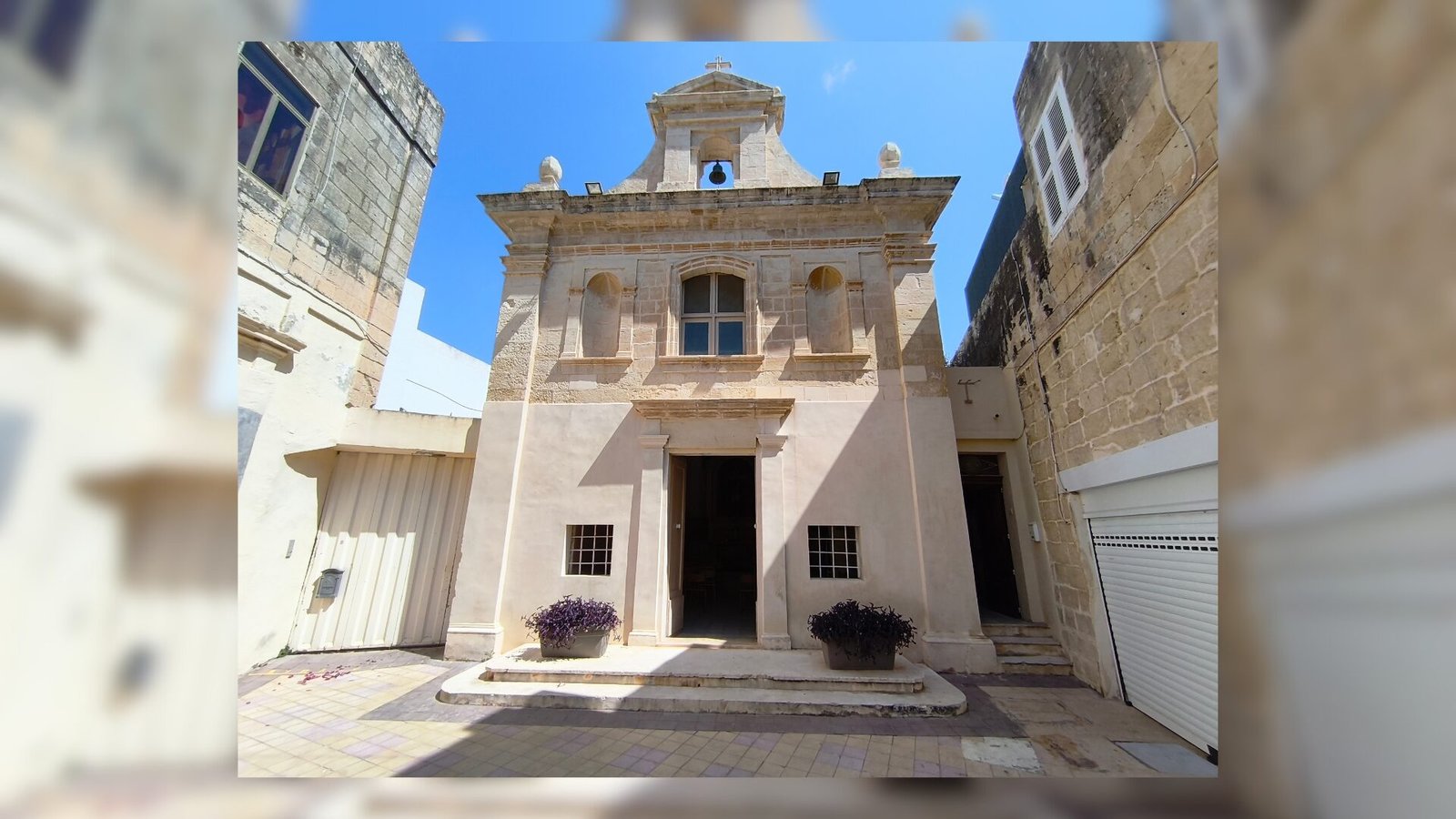
Construction features of the chapel include a straightforward rectangular nave and a raised frontispiece. The façade is built in dressed limestone blocks and is symmetrically arranged. A plain pediment-bounded belfry crowns the roof, complete with a single bronze bell that historically called the faithful to prayer. The belfry sits on a curved parapet and gives the structure a quaint silhouette against the sky. Below, the main doorway is framed by simple pilasters and a subdued cornice, giving it a dignified but unornamented appearance. Above the door sits a rectangular window (now glazed) that lets light into the choir loft area; this window is topped by a shallow open stone arch. Flanking it are two carved niches set into the masonry – shallow alcoves that may once have held statues or simply served as decorative recesses to break up the flat surface of the wall. This arrangement of door, window, and niches creates a balanced composition typical of 17th-century Maltese chapels. There is a restrained use of Baroque curves and flourishes – one sees a gentle curvilinear outline to the belfry backplate and a hint of volutes on either side – but overall the design is quite sober and orderly, befitting a community-funded sacred building where extravagance was likely limited by budget.
We do not have surviving detailed accounts of the cost of construction, but given that the chapel was a grassroots effort, it was probably built as economically as possible. Villagers might have donated money, materials, or their own labour. Limestone would have been quarried locally or reused from the previous chapel’s remnants. The process took a few years; by 1680 or shortly thereafter the chapel was completed and presumably blessed for use. Interestingly, one significant expense would have been its altarpiece – a painting commissioned to adorn the new altar (more on this in the artistic features below). There is no record of any major incidents or challenges during construction, but considering the context – Attard was recovering from plague losses – the building of St. Anne’s was itself a triumph of collective will over adversity. Oral tradition holds that the community’s devotion drove the project forward swiftly. In structure, the finished chapel is a single-nave design with thick walls (ideal for withstanding both time and, as it turned out, even wartime bombs). Its roof is a barrel vault – essentially a rounded tunnel-like ceiling – which was a common solution for small churches, providing both structural stability and a pleasing acoustical space for prayer. Impressively, the interior vault is enhanced by coffered panels (recessed stone squares), a touch that gives the ceiling a timeless, classical look. This detail suggests that skilled stone artisans were at work, creating a coffered barrel vault that elevates the chapel’s interior beyond plain utility. In summary, while the Chapel of St. Anne was built without fanfare or famous architects, it embodies solid Maltese craftsmanship. Every block in its walls tells the story of a community rebuilding faith and hope, literally, one stone at a time.
Cultural and Religious Significance
For over three centuries, the Chapel of St. Anne has played a quiet yet significant role in Attard’s religious and cultural life. Initially, its significance was very direct: it was a votive chapel marking the end of the Great Plague. In a deeply religious society, fulfilling a vow to God and the saints was of immense importance – the chapel was a symbol of gratitude, communal penance, and trust in divine protection. Each year on the feast of Saint Roque (16th August) or Saint Anne (26th July), the locals would remember the chapel’s origins. Even if no grand external festa was held (unlike the main parish feasts), one can imagine small gatherings or at least individuals visiting the chapel to light a candle in thanksgiving that their forebears survived the plague. Thus the chapel cemented itself as a memorial of mercy, a place where the community’s collective memory of suffering and salvation was enshrined.
As time went on, St. Anne’s chapel also found a place in the rhythms of village life. Attard, being one of Malta’s “Three Villages” (with neighbouring Balzan and Lija), is an old, close-knit community with strong Catholic traditions. Chapels like St. Anne’s became focal points for neighbourhood devotion. Local residents might stop by the chapel while passing through St Anne Square (Pjazzetta Sant’Anna) to say a quiet prayer. In the era before cars, the square around the chapel would have been a communal space where children played and older folk gathered in the chapel’s shade – with the presence of the little church subtly reinforcing moral and spiritual awareness in daily life. The chapel’s dedication to St. Anne (mother of Mary) also resonated culturally, as Maltese people have a great respect for motherhood and family. Saint Anne, being the grandmother of Jesus, is a figure of nurturing and faith – values that the village no doubt cherished. Even though the parish church remained the centre of sacramental life (for Mass, baptisms, etc.), the smaller chapel offered something different: intimacy and continuity. It linked generations – the people of Attard could say their ancestors built this sanctuary, and thus it belongs to everyone as part of local identity.
Another layer of significance was added in the 20th century. In 1968, the Chapel of St. Anne was entrusted to the Society of Christian Doctrine, better known in Malta as the M.U.S.E.U.M. (an acronym for a religious association of lay catechists founded by St. George Preca). Specifically, it was given to the society’s male section in Attard. This meant the chapel was repurposed as a centre for catechesis and youth religious education. Many Attard boys over the past decades would have attended M.U.S.E.U.M lessons in the chapel’s confines, learning about faith and morals after school. This usage reinforced the chapel’s role in shaping local religious life – it became a formative space for the young, effectively a bridge between the historical faith of the village and the nurturing of future generations. Culturally, almost every longtime resident of Attard can associate the building with childhood memories of “il-Mużew” (as the M.U.S.E.U.M. centre is colloquially called). This further ingrained the chapel in the social fabric of the town. It wasn’t just an old monument; it was a living part of daily life, even if in a quiet, unassuming way.
Throughout the years, even while serving as a teaching hall on weekdays, the chapel retained its sacred character. Special religious events have occasionally been held there. For instance, it has hosted Lenten talks, rosary groups, and the odd weekday Mass for small groups. By virtue of its history, the chapel is a protected sacred space – the local clergy and faithful ensure that its altar is cared for and that the atmosphere remains respectful of worship. The persistence of calling it “St. Anne’s” (despite the official titular being St. Roque) highlights how cultural perception can shape the identity of a place of worship. In Maltese tradition, St. Anne is venerated as the patroness of grandparents and mothers; it’s likely that devout individuals, especially grandmothers of the community, took a special interest in this chapel. Some might have organized occasional prayers or small feast-day gatherings on St. Anne’s day, maintaining a thread of devotion focused on this saint.
All told, the Chapel of St. Anne holds a multifaceted significance in Attard. Religiously, it stands as a testament to faith in adversity and a cradle of ongoing catechetical mission. Culturally, it is woven into local identity – a landmark that has seen Attard grow from a rural hamlet to a busy town, yet still offers a window into a simpler, devout past. It has been the backdrop for countless personal moments: a young student reciting Bible verses, an elderly villager whispering a prayer of thanks, perhaps even a young couple taking wedding photos on its steps (drawn by its quaint charm). In the grand tapestry of Malta’s heritage, St. Anne’s chapel is a small but precious thread, symbolising how faith and community are inseparably intertwined in the Maltese experience.
Present-Day Context
Today, the Chapel of St. Anne in Attard stands beautifully restored and well-preserved, continuing its quiet service to the community. In recent years, recognizing the chapel’s historic and architectural value, authorities undertook conservation works to ensure its survival for future generations. A major restoration project was completed in 2022 under a Local Council Restoration Scheme, with oversight by Malta’s Restoration Directorate. The works focused on the exterior masonry and structural integrity of this aging building. Centuries of Maltese sun, occasional winter rains, and urban pollution had left their mark – the limestone façade had accumulated grime, biological growth, and areas of black crust, and some stone blocks had deteriorated. Restoration experts carefully cleaned the walls, desalinated and re-pointed the stone joints, and replaced a few severely eroded blocks with matching new limestone. A breathable lime-based render was applied where needed (especially on parts of the façade that had been improperly coated in the past, causing stone damage). They also repaired the deffun roof – the traditional Maltese roof plaster – to seal cracks and prevent water infiltration. The belfry and bell were cleaned and stabilized, and the main doorway’s stone surround was consolidated for safety. Thanks to these efforts, the chapel’s honey-coloured façade now gleams once again, looking very much as it might have in its 17th-century youth.
Management of the chapel remains in ecclesiastical hands. The site is officially under the care of the Attard parish (as part of the Archdiocese of Malta), but day-to-day usage is still largely by the M.U.S.E.U.M. society. The male catechists of the society maintain the interior and use it for their meetings and lessons with local boys. This means the chapel is generally not open to the public on a daily basis, but it is certainly not neglected or forgotten – its doors open regularly for these educational gatherings and for any pastoral needs the parish might have that suit a smaller venue. Importantly, the local community and the Attard Local Council keep a watchful eye on the chapel’s upkeep, recognizing it as a key part of the town’s patrimony. The building has likely been scheduled (protected) as a Grade 1 historic property, which provides it legal protection against alteration or demolition and ensures that any restoration follows strict guidelines. This protected status is a testament to the chapel’s value. While it is modest in scale, one cannot replace the layers of history and meaning embedded in its walls.
In the present day, St. Anne’s chapel does not serve as a parish church – so regular liturgical functions like Sunday Masses are not held there. However, it does find use in special circumstances. The parish might celebrate Mass at the chapel on St. Anne’s feast (July 26) or St. Roque’s feast (August 16) if there is enough interest, or perhaps as part of the annual parish pilgrimage or feast activities (for example, a rosary rally or a youth Mass). It also occasionally opens during cultural heritage events. Attard sometimes features in heritage trails, and Heritage Malta or the local council might include the chapel in guided tours, especially since it is conveniently located near the centre of Attard and close to other attractions (like the stately San Anton Palace and gardens not far away). Visitors who stumble upon it can admire the exterior anytime from the square – and if one is lucky to find it open, they can step inside to feel the atmospheric serenity of this centuries-old sanctuary.
The chapel’s current condition is excellent post-restoration. Photographs of the rejuvenated façade show crisp details: the carved moulding around the niches and window are now sharp and defined, the bell-cot stands firm, and even the smallest decorative flourishes (like the little finials or stone orbs atop the corners) have been cleaned of soot and algae. Inside, the space is kept clean and simple, with minimal furnishings due to its use as a teaching area. It’s worth noting that, because the original paintings and much of the antique décor have been relocated (for preservation), the interior today has a rather austere charm – whitewashed walls, the stone vault overhead, wooden benches or chairs for the students, and perhaps a few statues or posters used by the M.U.S.E.U.M instructors. Yet, the aura of sacredness persists. The altar still stands, and above it hangs a modern representation (likely a printed image or a replica painting) of St. Anne or a religious scene, ensuring the chapel still “feels” like a chapel and not merely a hall. Management-wise, the Society of Christian Doctrine ensures the chapel is secure and respected. The fact that the building is actively used has arguably contributed to its preservation – it’s not a deserted relic, but a living part of Attard’s community infrastructure.
Looking ahead, the Chapel of St. Anne seems set to remain a treasured piece of Attard’s living heritage. It bridges the past and present seamlessly: on one hand, it’s a 17th-century ex-voto plague chapel lovingly restored, and on the other hand, it’s a modern meeting space for nurturing faith in young minds. This dual role enriches the community. Locals are proud of the chapel; it adds character to the town and is often featured in local publications and social media as a point of interest. Meanwhile, the ecclesiastical authorities see it as part of their pastoral landscape – it extends the reach of the Church into the neighbourhood in an informal but effective way. In summary, the present context of St. Anne’s is that of a protected historic monument and a functional community asset. It stands in good repair, cherished by both civic and church institutions, continuing its quiet mission that has lasted over 340 years.
Unique Stories and Legends
Over the centuries, the Chapel of St. Anne has accumulated its share of stories, folklore, and local legends, enriching its allure beyond the bare historical facts. Perhaps the most important story is the legend of its founding vow – often retold from one generation to the next. According to this account (part history, part legend), during the darkest days of the 1676 plague, as the death toll mounted in Attard, the frightened villagers gathered in prayer and made a solemn pledge: if St. Roque, St. Anne, and St. Nicholas (all invoked in times of pestilence) would intercede to save what was left of their community, they would build a new chapel in their honour. This heartfelt promise, made under dire circumstances, was fulfilled with much devotion when the plague finally abated. The story emphasizes that every able-bodied survivor contributed – some hauled stones, others mixed mortar, the women cooked for the workers, and even children helped carry water. Whether or not every detail is true, this tale conveys the deep sense of collective faith and unity that marks the chapel’s origin. It’s often said that the very stones of the chapel were laid “imbued with the tears and prayers” of the people. In local lore, the chapel thus has a quasi-miraculous aura: it exists because the village was spared from worse catastrophe. Some older Attard residents might recall their grandparents describing the chapel as a “miracle chapel” – not due to an apparition or specific miracle at the site, but because its existence is itself considered a miracle granted to the town.
Another poignant chapter in the chapel’s story comes from the Second World War. During WWII, Malta was heavily bombarded, and although Attard was not a primary target, it did endure its share of air-raid terror due to nearby military installations and the general blanket bombing of the island. A local anecdote recounts that two families found refuge inside St. Anne’s chapel during a particularly intense bombing raid. On one night in 1942, when explosions thundered around the vicinity (some bombs fell in adjacent fields and along the main road to Mdina), these families, whose homes were flimsy or unsafe, rushed to the chapel seeking shelter. They huddled together under the stone vault as the ground shook. The story goes that as they prayed the Rosary fervently, a bomb fell very close by – it blew out the chapel’s window shutters and filled the interior with dust, but the structure held firm and everyone inside survived unscathed. From then on, those individuals believed that St. Anne (and St. Roque) had protected them, and they spread word of the chapel’s sturdiness and heavenly patronage. For years after the war, they would visit on the anniversary of that night to light candles in thanks. This tale, while not widely known outside Attard, adds a layer of modern miracle lore to the chapel – it was seen as a sanctuary not just in metaphor but in reality. It underscores the chapel’s reputation as a safe haven, physically and spiritually, in times of peril.
The chapel is also linked with a few lesser-known folk beliefs. One such bit of folklore is that childless couples would go to St. Anne’s chapel to pray for a baby, since St. Anne is the patron of mothers and her own story involved a long period of infertility before Mary’s birth. Locals say that in the 19th century especially, some women who struggled to conceive made discreet pilgrimages to Sant’Anna, sometimes walking barefoot from their home as a sign of humility and would whisper a prayer in the quiet of the chapel asking St. Anne for the gift of a child. A charming legend claims that one such prayer was answered in a remarkable way: a young Attard woman, desperate to become a mother, spent a whole night in the chapel in prayer. As dawn broke, she swore she saw a gentle elderly lady (presumably St. Anne) smiling at her near the altar. Within a year, the woman indeed gave birth to a healthy son. Whether coincidence or divine intervention, stories like this circulated and contributed to the affectionate reverence for the chapel. It became known not only as a plague-vow church but also as a quiet little “wishing chapel” for heartfelt personal requests.
Yet another story concerns the art that once hung in St. Anne’s. People say that the original painting of St. Nicholas and St. Roque with the Virgin (the altarpiece painted by Suor Maria de Dominici) was locally reputed to have protective powers. During a minor cholera outbreak in the 19th century, villagers carried this painting in a procession through Attard’s streets, ending at the chapel, invoking the saints’ protection over the village. It’s said that Attard was indeed spared the worst of that outbreak, which only strengthened the lore around the painting. Today that painting resides in the parish museum, but older folks still point to it and recall how their ancestors walked with it in procession under the hot sun, praying for St. Anne and the saints to keep illness away.
In more recent times, a “legend” of a different sort has emerged: that of the hidden tunnel. Some locals speculate that there is a secret underground tunnel beneath St. Anne’s chapel, possibly connecting to San Anton Palace or to the parish church. This is a common myth that many old Maltese buildings share (tunnels are part of numerous local legends, often imagined as escape routes from corsairs or as wartime shelters). While there is no evidence of any tunnel under St. Anne’s – likely just a fanciful tale – a few treasure hunters over the years did ask the parish for permission to survey the ground, convinced that knights or clergy might have stashed something below. These requests have always been denied or yielded nothing, and the story remains in the realm of imagination. Nonetheless, it adds to the mystique: children trading rumours that “under Sant’Anna there are passages with skeletons” and such. The truth seems to be that the only crypt or cavity there would be the foundational voids or perhaps a very small storage cellar; no grand tunnel network. Still, it’s one of those communal whispers that give the site a hint of mystery.
Finally, the chapel’s continuity through time is itself a story often remarked upon. It has “seen” so much – the Knights of St. John era, the French blockade, British colonial rule, world wars, independence of Malta – yet it never closed its doors permanently. It’s said that even when it was officially deconsecrated back in 1658 (as St. Nicholas’s chapel), locals still used to sneak in to pray, unwilling to abandon a holy spot. Then it was reborn as St. Roque’s/Sant’Anna’s after 1676 and has remained active ever since. This uninterrupted usage is a point of pride and wonder. Unlike some rural chapels that fell into disuse, Sant’Anna always had someone to look after it – first the villagers, then the MUSEUM society. In a way, the chapel carries an oral history of Attard: if its stones could talk, they would tell the stories of plague funerals in the adjacent fields, moonlit litanies to ward off evil, children’s laughter echoing under the porch, and the trembling voices of wartime hymns. The legends and stories associated with the chapel all share a common thread: they highlight the chapel as a source of protection, comfort, and community identity. Each tale, whether factual or embellished, reinforces the bond between this little sanctuary and the people it serves.
Visual and Artistic Features
From an artistic and architectural standpoint, the Chapel of St. Anne may be small, but it is rich in visual interest. Externally, its design is a fine example of Maltese ecclesiastical architecture on a miniature scale. The freshly restored façade, built in warm golden limestone, features a subtle interplay of flat surfaces and carved details. At first glance one notices the bell-cot perched on top – a classic single-arch belfry that gives the chapel a quaint profile. This belfry is flanked by curving “shoulders” that blend into the gable, a Baroque touch that softens the transition to the roofline. Originally, a single bell within would peal to call locals to any service; that bell still hangs there today, often silent except perhaps on St. Anne’s day when it might be rung in celebration. Just below the belfry, the upper frontispiece of the chapel has a gentle curved pediment outline, adding to the elegance.
The restored façade of St. Anne’s Chapel in Attard showcases late-17th-century Maltese architectural charm. Symmetry and simplicity define its design – note the central doorway with a rectangular window above it, flanked by two decorative niches. The belfry at the top and the small finials at either end of the roofline give the chapel a dignified silhouette. This modest exterior conceals a beautifully vaulted interior and centuries of history behind its stones.
Moving down the façade, the main doorway is modestly ornamented. It is framed by a pair of squared pilasters (flat, rectangular columns) on either side, which support a plain horizontal lintel and a slightly protruding cornice (ledge). This cornice acts like a small roof over the door, protecting it from rain. Above the door, instead of a grand sculpted coat-of-arms or elaborate statue (as seen in larger churches), there is just that rectangular window. However, even this window is framed by a graceful moulded border and topped with a shallow open segmental arch in stone, giving it character. The two empty niches on either side of the window are topped with similar small arches and have neat little sill ledges at their base. Though empty now, one can imagine they might have once held small statues or at least painted panels of saints. Some speculate that perhaps statues of St. Roque and St. Anne could have been placed there, but no record confirms it – if statues ever existed, they may have eroded away or been removed. Today the niches are just concave shells, but they cast lovely shadows that enliven the façade as the sun moves. The corners of the façade have simple pilaster-like edges, giving an illusion of columns that frame the whole front. Crowning the top corners of the façade are two tiny spherical finials (stone orbs) – a common decorative motif in Maltese Baroque architecture symbolizing completeness or eternity. In summary, the exterior presents a harmonious composition: central axis symmetry, minimal ornamentation, but well-balanced proportions. The creamy colour of the limestone against Malta’s blue skies makes it a photographer’s delight, especially now that it has been cleaned to its original hue.
Stepping inside the chapel, one is greeted by an atmosphere of intimacy and sacred simplicity. The interior is a single nave (one room) with a high barrel-vaulted ceiling. This vaulted roof immediately draws the eye upward. Impressively, the vault is not plain – it is coffered, meaning it has a grid of recessed panels. These stone coffers form a pattern along the length of the vault, giving a sense of rhythm and classical elegance. Coffered barrel vaults are relatively uncommon in small chapels (more often seen in grander edifices), so this feature hints that the builders wanted to bestow a measure of refinement on even a humble village chapel. The coffering likely also improves acoustics, breaking up echoes and adding to the aesthetic appeal. The walls are thick and painted in a light hue (traditionally white or pale pastel), which amplifies the limited natural light that comes through the front window and door. The floor is a simple flagstone or tile, possibly with some patterned tiles near the altar area – older photos suggest a basic patterned cement tile might have been installed at some point in the mid-20th century.
At the far end of the nave stands the altar. The original altar is made of limestone, built against the back wall, as was customary. It’s a small altar table, above which there is a framed space where the altarpiece painting would reside. In St. Anne’s chapel, the altarpiece was the treasured oil painting commissioned in the late 1670s. This painting (now removed for conservation) was a work of art by Suor Maria de Dominici, one of Malta’s few known female Baroque artists. Suor Maria was a cloistered nun with considerable artistic talent; she was a follower of the great artist Mattia Preti. For this chapel, she painted a dramatic scene that served as the focal devotional image. The composition, as records describe, showed the Virgin Mary at the apex (perhaps an allegory of Our Lady of Grace or similar), with Saint Nicholas of Bari on one side and Saint Roque on the other, both imploring the Virgin on behalf of plague-stricken humanity. Below them, at ground level, the painting depicted a touching scene of a Maltese mother holding her sick child – representing the suffering of Attard’s people during the plague. And in the background, partly obscured but significant, was the figure of an older woman who, as mentioned, many believed to be Saint Anne watching over the scene. This rich iconography managed to combine all the patrons relevant to the chapel: the Virgin (to whom Maltese invariably turn in crisis), St. Nicholas (the original titular of the previous chapel on site), St. Roque (the plague saint) and possibly St. Anne (who ties to Mary’s life and whose name the chapel took on). It’s a lot for one canvas, but by all accounts Suor Maria de Dominici executed it brilliantly, with Baroque vitality and emotion. The painting’s dimensions (around 2.8m tall) fit the altar space perfectly.
Today, one will not see the original painting in the chapel – to protect it from humidity and theft, it was transferred to the Attard Parish Museum some years ago. In its place, however, there might be a high-quality reproduction or another painting. In some periods, the chapel had a print or smaller painting of St. Anne with the Virgin Mary in her arms placed above the altar, to maintain the dedication. Visitors now might find, for example, a modern icon of St. Anne teaching young Mary, or a statue of St. Anne on the altar. It’s also likely that a simple wooden cross is present at the centre of the altar as is typical. The lack of the original artwork in situ is a slight loss to the ambiance, but necessary for preservation. Fortunately, the Attard Parish Museum (located adjacent to the parish church) is accessible and one can view the actual 17th-century altarpiece there – it’s a stunning piece and seeing it can deepen one’s appreciation of the chapel it was made for.
Besides the main altarpiece, historically the chapel held a few other notable art pieces. Two other paintings were once hung on the side walls: one depicting The Birth of the Virgin Mary (a scene in which St. Anne features prominently as she gives birth to Mary), and another depicting The Martyrdom of St. Agatha (a revered virgin martyr saint). These paintings were likely added in the 18th century or early 19th century to adorn the chapel’s interior and perhaps came from donations. They, too, have since been removed for safekeeping and are now stored under the care of the parish (some sources suggest they are kept in the parish sacristy or museum). Their presence in the past tells us that the chapel was once more decorated than it appears now. Imagine the small space with three large canvases – it would have been quite visually rich, almost like a tiny art gallery of saints. Additionally, the chapel used to have some decorative statuary: a statue of St. Anne herself was reportedly placed in a niche inside (possibly a later addition in the 20th century). If one visits today, one might see a statue of St. Anne holding the young Mary, or it might have been relocated; such statues often are modern and brought out for feast days.
Architecturally, aside from the vault, another interior feature is the choir loft above the entrance. Many old chapels had a small wooden or stone gallery inside the front door, where perhaps a singer or a small group could stand, or simply for storage. St. Anne’s has evidence of a tiny loft area accessed by a narrow staircase. This loft is directly in front of that upper front window, allowing light in. These days, the loft might not be actively used (except maybe by curious kids clambering up during M.U.S.E.U.M sessions!), but it remains as part of the original design. The floor beneath likely covers a crypt or ossuary area – given that plague victims were buried in fields next door, the chapel itself doesn’t have a formal crypt, but sometimes small chapels had a pit for bones or a single burial of a benefactor. If present, it’s sealed and not visible to visitors.
The overall aesthetic inside is one of understated piety. White walls, a few framed holy pictures, a statue or two, and simple pews. What makes it special is the proportionality and the play of light. When the sun is right, light streams through the small window and door and gently illuminates the altar, while the vault casts soft shadows from the coffers – it’s quite atmospheric. Candles or oil lamps would have lit it in olden times, adding flicker to the paintings and gilded details. These days there might be electric bulbs hanging from the vault on a basic chandelier for practicality, but the charm of the space is best appreciated in natural light or candlelight. In terms of decorative motifs, one shouldn’t expect the riot of carved stone or gilding seen in larger Baroque churches. Here, the decoration is chiefly in the architecture itself (vault coffers, niche frames, etc.) and whatever liturgical adornments are set up at the altar.
In sum, the Chapel of St. Anne’s visual impact comes from a combination of its historical artworks, architectural grace, and humble scale. It is a place where art and faith met: a nun-painter created an altarpiece that conveyed a community’s story; local stone-workers carved a sacred space out of rock; generations added their touches (a statue here, a new coat of paint there) all culminating in the charming little chapel we see today. For lovers of architecture, it offers a peek into vernacular Baroque design. For art enthusiasts, it’s linked to an intriguing piece by a female Baroque artist. And for the average visitor, it simply feels quaint and authentic – an old chapel that hasn’t been overly altered or dolled-up for tourism. Instead, it remains largely as it was meant to be: a small, beautiful house of prayer, built by the people, adorned with their faith, and preserved with love.