
Chapel of Our Lady of The Rosary
(Please allow a few seconds for the video to load)
Welcome to
“The Chapel of Our Lady of The Rosary” digital experience where history and technology intertwine to bring you an immersive experience.
Explore the Chapel
Below, you will find a ‘Paywall’ feature, requesting you to make a donation to be able to enter the page.
Once you are in, you will find
360° Panorama
Zoom to full screen to view
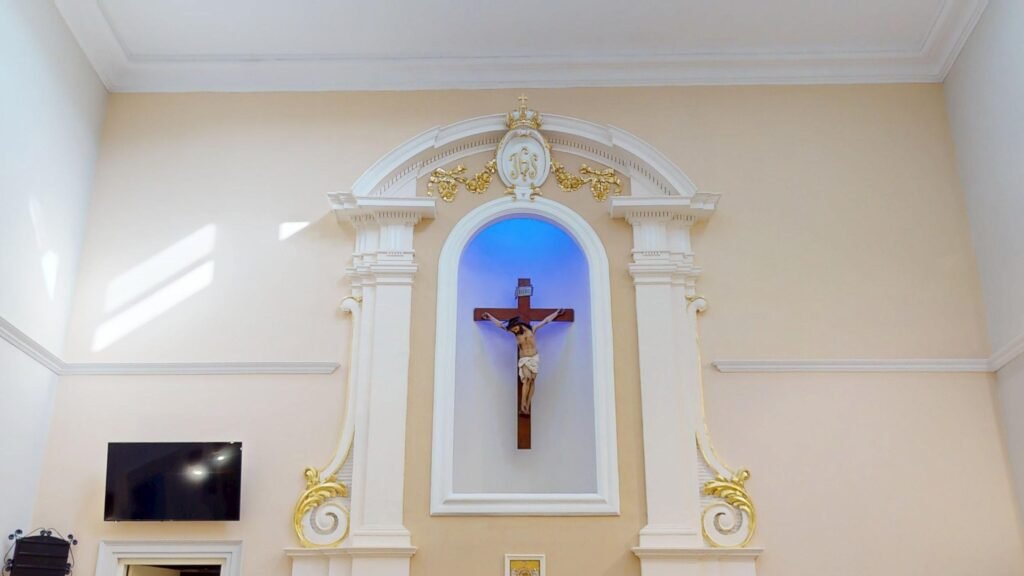
Chapel of Our Lady of the Rosary
The Chapel of Our Lady of the Rosary in Triq il-Kbira, Qormi, forms part of the historic complex of the Augustinian Sisters, Servants of Jesus and Mary. Their Maltese mission began here on 6 August 1894, when Bishop Pietro Pace established the congregation’s first house in Malta. Four sisters formed the original community, and by October that year they had opened a school for local children. The chapel consequently developed not merely as a convent oratory, but as a place serving education, religious formation and the surrounding community.
Published records do not presently provide a securely documented architect, construction cost or detailed building account for the chapel. Its setting within the convent complex reflects the practical character of late nineteenth-century religious foundations, where worship, community life and teaching were closely integrated. It was never intended to rival Qormi’s large parish churches, but to provide an intimate devotional space for the sisters and neighbouring faithful.
The chapel is particularly important because it is associated with the first Augustinian Sisters’ foundation in Malta. Its dedication also fits a much older Qormi tradition of devotion to the Rosary. A Rosary confraternity had already been established at St George’s parish in 1601, demonstrating how deeply this Marian devotion had become rooted in the town.
The chapel remains active within St Sebastian parish and continues to be associated with the Augustinian Sisters. The Archdiocese of Malta currently lists Mass at 7.15 a.m. from Monday to Saturday, with a Sunday Mass at the same time during summer. Its continued liturgical use gives the building significance beyond its historic fabric.
Its strongest human story is the arrival of the first four sisters in 1894, two Italian and two Gozitan, who established a religious and educational presence that later spread elsewhere in Malta. The Qormi house is therefore regarded as the cradle of the congregation’s Maltese mission.
The chapel is integrated into the convent rather than designed as a monumental standalone church. Its chief devotional focus is naturally Marian and centred on Our Lady of the Rosary. Publicly accessible records do not securely identify the artist or date of its principal sacred image, so unsupported artistic attributions should be treated cautiously.
Our Lady of the Rosary: From Nazareth and Lepanto to the Heart of Malta
Who is Our Lady of the Rosary?
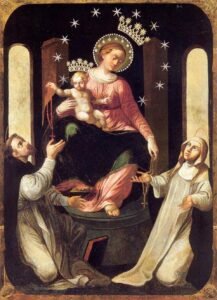 Our Lady of the Rosary is not a separate apparition or saint, but a devotional title given to the Virgin Mary, Mother of Jesus Christ. The title connects Mary with one of Christianity’s best-known forms of prayer, the Holy Rosary.
Mary herself belonged to the Jewish world of first-century Galilee. The Gospels place her at decisive moments in the life of Christ, from the Annunciation and Nativity to the wedding at Cana and the Crucifixion. She is also recorded praying with the disciples after Christ’s Ascension.
There are no reliable historical dates for Mary’s birth or death. The devotion known as Our Lady of the Rosary developed many centuries later as Christians sought a simple way of meditating upon the life, death and Resurrection of Christ through prayer.
How the Rosary Began
The Rosary did not appear fully formed at one particular moment. Medieval Christians who could not read the 150 Psalms often repeated shorter prayers instead, counting them with beads, knots or cords. Sets of 150 Hail Marys eventually became known as a Marian Psalter.
Dominican tradition tells a more dramatic story. According to this tradition, the Virgin Mary appeared to St Dominic around the beginning of the thirteenth century while he was preaching in southern France and encouraged him to use the Rosary in his mission.
The story became immensely popular, but it was recorded considerably later and does not appear in surviving contemporary accounts of St Dominic’s life. Historically, the Rosary developed gradually. What is beyond dispute is the enormous role played by the Dominican Order in spreading it.
During the fifteenth century, the Dominican preacher Alan de la Roche vigorously promoted the Marian Psalter and Rosary confraternities. By the sixteenth century, the Rosary had become one of Catholic Europe’s most familiar devotions.
The Day the Rosary Became Linked with a Battle
The event that permanently associated Our Lady of the Rosary with 7 October occurred in 1571.
The Ottoman Empire was then the dominant naval power in much of the eastern Mediterranean. Pope Pius V helped organise the Holy League, a Christian naval alliance which met the Ottoman fleet near Lepanto in western Greece on 7 October.
Pius V encouraged prayers for the Christian fleet, with the Rosary occupying a prominent place in Catholic tradition surrounding the campaign.
The Holy League won a major victory.
The result quickly became connected in Catholic devotion with the intercession of the Virgin Mary. A feast commemorating the victory was established and subsequently developed into the Feast of Our Lady of the Rosary, now celebrated on 7 October.
This explains why paintings of Our Lady of the Rosary sometimes contain more than gentle devotional imagery. Ships, banners, warriors and scenes of Lepanto occasionally appear alongside Mary, Christ, St Dominic and rosary beads.
Malta Was Part of the Lepanto Story
The connection with Malta is particularly strong.
Only six years earlier, Malta had survived the Great Siege of 1565. The Knights of St John remained one of the principal Christian naval forces confronting Ottoman power in the Mediterranean.
When the Holy League sailed to Lepanto, the Order of St John joined it. Its squadron was commanded by Admiral Fra Pietro Giustiniani, and Hospitaller galleys manned by Maltese and European sailors took part in the battle.
For Malta, therefore, Lepanto was not a distant episode. Men connected directly with the island fought in the battle from which the Feast of Our Lady of the Rosary acquired much of its historical identity.
The Rosary Takes Root in Malta
Dominican communities became major promoters of the devotion throughout the Maltese Islands. Rosary confraternities, altars, paintings, statues and processions appeared in parish and Dominican churches.
One remarkable survivor is the wooden processional statue of Our Lady of the Holy Rosary made in 1661 by the great Maltese sculptor Melchiorre Gafà for the Dominican church in Rabat.
Traditional Rosary processions were particularly associated with the first Sunday of October. In Rabat, Valletta and Vittoriosa, processions could include statues of both Our Lady of the Rosary and St Dominic.
The devotion became woven into Maltese village religious culture rather than remaining confined to Dominican monasteries.
Our Lady of the Rosary in Qormi
Qormi provides an exceptional example.
The Confraternity of the Rosary at St George’s parish received Dominican authorisation from Rome on 15 July 1601 and was formally established on 2 September that year. By 1630 it already had around thirty members.
The confraternity maintained its own altar. By the seventeenth century it had commissioned decorative stonework, gilding and silver crowns for images of the Virgin and Child. Records from 1686 also mention a processional statue of Our Lady of the Rosary.
The present Qormi processional statue associated with St George’s parish is a papier-mâché work by Carlo Darmanin dating from 1860.
The devotion even survived political upheaval. During the French occupation in 1798, silver belonging to Qormi’s Rosary confraternity was among valuables taken from St George’s church.
One of Qormi’s most touching Rosary stories came nearly a century later.
During the cholera epidemic of 1887, Wiġi Frendo promised Our Lady of the Rosary that if his family escaped the disease, he would erect a statue near his home. They survived unharmed. Frendo kept his promise and commissioned sculptor Ċensu Decandia to create the image erected in Triq San Pietru in 1888.
It remains a physical reminder of a time when epidemics could sweep through Maltese communities with terrifying speed and religious vows became intensely personal expressions of hope.
Devotion also developed around St Sebastian’s church. When the small church opened in 1890, a side altar was dedicated to Our Lady of the Rosary. Its painting was brought from Naples and paid for by members of the Gulia family in memory of their mother, Rożarja.
Following the establishment of St Sebastian parish in 1936, an October Rosary procession became part of parish life.
A Prayer That Continues to Change
The traditional Rosary eventually consisted of fifteen mysteries divided into the Joyful, Sorrowful and Glorious Mysteries. In 2002, Pope John Paul II proposed five additional Luminous Mysteries dealing with Christ’s public ministry.
Yet its basic character remains remarkably simple: beads passing through the fingers while repeated prayers provide a rhythm for contemplating episodes from the Gospel.
For Malta, and particularly Qormi, Our Lady of the Rosary therefore represents far more than the name of a chapel or feast. The devotion connects medieval prayer, Dominican preaching, Mediterranean warfare, Maltese sailors, Baroque art, confraternities, processions, epidemics, family vows and centuries of private prayer.
Few Marian titles carry quite so much history in a simple string of beads.
