
AFM Chapel of The Nativity of Our Lady
(Please allow a few seconds for the video to load)
Welcome to
“The Chapel of The Nativity of Our Lady” digital experience where history and technology intertwine to bring you an immersive experience.
Explore the Chapel
Below, you will find a ‘Paywall’ feature, requesting you to make a donation to be able to enter the page.
Once you are in, you will find
Support a Mission, Explore a Treasure
Your entry helps Missio Malta continue their vital work in missionary lands overseas. By donating, you directly support communities in need while gaining 24-hour full access to this chapel's 3D experience and history.
Learn more about Missio's workAccess is valid for 1 Chapel for 24 hours from the time of donation
OR
360° Panorama
Zoom to full screen to view
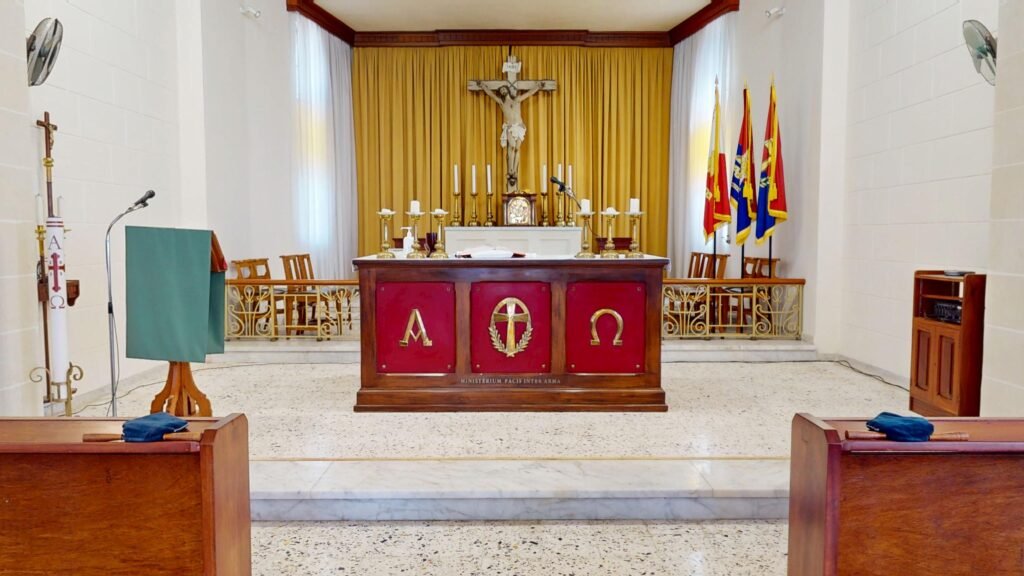
Chapel of the Armed Forces of Malta, Luqa: From RAF Church to Military Parish
Historical Background
The Chapel of the Armed Forces of Malta stands within Luqa Barracks and began as St Christopher’s Church, serving RAF Luqa. After the Second World War, the air station expanded with new barracks, married quarters and communal facilities. A station church was erected near the entrance to the domestic site and was ready by March 1955. Dedicated to St Christopher, patron of travellers, it served Church of England and Free Church personnel.
As British forces were reduced, the building passed into Air Malta’s control and became the airport chapel, dedicated to Our Lady of the Airways. When Malta’s new passenger terminal opened in 1992, that dedication transferred to the new terminal chapel. The former St Christopher’s was later handed to the Armed Forces of Malta, reopened for Roman Catholic worship and dedicated to the Nativity of Our Lady.
Construction and Architecture
No reliable published record has been found naming the architect, contractor, artisans or original cost. The building reflects practical post-war military architecture rather than Maltese Baroque tradition. Its compact rectangular form is faced in pale limestone, with a restrained, modernist façade. An angular canopy frames timber double doors, while a glazed panel above carries a cross. A second cross crowns the roofline.
Its uncluttered surfaces suggest economy, durability and functional worship. Published sources identify no major paintings, sculptures or named decorative commissions. Its artistic value rests mainly in its austere military character and later adaptation for Catholic liturgy.
Cultural and Religious Significance
The chapel links three chapters of Maltese history: RAF Luqa, civil aviation and the modern Armed Forces. Its successive dedications reflect three communities: British service personnel, airport workers and travellers, and Malta’s military parish.
St Christopher’s connection with safe journeys was particularly appropriate beside an airfield. The later Marian dedications continued the theme of protection. No established legend is recorded, but the building’s three identities form a distinctive historical story.
Present-Day Context
The chapel remains active under the Armed Forces chaplaincy. The Archdiocese of Malta lists Sunday Mass in Maltese at 8.00 am. Baptisms, marriages, memorial services and Holy Week observances reinforce its role as both garrison chapel and community church. No major recent restoration has been publicly documented, although it appears maintained and in regular use.
The Child of Victory: The Nativity of Our Lady, Malta and the Armed Forces
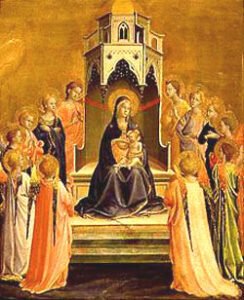 The dedication of the Armed Forces of Malta Chapel at Luqa to the Nativity of Our Lady carries a meaning that reaches far beyond the commemoration of Mary’s birth. In Malta, 8 September is both a major Marian feast and Victory Day, a national occasion associated with survival, resistance and deliverance during some of the most dangerous moments in the islands’ history.
For a military chapel, few dedications could unite faith, national memory and service more naturally.
What Is the Nativity of Our Lady?
The Nativity of Our Lady, celebrated on 8 September, commemorates the birth of the Virgin Mary. In Malta, the feast is commonly known as Marija Bambina, Il-Bambina, Il-Vitorja or Our Lady of Victories.
The feast does not celebrate an event described in the canonical Gospels. Matthew and Luke provide accounts of Mary as the mother of Jesus, but neither records her birth, childhood or the names of her parents.
The traditional story comes principally from the Protoevangelium of James, an early Christian text generally dated to the second century. Although it was not accepted as part of the New Testament, it greatly influenced Christian devotion, preaching and religious art.
According to this tradition, Mary’s parents were Joachim and Anne, a devout but childless couple. Their lack of children caused them considerable sorrow, particularly within a society where parenthood was often regarded as a sign of divine favour. After prolonged prayer, both received the promise that they would have a child whose life would be dedicated to God.
Anne subsequently gave birth to Mary. In fulfilment of their vow, Joachim and Anne are said to have presented her at the Temple in Jerusalem when she was three years old.
These details belong to Christian tradition rather than verifiable biography. Nevertheless, the names Joachim and Anne became firmly established, and both are honoured as saints.
Mary’s World and Early Life
Mary was probably born during the closing decades of the first century BC, when the Holy Land was governed by Herod the Great as a client kingdom of Rome.
It was a period of political tension, heavy taxation and profound religious expectation. Jewish communities lived under foreign influence while awaiting deliverance and the fulfilment of ancient promises concerning the Messiah.
Christian tradition places Mary’s birth in Jerusalem, close to the Pool of Bethesda, where the Church of Saint Anne now stands. Other traditions associate her family with Sepphoris in Galilee or with Nazareth, where Mary was living at the time of the Annunciation.
Her daily life would have been shaped by Jewish prayer, family responsibilities, religious festivals and the rhythms of a predominantly agricultural society. She would have spoken Aramaic, heard Hebrew in religious worship and lived in a culture where girls were prepared from an early age for marriage and household management.
The Gospels introduce Mary as a young woman betrothed to Joseph. Her acceptance of the angel Gabriel’s message placed her at the centre of the Christian account of salvation.
Why the Church Celebrates Mary’s Birth
The Church normally commemorates saints on the date of their death, understood as their birth into eternal life. Only three earthly birthdays receive liturgical celebration in the Roman calendar: Jesus Christ at Christmas, Saint John the Baptist on 24 June and the Virgin Mary on 8 September.
Mary’s birth is celebrated because it announces the approaching birth of Christ. Ancient Christian writers compared her arrival to the first light of dawn. Mary is the morning light that appears before Christ, the sun of salvation.
The feast probably developed in Jerusalem during the sixth century in connection with the dedication of a church built near the traditional home of Joachim and Anne. It later spread through the Byzantine world and was introduced in Rome by the beginning of the eighth century.
The date of 8 September is liturgical rather than historically proven. The Feast of the Immaculate Conception is observed nine months earlier, on 8 December, forming a symbolic calendar between Mary’s conception and birth.
The Nativity of Our Lady and Malta
The Maltese connection with the feast is unusually strong because 8 September became associated with several national victories.
The first and most famous was the conclusion of the Great Siege of 1565. After months of intense fighting, the Ottoman forces abandoned their attempt to capture Malta around the feast of the Nativity of Our Lady. The Knights of Saint John and the Maltese population interpreted their survival as an extraordinary deliverance and attributed the victory, in part, to the intercession of the Virgin Mary.
The date consequently became known as Il-Vitorja, the Victory.
The national commemoration also recalls the departure of the French occupation forces in September 1800, following a prolonged blockade and Maltese uprising.
A third military association was added on 8 September 1943, when the armistice between Italy and the Allies was publicly announced. Malta had endured years of bombing, hunger and wartime hardship, so the announcement carried enormous emotional significance. The Italian fleet subsequently sailed to Malta to surrender.
The feast of a child had become joined to the memory of a nation repeatedly emerging from danger.
Marija Bambina and Our Lady of Victories
The Nativity of Mary and the title Our Lady of Victories are not exactly the same devotion. The first celebrates Mary’s birth; the second honours her as a heavenly protector associated with deliverance and victory.
In Malta, however, the two became inseparable because the Great Siege ended at the time of Mary’s birthday. The infant Mary came to represent innocence overcoming aggression, hope defeating despair and life continuing despite destruction.
Major celebrations are held in Senglea, Naxxar and Mellieħa in Malta, and in Xagħra, Gozo. Each locality has developed its own processions, statues, music, fireworks and local traditions, yet all share the affectionate name Marija Bambina.
Senglea and the Little Statue from the Sea
Senglea possesses one of the most important Bambina traditions in Malta. The city remained unconquered during the Great Siege and received the title Città Invicta, the Unconquered City.
Its parish church, dedicated to the Nativity of Our Lady, was built as a permanent memorial of the victory. The present church was completed around 1580.
The small titular statue venerated there is traditionally said to have been recovered from the wreckage of a galleon near the Dalmatian coast. An Austrian galley captain reportedly rescued the figure from the sea and promised to present it to a church on the first Christian land he reached. At the request of two Senglean passengers, it was given to the parish of Senglea around 1618.
The statue’s small size encouraged the affectionate name Il-Bambina. It is considered one of Malta’s earliest processional titular statues and was solemnly crowned in 1921.
Stories connected with it include a penitential procession during the drought of 1718, after which rain reportedly began to fall, and a vow made during the plague of 1813 when Senglea sought the Virgin’s protection.
Why Would the Armed Forces Choose This Dedication?
No publicly available decree or AFM historical account has been found that records the precise discussion or formal reason behind the dedication. It should therefore not be presented as a documented decision by a named commander or chaplain.
The historical and symbolic explanation, however, is compelling.
A dedication connected with Malta’s military history
The Nativity of Our Lady falls on Malta’s Victory Day. The Armed Forces participate in national ceremonies, guards of honour, commemorations and acts of remembrance connected with the events celebrated on 8 September.
A military chapel dedicated to Marija Bambina therefore links present-day service personnel with the defenders of Malta in 1565, the Maltese who resisted French occupation and the wartime generation that endured the Second World War.
Continuity with the chapel’s previous Marian identity
Before becoming the Armed Forces chapel, the building served as an airport chapel dedicated to Our Lady of the Airways. Rededicating it to the Nativity of Our Lady preserved its Marian character while replacing a title associated principally with aviation and travellers with one carrying wider national significance.
The chapel’s earlier dedication to Saint Christopher, another protector of travellers, also formed part of this continuing theme of protection during dangerous journeys.
Protection without glorifying warfare
The infant Mary is not an image of military power. She represents new life, humility, peace and the beginning of salvation.
This makes the dedication particularly suitable for a Christian military chapel. It directs attention away from conquest and towards protection, duty, sacrifice and the restoration of peace. Members of the Armed Forces are reminded that their ultimate purpose is not conflict itself, but the protection of life, national security and the common good.
Hope in dangerous service
Military personnel may face uncertainty during maritime patrols, search and rescue operations, overseas assignments, emergency responses and other demanding duties. Marian devotion has traditionally offered soldiers, sailors, aircrew and their families a source of comfort and spiritual protection.
The Nativity introduces the additional idea of a new beginning. It speaks of hope appearing quietly before the danger has passed completely.
Luqa’s wartime and aviation associations
The chapel stands within a former RAF environment closely connected with Malta’s twentieth-century military and aviation history. Luqa and its airfield were central to the defence of the islands during the Second World War and were repeatedly targeted.
A dedication linked with 8 September recalls not only the Great Siege but also Malta’s wartime aviation story and the announcement of the Italian armistice in 1943.
A Dedication with Several Meanings
Within the Armed Forces chapel, the Nativity of Our Lady can be understood on several levels.
For the Church, it recalls the birth of the woman who would become the mother of Christ.
For Malta, it is the feast of Il-Bambina and the religious heart of Victory Day.
For the Armed Forces, it recalls courage, protection, sacrifice and service to the nation.
For individual soldiers and their families, it offers an image of maternal care and hope during periods of danger, separation and uncertainty.
The chapel’s dedication therefore joins a personal devotion to a national story. It remembers victory, but its central image is not a weapon, fortress or battlefield. It is a child whose birth announces peace.
