
Church of Our Lady, Mother of Christians and St. Bartolomew
(Please allow a few seconds for the video to load)
Welcome to
“The Church of Our Lady, Mother of Christians and St. Bartolomew” digital experience where history and technology intertwine to bring you an immersive experience.
Explore the Chapel
Below, you will find a ‘Paywall’ feature, requesting you to make a donation to be able to enter the page.
Once you are in, you will find
Support a Mission, Explore a Treasure
Your entry helps Missio Malta continue their vital work in missionary lands overseas. By donating, you directly support communities in need while gaining 24-hour full access to this chapel's 3D experience and history.
Learn more about Missio's workAccess is valid for 1 Chapel for 24 hours from the time of donation
OR
360° Panorama
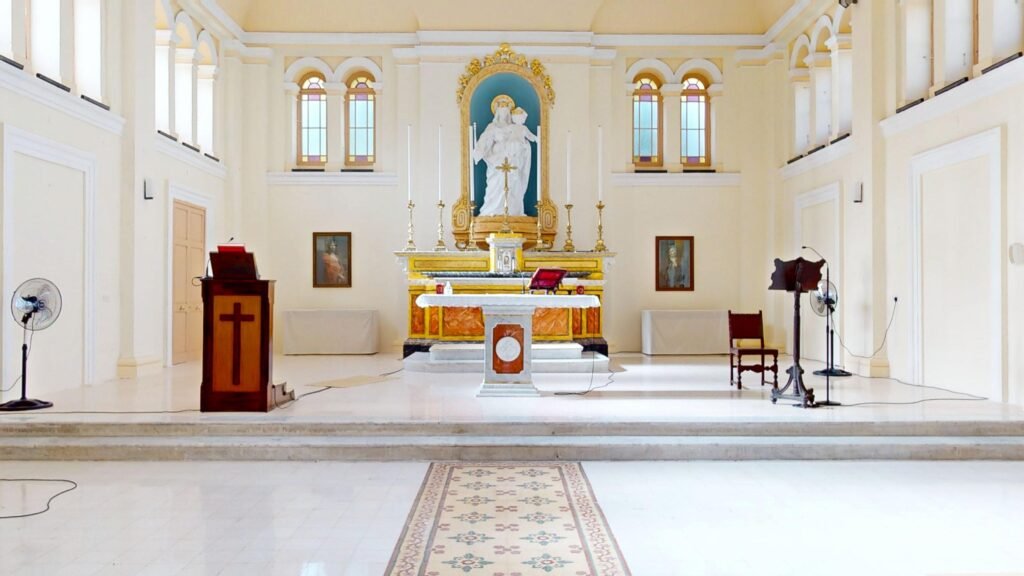
The Church of Our Lady, Mother of Christians and St. Bartholomew
(Knisja ta’ Omm l-Insara u San Bartilmew)
The Church of Our Lady Mother of Christians and St. Bartholomew is situated within the grounds of the St Vincent de Paul Residence, one of Malta’s principal state-run homes for the elderly. Its origins are closely tied to the expansion of social welfare institutions in Malta during the 20th century, when dedicated religious spaces were considered essential within residential care environments.
The chapel was established to serve both residents and staff, offering daily Mass, pastoral care, and a spiritual centre within the complex. Its dedication reflects dual devotions: to the Virgin Mary under the title “Caring for Christians”, emphasising compassion and protection, and to St. Bartholomew, an early Christian apostle associated with healing and endurance—qualities deeply resonant within a care home setting.
Constructed as part of the broader development of the residence, the chapel follows a modest yet dignified architectural style typical of institutional religious buildings in Malta. While detailed archival records of cost and individual craftsmen remain limited, the design prioritised accessibility, simplicity, and a calm liturgical atmosphere.
The structure incorporates traditional Maltese limestone, with restrained ornamentation and a focus on functional layout. The altar area is clearly defined, ensuring visibility for elderly congregants, and seating arrangements are designed for ease of movement, including provisions for wheelchairs.
Though not a parish church, the chapel holds deep significance within the micro-community of the residence. It plays a vital role in maintaining religious continuity for elderly Maltese individuals, many of whom have practised Catholic devotion throughout their lives.
Daily liturgies, feast day celebrations, and sacramental services are integral to life within the residence. The dedication to Our Lady reinforces Malta’s strong Marian tradition, while St. Bartholomew’s inclusion adds a layer of apostolic heritage. In this context, the chapel serves as both a place of worship and emotional comfort, bridging personal faith with communal care.
Today, the chapel remains active and well-maintained under the administration of the residence. It continues to host regular Mass and religious services, often adapted to the needs of elderly residents. Clergy and pastoral workers ensure ongoing spiritual support, making the chapel a central element of daily life within the institution.
Its relevance has grown as the population ages, reinforcing its role as a sanctuary of reflection and dignity in later life.
While no widely recorded legends are associated with the chapel, its significance lies in quieter, deeply personal narratives. For many residents, it represents continuity—offering familiar prayers, hymns, and rituals that connect them to earlier stages of life. These lived experiences form an intangible heritage rooted in memory, faith, and care.
The chapel interior is understated yet reverent. The main altar is dedicated to the Virgin Mary, often depicted in a protective and maternal posture. Subtle decorative elements, including religious paintings and statues, reinforce themes of compassion and healing.
Natural light is used effectively to create a serene atmosphere, while the clean lines and uncluttered design reflect both practicality and spiritual focus.
Saint Bartholomew: The Apostle of Quiet Faith and Enduring Courage
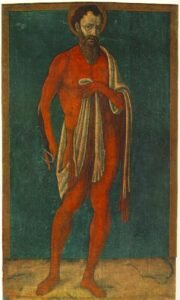 Saint Bartholomew, one of the Twelve Apostles of Christ, is traditionally identified with Nathanael from the Gospel of John. He is believed to have come from Cana in Galilee, a place closely associated with Christ’s first miracle. His introduction in scripture is strikingly human—initially sceptical, yet quick to recognise truth when he encounters it. This blend of honesty and faith would come to define his legacy.
The name “Bartholomew” itself is patronymic, meaning “son of Tolmai”, suggesting a man of lineage, yet remembered not for status, but for devotion.
Life and Mission
After the Resurrection, Bartholomew is said to have travelled extensively as a missionary. Early Christian tradition places him in regions stretching from Arabia to India and Armenia, spreading the Gospel in lands far removed from his Galilean roots.
His work was not without danger. In Armenia, where his mission is most firmly rooted in tradition, Bartholomew is believed to have converted members of the royal household. This bold act led to his arrest under King Astyages, who saw Christianity as a threat to established power.
Bartholomew’s martyrdom is among the most harrowing in Christian history. He is said to have been flayed alive before being executed—an image that would later define his artistic representation. Yet this brutal end also cemented his reputation as a symbol of unwavering faith.
Symbolism and Artistic Legacy
Saint Bartholomew is commonly depicted holding a knife, the instrument of his martyrdom, and in some works, his own skin. One of the most famous portrayals appears in Sistine Chapel, where Michelangelo painted him in The Last Judgement, holding his flayed skin—widely believed to bear the artist’s own face.
This powerful imagery transformed Bartholomew into a patron saint of endurance, often associated with those who suffer for their beliefs, as well as trades such as tanners and butchers.
Life and Times
Bartholomew lived during a period of profound upheaval in the 1st century, when Roman authority dominated the known world and early Christianity was viewed with suspicion and hostility. Apostles like him carried their message across vast distances without protection or certainty, relying solely on conviction and word of mouth.
Enduring Legacy
Saint Bartholomew remains one of the more quietly spoken Apostles in scripture, yet his legacy is anything but small. His journey from scepticism to conviction, from disciple to martyr, offers a powerful narrative of transformation.
He stands not as a figure of grandeur, but of steadfast belief—an Apostle whose strength lay in certainty once truth was found, and whose memory continues to inspire centuries later.
