
Oratory of The Onorati
(Please allow a few seconds for the video to load)
Welcome to
“The Oratory of The Onorati” digital experience where history and technology intertwine to bring you an immersive experience.
Explore the Chapel
Below, you will find a ‘Paywall’ feature, requesting you to make a donation to be able to enter the page.
Once you are in, you will find
Support a Mission, Explore a Treasure
Your entry helps Missio Malta continue their vital work in missionary lands overseas. By donating, you directly support communities in need while gaining 24-hour full access to this chapel's 3D experience and history.
Learn more about Missio's workAccess is valid for 1 Chapel for 24 hours from the time of donation
OR
360° Panorama
Zoom to full screen to view
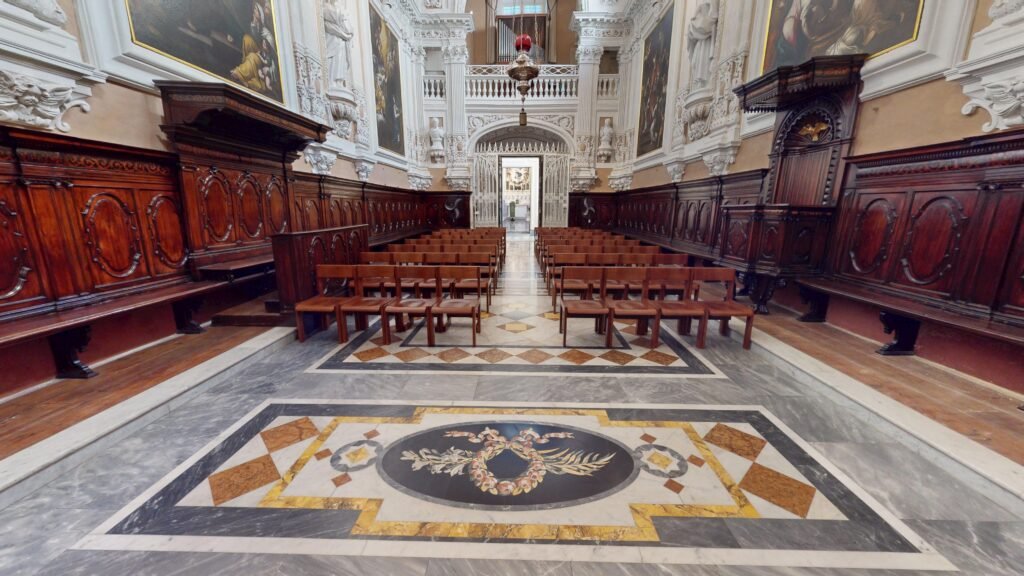
Oratory of The Honoured (Onorati)
Historical background
Tucked beside the Jesuits’ Church on Merchants Street, the Oratory of the Honoured—popularly known as the Oratorju tal-Onorati—grew out of the Jesuit college’s lay devotional life in early-seventeenth-century Valletta. Formed as the Congregation of the Onorati (originally the Congregazione dei Secolari), its members were educated laymen associated with the Collegio; the title “Onorati” echoed the period’s usage for the “distinguished” classes. The oratory was dedicated to the Assumption of the Virgin and, following damage to the Jesuit complex from the nearby powder-magazine explosion of 12 October 1634, it underwent a thorough remodelling completed by July 1659. The re-ordering belongs to the Buonamici phase of Baroque renewal at the complex, itself rooted in an earlier master plan attributed to the Jesuit architect-painter Padre Giuseppe Valeriano.
Construction and architecture
The mid-seventeenth-century intervention (1657–1659) went far beyond repair. The original roof was dismantled and replaced with an attic and richly profiled soffit, while the interior was comprehensively refitted in the full Baroque idiom credited to Francesco Buonamici’s influence in Malta. The present envelope integrates carved stonework, a refined timber roof structure, and a coherent decorative scheme designed to frame a narrative cycle of Marian paintings.
Recent conservation provides unusually clear construction detail: structural and fabric restoration of the sacristy and both oratories amounted to roughly €895,000; new services (fire and security detection, lighting and sound) cost about €248,000; and the Onorati soffit alone accounted for about €103,000. The conservation of the oratories’ paintings—15 canvases across the pair—was completed in 2023 through ERDF Cultural Valorisation funding with co-financing by the Archdiocese. Contractors included AX Holdings/AX Construction and specialist studios; the works were directed in partnership with the state Restoration & Preservation Department and the Jesuits’ Church Foundation.
Cultural and religious significance
From its origins as a lay confraternal chapel, the Onorati Oratory bridged scholarship, devotion and civic life in Valletta. Its Marian dedication and Jesuit setting made it a catechetical space as much as a liturgical one, with the Erardi cycle teaching the life of the Virgin to generations of faithful. Following decades of decline and closure in the 1990s due to roof failure, the oratory’s return to use from 2023 repositioned it as a boutique sacred venue for prayer, chamber music, lectures and cultural programming. This reintegration has broadened access to one of the capital’s most intimate Baroque interiors, strengthening Valletta’s identity as a city where worship and culture meet.
Present-day context
Since 2021 the Jesuits’ Church Foundation—created by agreement between the Government of Malta and the Archdiocese—has administered the complex as both a living church and a heritage site. The Onorati restoration sits within a multi-year project that also renewed roofs, façades and services across the ensemble. Public reopening has been marked by curated concerts (including a St Cecilia’s Day inauguration) and campus-linked events, with ongoing main-church works proceeding in parallel. The result is a stabilised, professionally managed oratory equipped to host liturgy and high-calibre cultural activity.
Unique stories and anecdotes
The oratory’s story is entwined with the 1634 polverista blast that reshaped Valletta’s skyline and prompted the Buonamici programme. Within the oratory itself, conservation recently confirmed a hidden lower section to the titular Assumption altarpiece—folded back during a past alteration—bearing the painter’s inscription and a tantalising coat of arms now under study. The very name “Onorati” preserves a social memory of the confraternity’s aspirational character among Malta’s learned laity.
Visual and artistic features
The oratory’s walls carry a unified Marian narrative by Stefano Erardi (1630–1716) and his son Alessio (1669–1727), painted largely in the late 1680s–1690s. The seven lateral scenes—Immaculate Conception, Birth of the Virgin, Presentation of the Virgin, Annunciation, Visitation, Presentation of Christ in the Temple, and a concluding sopra-quadro of the Trinity—encircle the space and converge on the monumental titular: The Assumption of the Virgin (dated 1660), a work of Stefano at his most theatrical. Gilded and silvered frames, revealed and re-finished during conservation, now sit on discreet magnetised mounts rather than nails to protect the canvases. The restored soffit and lighting recover the intended chiaroscuro, while the compact plan, timber roof and sculptural detailing create an intimate Baroque jewel box perfectly scaled to prayer and music.
The Jesuits’ Church, Valletta: Four Centuries of Faith, Fire, and Learning
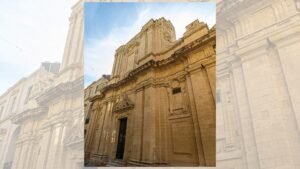
Rising on Merchants Street beside the Old University Building, the Jesuits’ Church—dedicated to the Circumcision of the Lord—was built between 1593 and 1609 as the spiritual heart of the Jesuit Collegium Melitense, Malta’s early university. A catastrophic gunpowder explosion in 1634 badly damaged the complex; the church was rebuilt in high Baroque by the Luccan architect Francesco Buonamici. The Jesuits were expelled in 1768, yet the church remained open and continued to host academic rites for the University of Malta, a tradition that endures.
The post-1634 rebuilding introduced a bold Baroque façade and a nave inspired by Rome’s Il Gesù. Inside, a disciplined Doric vocabulary frames seven side chapels and a richly modelled chancel. After major restorations in 1996–2002 and again 2016–2018 (façade, roof, dome), a new conservation drive launched in 2021 is stabilising the belfries, roofs and eight chapels. Recent works document significant investment, including €1.25m for the main church interiors and €450k for services and lighting.
From its foundation, the church anchored Malta’s intellectual and devotional life: the Collegium educated clergy and nobles, while the church hosted solemn liturgies and university graduations. Today it remains a living shrine and a cultural venue, with programmes across the adjoining Oratories of the Immaculate Conception and the Onorati, reinforcing Valletta’s Baroque identity and community memory.
The Jesuits’ Church Foundation—created by the Archdiocese of Malta and the Government in 2021—manages conservation, security, and interpretation. Recent grants include the restoration of the gilded wooden altar in the Chapel of Saint Ann, underscoring sustained, professional care.
A 1695 sundial on the church’s rear bears a stark Latin memento—“There will be a time where time will cease…”—thought to reflect anxieties after the 1693 earthquake. The church façade retains an intentionally austere, “unfinished” quality from 17th-century works, a feature long noted by historians and locals alike.
The titular altarpiece, The Circumcision of Jesus by Filippo Paladini, crowns a dynamic white-stone reredos alive with sculpture. Masterworks across the church and oratories include paintings by Mattia Preti, Francesco Romanelli, Battistello Caracciolo, Stefano and Alessio Erardi, and Giuseppe d’Arena—an ensemble often compared, for quality, with St John’s Co-Cathedral.
