
Chapel of Saint Agatha
(Please allow a few seconds for the video to load)
Welcome to
“The Chapel of Saint Agatha” digital experience where history and technology intertwine to bring you an immersive experience.
Explore the Chapel
Below, you will find a ‘Paywall’ feature, requesting you to make a donation to be able to enter the page.
Once you are in, you will find
Support a Mission, Explore a Treasure
Your entry helps Missio Malta continue their vital work in missionary lands overseas. By donating, you directly support communities in need while gaining 24-hour full access to this chapel's 3D experience and history.
Learn more about Missio's workAccess is valid for 1 Chapel for 24 hours from the time of donation
OR
360° Panorama
Zoom to full screen to view
Chapel of Saint Agatha
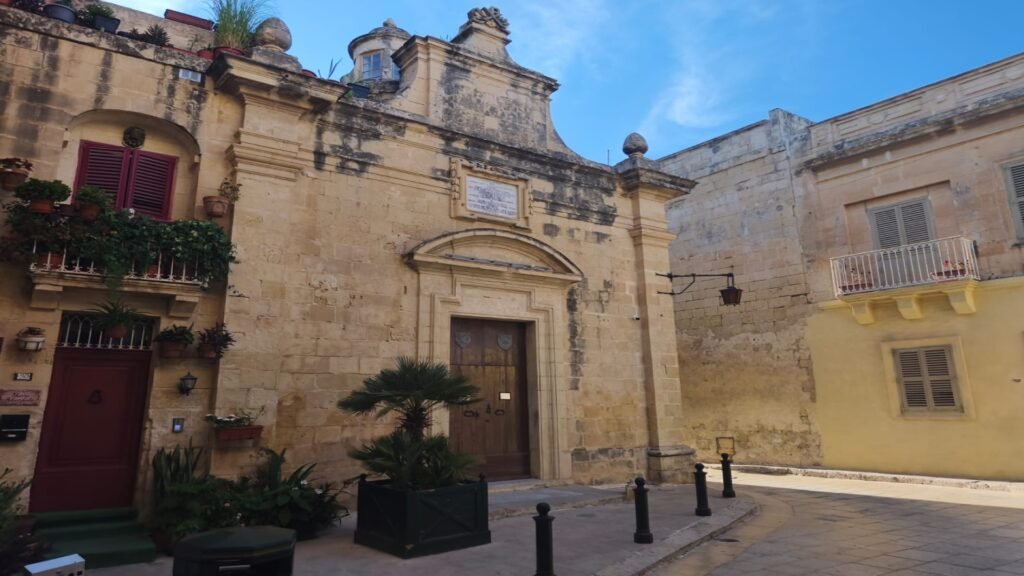
The Chapel of St Agatha stands just within Mdina’s inner precincts, on a site consecrated to the Sicilian martyr since the Middle Ages. Earliest documentary traces point to a bequest for “the fabrication of this church” in 1414, and tradition holds that the medieval chapel was erected soon after by the noble Francesco Gatto (Gatt/Gatto Murina) and his wife Donna Paola Castelli. The chapel passed through the Gatto Murina family until it was donated to the Church in the seventeenth century, and it was recorded during Inquisitor Pietro Dusina’s pastoral visitation in 1575. The medieval structure suffered severely in the 1693 Sicilian earthquake, which devastated much of Mdina. In the mid-1690s the chapel was rebuilt to Baroque designs by Malta’s foremost architect, Lorenzo Gafà, and was solemnly blessed in June 1696 in the presence of Bishop Davide Cocco Palmieri and Grand Master Adrien de Wignacourt.
Construction and architecture
No original building accounts survive, but the reconstruction bears Gafà’s mature Baroque language: a compact, single-space church composed in warm Maltese limestone, with a cleanly articulated façade framed by shallow pilasters and crowned by a curvilinear bell-cote-like gable. Corner finials and a central cartouche lend restrained flourish. The moulded portal sits beneath an aedicule with inscription, while a small parvis rises by shallow steps. The interior centres on the high altar and its titular image; the plan is modest and devotional rather than processional, echoing the wayside-chapel typology that Gafà refined across Malta. Craftsmanship would have involved Mdina’s master-masons and carvers working under the cathedral workshop’s orbit.
Cultural and religious significance
St Agatha’s cult in Malta is ancient and closely tied to Sicily. In Mdina it became a touchstone of civic identity: for centuries, the Cathedral Chapter marked 5 February (Agatha’s feast) with a thanksgiving observance recalling her protection of the city. The chapel’s titular painting shows St Agatha with St Adrian—a deliberate reference to Grand Master Adrien (Wignacourt) who ruled when the church was rebuilt—signalling how devotion, politics and patronage intertwined in late seventeenth-century Mdina.
Present-day context
The chapel remains part of the Archdiocese of Malta and the Cathedral parish ambit. It is included on Malta’s national heritage inventory and is a regular stop for cultural routes through the Silent City. The altarpiece story also bridges past and present: a painting of St Agatha by Giuseppe D’Arena (originally the chapel’s altarpiece) is conserved at the Cathedral Museum, while the chapel today displays a faithful copy, keeping the historic iconography in situ for worshippers and visitors.
Unique stories and legends
Local memory preserves a dramatic episode during the Ottoman raid of 1551. Tradition relates that a cloistered nun received a vision of St Agatha, prompting a procession with the saint’s image around Mdina’s walls. Seeing crowds on the ramparts, the attacking force reputedly judged the city too well defended and withdrew, turning their fury on Gozo instead. Whether or not one attributes the outcome to miracle, Hospitaller historian Giacomo Bosio records that such a procession to the fortifications did occur, and a commemorative procession continued to be held annually. This legend, anchored in a documented civic rite, powerfully shaped Mdina’s devotion to St Agatha.
Visual and artistic features
The façade’s measured Baroque is typical of Gafà: planar walls enlivened by crisp profiles, a dignified portal and a sculpted, scroll-shouldered gable with floral cartouche. The timber double doors carry ironwork rings and small shields. Inside, the focal point is the titular canvas of St Agatha and St Adrian by Giuseppe D’Arena—an artist active in late sixteenth–seventeenth-century Malta—whose composition anchors the chapel’s iconographic programme and links it to Mdina’s post-earthquake renewal.
Saint Agatha: Martyr of Sicily, Protector of Malta
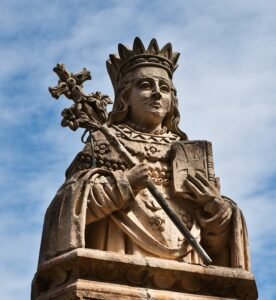
Saint Agatha of Sicily (c. 231–251) is one of the most venerated early Christian martyrs, remembered for fierce integrity and an influence that outlived the Roman persecutions. Born into a well-to-do family in Catania (some traditions say Palermo), she is said to have consecrated her life to God at a young age. During the Decian persecution she drew the attention of a Roman official, Quintianus, who attempted to coerce her into renouncing her faith and her vow of virginity. Agatha refused. What followed was a sequence of humiliations and tortures that culminated in her death in prison. Early hagiographers recount a visit from Saint Peter who miraculously tended her wounds; the episode underscores how quickly her story entered the bloodstream of Christian memory.
Agatha’s cult spread with remarkable speed. By late antiquity she is named in the Roman Canon (Eucharistic Prayer I), placing her among a select circle of early martyrs whose witness shaped Western liturgy. Her feast on 5 February is kept with particular fervour in Sicily, where Catania’s celebrations rank among the Mediterranean’s great religious festivals. A striking element of her iconography is the platter bearing her severed breasts—shocking yet eloquent, a stark symbol of steadfastness under violence. Bakers took her as a patron; so did nurses and all those who seek protection from volcanic eruptions, fires, and earthquakes—apt for a saint invoked against the furies of Mount Etna.
Legends surrounding Agatha often pivot on deliverance. A celebrated tradition holds that, the year after her martyrdom, an eruption threatened Catania; citizens processed with her veil and the lava flow halted at the city’s edge. Whether read as miracle or metaphor, the story crystallised her role as guardian of the vulnerable and protector of place.
Malta’s connection to Saint Agatha is both devotional and topographical. Local tradition says that during her persecution she briefly took refuge on the islands, praying in a rock-hewn crypt at Rabat by Mdina. The Crypt and Catacombs of St Agatha, enriched over centuries, preserve medieval fresco cycles that witness to a long, affectionate cult. Within Mdina itself the Chapel of St Agatha, rebuilt in refined Baroque after the 1693 earthquake, anchors her memory in the Silent City’s sacred geography. On Malta’s northern heights stands St Agatha’s Tower—popularly the Red Tower—an evocative Lascaris-era sentinel named for her, a sign that Maltese devotion to Agatha was woven into civic life as well as personal piety.
A powerful Maltese legend binds Agatha to the islands’ survival. In 1551, as Ottoman forces menaced the archipelago, a cloistered nun is said to have seen a vision of the saint. The Mdina community processed with Agatha’s image along the fortifications; the enemy, judging the city too resolute, withdrew and turned their fury elsewhere. The tale blends piety and public ritual, but its endurance shows how Agatha’s intercession became part of Malta’s self-understanding—courage under siege, unity in danger, gratitude afterwards.
Artists across Europe found in Agatha a subject of human dignity under duress. Painters rendered her as serene yet unyielding, a palm of victory in one hand and the tools of her torture nearby. In Malta, altarpieces and frescoes echo the Sicilian prototypes while absorbing local style: clear profiles, warm limestone settings, and intimate devotional scale. The continuity of her imagery—saint, martyr, protector—helps audiences read church interiors as living narratives rather than static galleries.
Why does Agatha still matter? Because her story refuses to be reduced to spectacle. It is a drama of conscience, the refusal to be defined by fear or force. For women facing illness, for communities facing catastrophe, and for anyone whose convictions come at a cost, Agatha offers a grammar of hope. In Malta that hope has a home: chapels, crypts, and towers bearing her name; processions and prayers that remember her not as a distant Sicilian figure but as a neighbour who stood guard when it counted.
