
Chapel of The Visitation (Taż-Żejt)
(Please allow a few seconds for the video to load)
Welcome to
“The Chapel of The Visitation” digital experience where history and technology intertwine to bring you an immersive experience.
Explore the Chapel
Below, you will find a ‘Paywall’ feature, requesting you to make a donation to be able to enter the page.
Once you are in, you will find
Support a Mission, Explore a Treasure
Your entry helps Missio Malta continue their vital work in missionary lands overseas. By donating, you directly support communities in need while gaining 24-hour full access to this chapel's 3D experience and history.
Learn more about Missio's workAccess is valid for 1 Chapel for 24 hours from the time of donation
OR
360° Panorama
Zoom to full screen to view
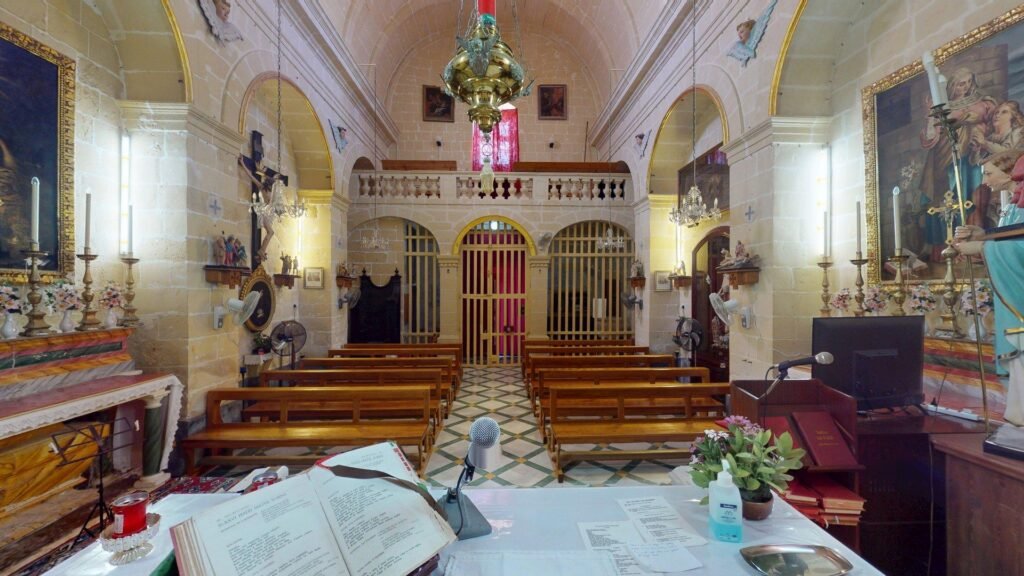
Chapel of The Visitation (Taż-Żejt)
Set beside Għarb’s cemetery on Triq Santu Pietru, the Chapel of the Visitation—affectionately known as Taż-Żejt (“of the oil”)—is the village’s original parish seat. A small church dedicated to the Visitation replaced an earlier Marian chapel around the mid-16th century and is recorded in the apostolic visitation of 1575. Rebuilt between 1675 and 1678, it was raised to parish status by Bishop Miguel Jerónimo de Molina on 29 August 1679, serving Ġarb until the larger baroque parish church was completed in 1729. Ex-voto offerings attest to centuries of local devotion at this modest rural shrine.
The present chapel is a compact limestone building with a 17th-century façade: two long Doric pilasters support a full entablature, above which a Vignola-style broken frontispiece curves towards flame-shaped finials. An arched forecourt with an iron gate leads to the entrance. To the rear rises a square bell-turret set on four arches and topped, in local tradition, with a figure of St Paul. The plan is rectangular, with a choir altar and two side altars; a small rear oratory historically served as a mortuary room for burials at the adjacent cemetery. The titular altarpiece—likely from 1651—depicts the meeting of the Virgin and St Elizabeth, with a curtain perspective flanked by Ionic columns. Later additions include a Crucifix (1920) by Wistin Camilleri, a Via Sagra (1966) by Alfred Camilleri, and two canvases (1967) by Paul Camilleri Cauchi; parish benefactor Dun Alwiġ Mizzi supported mid-20th-century embellishments.
As Għarb’s first parish church, Taż-Żejt embodies the village’s spiritual beginnings and the enduring Maltese devotion to the Visitation, whose feast is kept on 31 May, with the village festa celebrated the first weekend of July. Many historical ex-votos—now preserved in the parish museum—record healings at the chapel and safe deliverance at sea, reflecting a lived piety tied to everyday risks of island life. The chapel’s continued use for Mass and cemetery rites anchors communal memory, even after the parish transferred uphill to the present basilica in the 18th century.
Today the chapel is active and well kept under the Għarb parish. Regular worship includes weekend Masses (typically Saturday afternoon and Sunday morning), and the site remains integral to funerary liturgy given its cemetery setting. Although far from military targets, the complex suffered bomb damage during March and July 1942; subsequent repairs and recent conservation have stabilised the fabric. The chapel continues to welcome villagers, pilgrims and visitors seeking a quieter counterpoint to Gozo’s larger sanctuaries.
Taż-Żejt takes its name from a beloved local tradition: an elderly woman devoted to Our Lady, unable to afford lamp oil for the sanctuary, was instructed in a vision to bring a jar to the chapel, where she found oil flowing near the church. Pilgrims gathered to collect the oil—some for devotion, some for profit—until, as the story goes, a fire ignited the stream and the flow ceased. The episode lives on in the chapel’s popular name and in the gratitude paintings once hung inside. A simpler village variant holds that oil once oozed from the chapel wall and healed an old woman who anointed herself with it.
Beyond its restrained façade, the interior focuses attention on the Visitation altarpiece, framed by Ionic columns and a theatrical drapery motif. The side altars carry images of St Anne and St Mary Magdalene, while the 1920 sculpted Crucifix invites private devotion. The 1960s interventions—Stations of the Cross and additional Marian canvases—blend mid-century Gozitan artistry with traditional iconography. Outside, the parvis opens directly to the cemetery, visually binding the chapel’s liturgical life with the village’s rites of remembrance.
Our Lady of the Visitation: A Journey of Faith and Grace

The devotion to Our Lady of the Visitation arises from a profound moment in the Gospel of St Luke. After the Annunciation, when Mary learned she was chosen to be the Mother of God, she set out to visit her kinswoman Elizabeth, who was carrying St John the Baptist. Their meeting was not merely a family encounter but a sacred moment where divine grace was revealed. As Elizabeth heard Mary’s greeting, the child in her womb leapt for joy, and Elizabeth, filled with the Holy Spirit, proclaimed Mary “blessed among women.” This event, celebrated as the Visitation, reflects themes of charity, humility, and the sharing of divine joy.
The feast of the Visitation was formally introduced into the Church’s calendar in the 13th century, gaining wider celebration in the 14th century through Pope Urban VI. It became a symbol of unity and peace during times of division in Christendom. Artists and theologians alike embraced the Visitation as an image of faith in action—Mary, carrying the Saviour, offering her service to Elizabeth, who in turn acknowledged her as the Mother of the Lord. Across centuries, this devotion spread throughout Europe, inspiring chapels, confraternities, and liturgical celebrations that emphasised community, charity, and divine encounter.
The Visitation embodies Mary as a model of service and Elizabeth as a witness of faith. The encounter symbolises the meeting of the Old and New Covenants: Elizabeth, elderly and representing Israel’s past, greets Mary, young and bearing the promised Messiah. It also anticipates the Magnificat, Mary’s song of praise, which has since become a daily prayer of the Church. The event has inspired countless works of art, from medieval frescoes to Renaissance masterpieces, all capturing the tender embrace of two women through whom salvation history was revealed.
Malta’s devotion to the Visitation is centuries old. Several chapels across Gozo and Malta are dedicated to Our Lady of the Visitation, including the renowned chapel in Għarb, Gozo, affectionately known as Taż-Żejt. This chapel was once the first parish church of Għarb and carries the legend of miraculous oil flowing from its grounds, strengthening local devotion. Other Maltese localities also celebrate the feast with processions and liturgies, keeping alive the biblical message of faith, charity, and thanksgiving. The Visitation’s themes of service and divine blessing deeply resonate with the Maltese islands, where Marian devotion forms an essential part of spiritual and cultural life.
The story of Our Lady of the Visitation is not only a biblical account but also a timeless message of compassion and faith in action. It highlights Mary’s role as a bearer of hope and reminds the faithful of the importance of reaching out to others in love. Whether through art, architecture, or popular devotion, the Visitation continues to inspire Christians worldwide, and in Malta it remains a cherished dedication tied to village traditions, sacred art, and community celebrations.
