
Chapel of Christ The Saviour
(Please allow a few seconds for the video to load)
Welcome to
“The Chapel of Christ The Saviour” digital experience where history and technology intertwine to bring you something that is immersive and entertaining.
Explore the Chapel
Below, you will find a ‘Paywall’ feature, requesting you to make a donation to be able to enter the page.
Once you are in, you will find
360° Panorama
Zoom to full screen to view
Chapel of Christ The Saviour
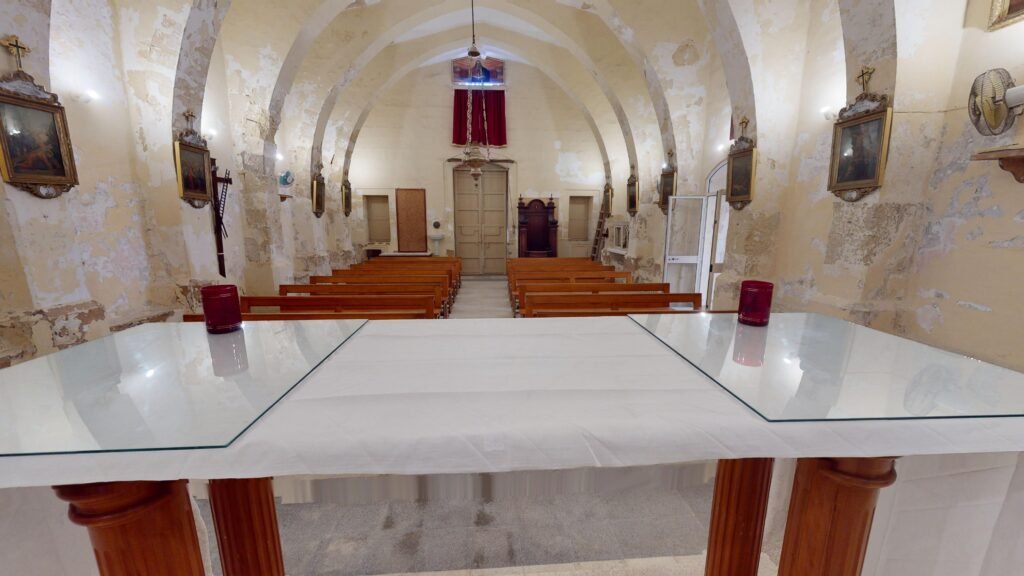
The Chapel of Christ the Saviour, known locally as “Tas-Salvatur,” is a Roman Catholic church situated in Żejtun, Malta. Formally dedicated to the Transfiguration of Jesus, it has served as a significant religious and cultural landmark in the region
Historical Background
In the medieval period, Żejtun comprised several small hamlets, one of which was Bisqallin. To cater to the spiritual needs of its residents, two adjacent chapels were constructed around 1500: one dedicated to the Visitation of Our Lady and the other to Our Saviour. These chapels are documented in Inquisitor Pietro Dusina’s 1575 report, which noted that the Chapel of Our Saviour lacked essential items for religious services and even a door, leading to directives for necessary installations
Construction Details
By the 18th century, the original chapels had deteriorated significantly. A decision was made to demolish the Chapel of Our Saviour and integrate it with the medieval Chapel of the Visitation, which was repurposed as the sacristy. This reconstruction resulted in a chapel featuring an 18th-century façade and a medieval rear section. In the 20th century, the façade underwent a redesign in the neo-Gothic style
Cultural and Religious Significance
Historically, the chapel served as the primary place of worship for the residents of Bisqallin, especially given the considerable distance to the main parish church of St. Catherine. It played a pivotal role in the community’s religious life, hosting various services and events. The chapel’s endurance and adaptations over the centuries reflect its importance to the local populace
Present-Day Context
Today, the Chapel of Christ the Saviour stands as a testament to Żejtun’s rich religious heritage. It houses notable artworks, including paintings by Toussaints Busuttil and a titular piece attributed to Francesco Zahra, depicting the Transfiguration of Christ on Mount Tabor. An interesting feature within the chapel is the presence of stone benches, known in Maltese as “dkieken.” The chapel is accessible to the public by appointment through the Żejtun Parish Office
Unique Stories or Legends
While specific legends directly associated with the Chapel of Christ the Saviour are not well-documented, its historical evolution—from two separate chapels to a unified structure—highlights the community’s resilience and dedication to preserving their places of worship
Visual and Artistic Features
The chapel’s interior boasts a stone altar and several significant artworks. Among these is a painting of the Transfiguration of Jesus by Toussaints Busuttil. Other notable paintings include depictions of the Visitation of Mary to her cousin Elizabeth and Saint Anne, the former commemorating the medieval Chapel of the Visitation. The combination of architectural styles—an 18th-century façade with a medieval backside—adds to the chapel’s unique aesthetic appeal.
In summary, the Chapel of Christ the Saviour in Żejtun stands as a significant monument, reflecting the area’s historical depth, cultural richness, and artistic heritage.
Christ the Saviour: A Global Symbol of Faith, Redemption, and Resilience
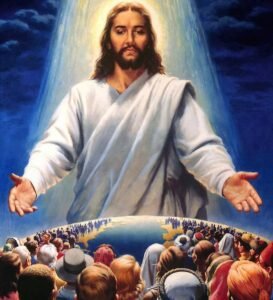 The title “Christ the Saviour” (Latin: “Christus Salvator”) is central to Christian theology, signifying Jesus Christ as the redeemer of humanity. This designation emphasises the belief in Jesus’ role in delivering believers from sin and granting eternal life through his sacrificial death and resurrection.
Throughout history, this profound concept has inspired the construction of numerous churches and cathedrals worldwide, each reflecting unique cultural and historical contexts.
Cathedral of Christ the Saviour in Moscow
One of the most renowned edifices bearing this dedication is the Cathedral of Christ the Saviour in Moscow, Russia. Originally commissioned by Tsar Alexander I in 1812 to commemorate Russia’s resilience against Napoleon’s invasion, the cathedral’s construction spanned several decades, culminating in its consecration in 1883. The majestic structure became a symbol of national pride. However, in 1931, under Soviet leader Joseph Stalin, it was demolished to make way for the proposed Palace of the Soviets—a project that never materialised. Following the Soviet Union’s dissolution, the cathedral was meticulously reconstructed between 1995 and 2000, restoring its former grandeur.
Christ the Saviour in Malta
Malta, with its deep-rooted Christian traditions, also honours the title “Christ the Saviour” in its sacred architecture. Notably:
- Our Saviour’s Church, Lija: Formally known as the Parish Church of the Transfiguration of Jesus, this Baroque church is a significant landmark in the village of Lija.
- Chapel of Christ the Saviour, Qrendi: This Roman Catholic chapel, dedicated to the Transfiguration of Jesus, dates back to at least 1575. Rebuilt in 1658 by Beneditto Camilleri, it has undergone various restorations, notably in 1997, to preserve its historical and architectural integrity.
These Maltese churches underscore the island’s devotion to Christ the Saviour, reflecting its rich religious heritage.
Global Dedications
The reverence for Christ the Saviour extends beyond Russia and Malta. For instance, the Cathedral of Christ the Saviour in Banja Luka, Bosnia and Herzegovina, stands as a testament to the enduring faith of the Serbian Orthodox community. Originally completed in 1929, it was destroyed during World War II and subsequently rebuilt, symbolising resilience and spiritual dedication.
In summary, the title “Christ the Saviour” encapsulates a core Christian belief in Jesus as the redeemer. This profound concept has inspired the establishment of numerous places of worship worldwide, each serving as a beacon of faith and a testament to the enduring legacy of this central tenet of Christianity.
